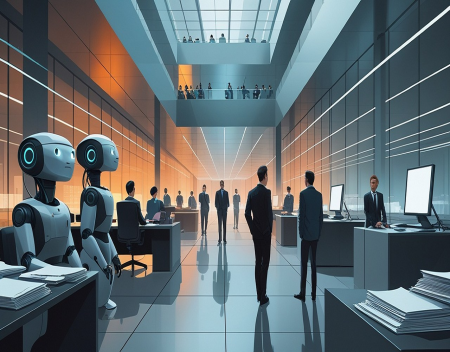
The office has always been a laboratory for machines that promise to do routine work faster than people can. What began with mechanical typewriters in the 1870s has, over roughly a century and a half, become a layered system of software that drafts, files, routes, checks, and increasingly decides. The rise of automation in offices is not a sudden rupture caused by generative artificial intelligence. It is the latest chapter in a long substitution of rules, calculation, and coordination for manual clerical labor.
Early mechanical tools already changed the shape of white-collar work. The commercial typewriter, commercialized by Remington from the 1870s, replaced handwritten correspondence with standardized documents and created a large class of typists. Electric models and IBM’s Selectric later raised speed and reduced fatigue. Adding machines and punched-card tabulators handled ledgers that had once required rooms of clerks. By the late 1970s and early 1980s, word processors and electronic spreadsheets let people edit text and recalculate budgets without retyping entire pages. Personal computers, local networks, email, and enterprise databases then moved most office information off paper. Each wave removed some tasks and created others: someone still had to design the form, check the exception, and explain the result.
The 2000s and 2010s added a more deliberate form of automation. Robotic process automation (RPA) software could log into existing systems, copy data between screens, and follow fixed rules without rewriting the underlying applications. Workflow tools and chatbots handled simple requests. Adoption was real but uneven. Surveys repeatedly found that many firms piloted automation while far fewer scaled it across the business. Cost reduction and cycle-time gains were common where processes were stable and high-volume; fragmentation, poor data, and unclear ownership limited the rest.
Generative AI and related agent-style systems have accelerated the shift since 2022–2023. These tools draft emails, summarize meetings, extract fields from documents, answer internal questions, and propose next steps in software that office workers already use. McKinsey’s global surveys have tracked a sharp rise in organizations using AI in at least one business function, moving from the mid-50 percent range in the early 2020s into the high 70s and, in later readings, near 80–88 percent. Generative AI specifically spread faster still, with large shares of firms reporting use in marketing, service operations, software work, and knowledge management. Separate workforce surveys find that knowledge and remote-capable roles adopt these tools at roughly twice the rate of jobs that cannot be done from a desk.
Market and employment figures underline the scale. Estimates place the global RPA market in the low-to-mid tens of billions of dollars in the mid-2020s, with forecasts of strong compound growth through the early 2030s; adjacent markets for AI agents are projected to expand even faster from a smaller base. The World Economic Forum’s Future of Jobs reporting has described a present mix in which a minority of work tasks are performed mainly by technology, a larger share mainly by humans, and a substantial share jointly, with employers expecting a more even split by 2030. In the United States, the Bureau of Labor Statistics has projected office and administrative support occupations to shrink by hundreds of thousands of jobs over the decade from the mid-2020s, with data-entry roles among the steepest declines, even as other professional categories grow.
Measured benefits are usually partial. Some enterprise surveys report that a sizable minority of organizations have cut costs by 25 percent or more in automated processes, and efficiency gains of a similar magnitude are commonly claimed. Companies that invest more systematically tend to report larger process-cost reductions than laggards. At the same time, fully autonomous end-to-end processes remain rare. Analyses of real deployments often find that human approval is still required before an automated step triggers action, and that a large share of generative-AI pilots have not yet shown clear profit-and-loss impact. Underused licenses, siloed bots, and weak orchestration are recurring complaints.
The practical pattern in offices is therefore augmentation more than wholesale replacement. Invoice processing, employee onboarding checklists, expense audits, contract clause extraction, scheduling, and first-line IT or HR responses are frequent targets because they are repetitive and rules-heavy. Judgment, relationship management, exception handling, and accountability stay with people, at least for now. New roles have appeared around designing automations, governing data, reviewing model outputs, and integrating tools that do not talk to one another.
Risks track the same boundary. Automated systems can propagate biased or outdated rules at scale, create opaque decision trails, and expose sensitive data if access controls are loose. Over-automation of customer or employee interactions can damage trust. Workforce effects are concentrated in clerical and administrative support rather than spread evenly, which raises questions of retraining and job redesign that many organizations still treat as secondary to tool deployment.
Looking ahead, the constraint is less raw technical capability than integration and governance. Office automation will keep expanding wherever a task can be specified, observed, and checked. The offices that gain most are likely to be those that treat automation as an operating-system change—clear process ownership, clean data, human review where stakes are high, and training that lets staff direct the tools—rather than a stack of disconnected bots. The typewriter did not eliminate writing; it standardized and accelerated it. Contemporary office automation is doing something similar to a much wider set of cognitive routines, with the unsettled question of how much discretion remains after the routine has been removed.
Great experience with Computer Geek. They helped with my website needs and were professional, respon . . . [MORE].

Great, quick service when my laptop went into meltdown and also needed Windows 11 installed. Also ca . . . [MORE].
It was a great experience to working with you. thank you so much. . . . [MORE].
Thank you so much for great service and over all experience is good . highly recommended for all peo . . . [MORE].
We engaged The Computer Geeks in mid-2023 as they have a reputation for API integration within the T . . . [MORE].
The Rise of Automation in
Why Every Business Needs
ERP Systems for Small Bus