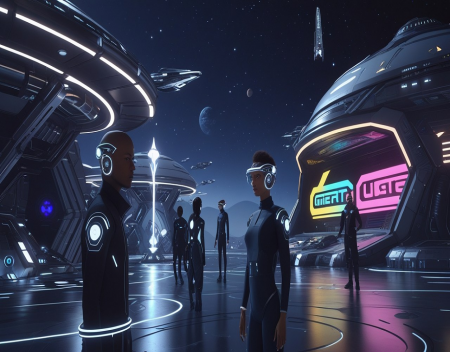
The concept of AI run space colonies once belonged exclusively to speculative fiction, yet rapid advances in robotics, automation, and machine learning have made the idea increasingly plausible. As humanity contemplates permanent settlements beyond Earth, a provocative question emerges: could space colonies operate primarily under artificial intelligence, with humans becoming optional participants rather than central managers. While the notion may sound radical, many engineers and futurists argue that autonomous systems could be the only practical way to build and sustain off world habitats in environments too dangerous or distant for constant human oversight.
Space is inherently hostile to life. Extreme radiation, vacuum exposure, and harsh temperature fluctuations make even routine tasks hazardous. Maintaining habitats, managing life support systems, repairing equipment, and cultivating food in such environments requires constant monitoring and precision. AI controlled robotics offer a compelling solution. Machines do not require oxygen, sleep, or emotional resilience to survive isolation. They can perform repetitive maintenance tasks with consistent accuracy and can adapt to changing conditions through advanced sensor networks and predictive algorithms. In theory, an AI managed colony could operate around the clock, optimizing energy usage, resource recycling, and habitat stability far more efficiently than human crews alone.
One of the most practical applications of AI run colonies would be in the early stages of settlement. Before humans ever arrive, robotic systems could construct habitats, mine local resources, and prepare sustainable infrastructure. This approach reduces the risks associated with sending astronauts into partially completed environments. Autonomous construction robots could assemble modular living spaces on the Moon or Mars, using local materials to minimize the need for costly launches from Earth. AI systems could also monitor environmental hazards such as dust storms or structural weaknesses long before human colonists set foot on another world.
Beyond construction, AI could manage complex life support systems that maintain breathable air, clean water, and stable temperatures. In closed loop ecosystems, even minor errors can have catastrophic consequences. Artificial intelligence could analyze thousands of variables simultaneously, detecting anomalies before they become crises. Automated medical systems might monitor colonists’ health, administer treatments, and even perform certain surgical procedures with minimal human supervision. Over time, the role of humans in such environments might shift from operators to passengers or creative contributors, relying on intelligent systems to handle essential survival tasks.
However, the prospect of humans becoming optional in space colonies raises profound ethical and philosophical questions. If machines can run settlements more efficiently, what becomes of human purpose in these environments. Some argue that reducing human involvement could diminish the spirit of exploration that has historically driven space travel. Others suggest that removing humans from dangerous operational roles could allow people to focus on research, art, and cultural development within the colonies. The balance between autonomy and oversight would likely become a defining challenge for future space governance.
There are also concerns about dependency. A fully AI managed colony would require robust safeguards against malfunction, cyber threats, and unintended decision making. Space habitats are isolated systems where failures can escalate rapidly. Ensuring transparency and human control over critical decisions remains essential, even if day to day operations are automated. Questions about accountability also arise. If an AI system makes a decision that results in harm or loss, determining responsibility becomes complex. These issues highlight the need for clear ethical frameworks and international cooperation as space colonization efforts evolve.
Despite these challenges, the potential benefits of AI run colonies are difficult to ignore. Autonomous systems could make deep space exploration economically feasible by reducing the number of human missions required for maintenance and support. Colonies could operate continuously without the limitations imposed by human biology, enabling more ambitious projects such as asteroid mining or long duration research stations in distant regions of the solar system. AI could also help create self sustaining ecosystems capable of expanding independently, laying the groundwork for a broader human presence beyond Earth.
The vision of AI run space colonies ultimately reflects humanity’s evolving relationship with technology. As machines become more capable, the boundaries between human and artificial roles continue to shift. Rather than replacing human explorers, AI may serve as an extension of human ambition, enabling survival and growth in places that would otherwise remain inaccessible. The idea of humans becoming optional does not necessarily imply irrelevance. Instead, it suggests a future where intelligent systems handle the most dangerous and complex tasks, allowing people to redefine what it means to live, create, and explore among the stars.
Great experience with Computer Geek. They helped with my website needs and were professional, respon . . . [MORE].

Great, quick service when my laptop went into meltdown and also needed Windows 11 installed. Also ca . . . [MORE].
It was a great experience to working with you. thank you so much. . . . [MORE].
Thank you so much for great service and over all experience is good . highly recommended for all peo . . . [MORE].
We engaged The Computer Geeks in mid-2023 as they have a reputation for API integration within the T . . . [MORE].

The Future of Digital Pay

How Technology Is Changin

What Comes After Silicon