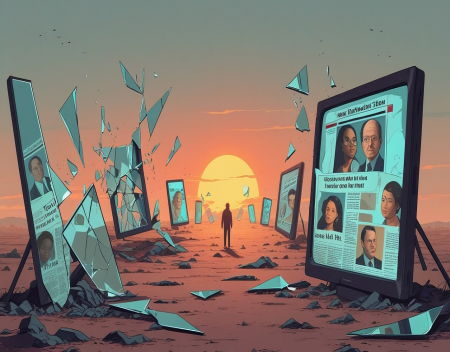
For much of the twentieth century, mass media functioned as a kind of cultural campfire. Large segments of the population watched the same evening news broadcasts, read the same major newspapers, and discussed the same headlines the next day. While disagreements certainly existed, there was often a baseline of shared facts and common reference points. Today, that shared reality is increasingly fragile. Fragmented media ecosystems—shaped by digital platforms, personalized algorithms, and niche content communities—have transformed how information is consumed and understood.
The shift began with the expansion of cable television and online publishing, which multiplied available channels and viewpoints. The rise of social media accelerated this diversification dramatically. Instead of relying on a handful of gatekeepers to curate news, individuals now navigate an almost limitless stream of content. Personalized recommendation systems tailor feeds based on past behavior, reinforcing preferences and filtering out content deemed less relevant. The result is a highly individualized information environment.
Fragmentation itself is not inherently negative. Diverse media landscapes can amplify marginalized voices, provide alternative perspectives, and challenge monopolistic narratives. However, when audiences inhabit largely separate informational worlds, consensus on basic facts becomes harder to achieve. Individuals may encounter entirely different interpretations of the same event—or different events altogether. Trending topics vary across platforms, communities, and regions, creating parallel conversations with minimal overlap.
Algorithmic curation plays a central role in this process. Platforms optimize for engagement, promoting content likely to elicit clicks, shares, and reactions. Users who frequently interact with particular viewpoints receive more of the same, reinforcing existing beliefs. Over time, this feedback loop can deepen ideological divides, as exposure to contrasting perspectives diminishes. Confirmation bias, a natural cognitive tendency, is amplified by technological design.
The consequences extend beyond political polarization. Shared reality underpins trust in institutions, scientific consensus, and democratic deliberation. When basic facts are contested, public discourse becomes unstable. Misinformation and disinformation can flourish in fragmented ecosystems, especially when sensational claims spread faster than corrections. Competing narratives may circulate simultaneously, each supported by selective evidence and amplified by sympathetic communities.
Fragmented media also affects social cohesion. Cultural touchstones once provided common ground—major sporting events, nationally broadcast programs, or widely read publications. While global events still attract widespread attention, the proliferation of niche platforms means that cultural experiences are increasingly individualized. This personalization can foster vibrant subcultures, yet it may also reduce opportunities for collective understanding across social boundaries.
Economic incentives further complicate the landscape. Advertising based business models reward attention and engagement, sometimes privileging emotionally charged or divisive content. Independent creators and media outlets compete in crowded markets, often relying on distinctive branding to attract loyal audiences. In some cases, strong ideological positioning becomes a strategy for survival, reinforcing fragmentation.
The decline of shared reality does not imply that consensus was ever perfect or universally inclusive. Historically dominant narratives often marginalized certain communities. The challenge today is balancing pluralism with coherence—ensuring that diverse voices contribute to a broader conversation rather than splintering into isolated echo chambers.
Efforts to address fragmentation involve multiple stakeholders. Media literacy education can equip individuals to evaluate sources critically and seek varied perspectives. Journalistic institutions can emphasize transparency, clearly distinguishing between reporting, analysis, and opinion. Technology companies may explore algorithmic adjustments that introduce cross cutting content, though such interventions must navigate concerns about autonomy and censorship.
At an individual level, cultivating intentional media habits can mitigate extreme fragmentation. Actively following reputable sources across ideological lines, engaging respectfully in dialogue, and verifying information before sharing are small but meaningful steps. While structural reforms are important, personal responsibility remains a component of rebuilding common ground.
The loss of shared reality is not inevitable, but it reflects profound transformations in how information circulates. Fragmented media ecosystems mirror the diversity and complexity of contemporary society. The task ahead is not to return to a monolithic media landscape, but to foster connections across informational divides. A functioning public sphere depends on the ability to disagree about interpretations while agreeing on foundational facts. Preserving that balance in a digital age may be one of the defining challenges of modern democracy.
Great experience with Computer Geek. They helped with my website needs and were professional, respon . . . [MORE].

Great, quick service when my laptop went into meltdown and also needed Windows 11 installed. Also ca . . . [MORE].
It was a great experience to working with you. thank you so much. . . . [MORE].
Thank you so much for great service and over all experience is good . highly recommended for all peo . . . [MORE].
We engaged The Computer Geeks in mid-2023 as they have a reputation for API integration within the T . . . [MORE].

The Future of Digital Pay

How Technology Is Changin

What Comes After Silicon