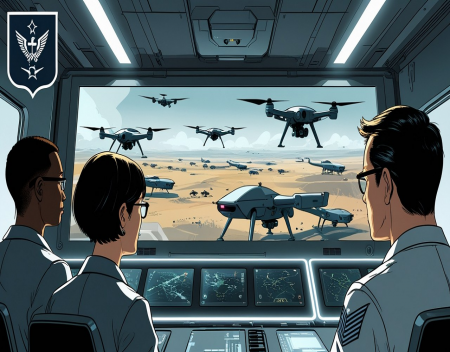
Throughout history, warfare has been shaped by technology. From the invention of the longbow to the development of nuclear weapons, each advancement has altered not only how wars are fought but also how they are perceived. In the twenty first century, a new transformation is underway: the increasing automation of warfare. With the rise of drones, autonomous systems, and artificial intelligence, conflict is becoming more technologically mediated than ever before. This shift introduces a critical ethical question: what happens when distance—both physical and psychological—separates those who make decisions from the consequences of those decisions?
Automation in warfare takes many forms. Unmanned aerial vehicles, commonly known as drones, allow operators to conduct surveillance and, in some cases, carry out strikes from thousands of kilometers away. Ground based robots can be used for reconnaissance or to neutralize explosives. More advanced systems are being developed with increasing levels of autonomy, capable of identifying targets and making decisions with minimal human intervention. These technologies are often justified on the basis of efficiency and safety. By reducing the need for human soldiers in dangerous environments, they can lower the risk of casualties among military personnel.
However, this physical distance also creates a new kind of detachment. In traditional combat, soldiers experience the immediate reality of conflict, including its risks and consequences. The presence of danger can influence decision making, imposing a sense of gravity on each action. When warfare is conducted remotely, that immediacy is reduced. Operators may engage in missions from secure locations, interacting with screens and data rather than direct physical surroundings. While the outcomes of their actions are real, the experience of those outcomes is mediated through technology.
This distance can have complex psychological effects. On one hand, remote operators are shielded from the immediate dangers of combat, which can reduce certain forms of trauma. On the other hand, the act of making life and death decisions from afar can create a different kind of stress. Operators may witness the results of their actions through high resolution video feeds, sometimes repeatedly reviewing events as part of mission analysis. This combination of distance and exposure can lead to a unique form of emotional strain, where individuals are both removed from and intimately connected to the consequences of their decisions.
The ethical implications extend beyond individual experiences to broader questions of responsibility. As systems become more autonomous, determining accountability becomes increasingly complex. If an automated system identifies a target and takes action based on its programming, who is responsible for the outcome? Is it the operator, the programmer, the commanding authority, or the institution that deployed the technology? Traditional frameworks of accountability may struggle to address these scenarios, as decision making becomes distributed across human and machine systems.
Another concern involves the potential lowering of thresholds for conflict. When the risks to one’s own forces are reduced, the political and social barriers to initiating or continuing military operations may also decrease. Governments may find it easier to justify the use of force if it does not involve significant risk to their personnel. This dynamic could lead to more frequent or prolonged engagements, altering the nature of international relations and conflict resolution.
The precision of automated systems is often cited as an ethical advantage. Advanced sensors and algorithms can, in theory, identify targets with greater accuracy than human observers, potentially reducing unintended harm. However, this assumption depends heavily on the quality of data and the design of the systems. Errors in identification, misinterpretation of context, or flaws in programming can still lead to unintended consequences. In complex environments where distinguishing between combatants and non combatants is difficult, reliance on automated systems may introduce new risks.
There is also a moral dimension related to the human experience of conflict. Warfare has traditionally involved a direct confrontation with its realities, shaping cultural and ethical attitudes toward violence. As conflict becomes more automated and distant, there is a risk that the human cost of war becomes less visible. When the realities of destruction and loss are mediated through technology, they may be easier to abstract or ignore.
Despite these concerns, it is important to recognize that the automation of warfare is part of a broader technological evolution. Nations are unlikely to abandon these developments, given their potential strategic advantages. The challenge, therefore, lies in establishing ethical frameworks and international agreements that govern how such technologies are used.
Efforts to regulate autonomous weapons systems are already being discussed at international levels, focusing on maintaining meaningful human control over critical decisions. Transparency, accountability, and adherence to existing laws of armed conflict are essential components of this process. Ensuring that human judgment remains central to decisions involving the use of force may help preserve ethical standards in an increasingly automated environment.
Ultimately, the ethics of distance in warfare reflect a deeper tension between technological capability and human responsibility. As machines take on greater roles in conflict, the question is not only what they can do, but what they should do. Preserving a sense of accountability, empathy, and awareness of consequences will be crucial in navigating this new landscape.
In a world where decisions can be made from far away, the moral weight of those decisions must remain close at hand.
Great experience with Computer Geek. They helped with my website needs and were professional, respon . . . [MORE].

Great, quick service when my laptop went into meltdown and also needed Windows 11 installed. Also ca . . . [MORE].
It was a great experience to working with you. thank you so much. . . . [MORE].
Thank you so much for great service and over all experience is good . highly recommended for all peo . . . [MORE].
We engaged The Computer Geeks in mid-2023 as they have a reputation for API integration within the T . . . [MORE].

How Technology Is Changin

What Comes After Silicon

The Future of Batteries