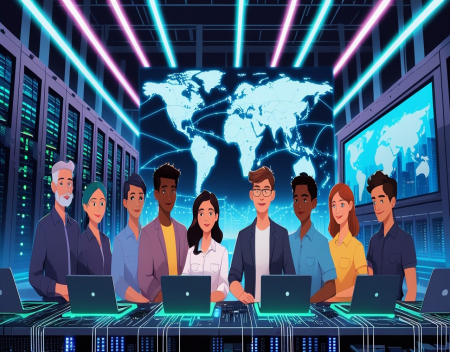
Modern technology depends on speed. Whether someone is streaming video, using a smart device, playing an online game, or driving a connected vehicle, information needs to move quickly and efficiently. For many years, most computing tasks relied heavily on centralized cloud servers located far away from the user. While this approach works well in many situations, it also creates delays because data must travel across the internet before it can be processed. To solve this problem, the technology industry has increasingly turned toward Edge Computing.
Edge computing is the idea of processing data closer to where it is created instead of sending everything to distant data centers. In simple terms, it moves computing power nearer to devices and users. Rather than relying entirely on the cloud, edge systems handle many tasks locally or at nearby servers. This reduces delays, improves performance, and helps connected systems operate more efficiently.
To understand why edge computing matters, it helps to first look at how traditional cloud computing works. In a cloud-based system, devices send data over the internet to large remote servers. Those servers process the information and send back the results. For example, a smart security camera may upload video footage to the cloud where it is analyzed and stored. While effective, this process takes time because the information must travel long distances.
With edge computing, much of that work happens closer to the camera itself. The device or a nearby local server can analyze the video immediately, detect motion, and trigger alerts without waiting for a cloud response. Only important data may then be uploaded for long-term storage or further analysis. This creates a much faster and more responsive system.
One of the biggest advantages of edge computing is reduced latency. Latency refers to the delay between sending and receiving information. In applications where timing is critical, even a small delay can be a problem. Self-driving vehicles are a good example. These systems must react almost instantly to traffic conditions, pedestrians, and obstacles. Sending sensor data to a distant server and waiting for instructions would take too long. Edge computing allows the vehicle to process information locally and make split-second decisions.
Another major benefit is reduced bandwidth usage. Modern devices generate enormous amounts of data every second. Smart factories, connected vehicles, surveillance systems, and industrial sensors all create continuous streams of information. Sending all of this data to the cloud would require massive network capacity and increase costs. Edge computing reduces this burden by processing much of the information locally and only transmitting what is necessary.
The rise of the Internet of Things has accelerated the need for edge computing. Smart thermostats, wearable devices, home assistants, and industrial machines are all examples of devices that collect and exchange data constantly. Edge systems allow these devices to respond faster and continue operating even if internet connectivity becomes unreliable.
Edge computing also improves reliability. Traditional cloud systems depend heavily on stable internet connections. If connectivity is interrupted, cloud-dependent devices may stop functioning correctly. Edge computing reduces this dependency because many tasks can continue locally even during outages. This is especially important in industries such as healthcare, transportation, and manufacturing, where downtime can have serious consequences.
Another area where edge computing is becoming increasingly important is Artificial Intelligence. AI applications often require real-time processing. Voice assistants, facial recognition systems, robotics, and smart cameras all rely on rapid decision-making. Running AI models directly on edge devices or nearby servers allows systems to respond much faster than if they depended entirely on cloud processing.
Despite its advantages, edge computing does not replace cloud computing entirely. In reality, the two technologies usually work together. The cloud remains valuable for storing large amounts of data, running advanced analytics, and managing centralized systems. Edge computing handles immediate processing and real-time responses, while the cloud provides long-term storage and deeper analysis. This combination creates a more balanced and efficient computing environment.
There are still challenges associated with edge computing. Managing large numbers of distributed devices can be difficult, especially when updates and security patches must be deployed across many locations. Security is also a concern because edge devices may operate outside controlled environments, making them more vulnerable to tampering or cyberattacks. Organizations must carefully design systems to maintain both performance and protection.
Looking ahead, edge computing is expected to become even more important as connected technologies continue to expand. Smart cities, autonomous vehicles, industrial automation, and next-generation communication networks will all depend heavily on local processing capabilities. As the demand for faster and more responsive systems grows, edge computing will continue to play a central role in shaping the future of technology.
In the end, edge computing is about bringing intelligence closer to where data is created and used. By reducing delays, improving reliability, and lowering network demands, it helps modern technology work faster and more efficiently. Even though most users may never notice it directly, edge computing is quietly becoming one of the most important foundations of the connected digital world.
Great experience with Computer Geek. They helped with my website needs and were professional, respon . . . [MORE].

Great, quick service when my laptop went into meltdown and also needed Windows 11 installed. Also ca . . . [MORE].
It was a great experience to working with you. thank you so much. . . . [MORE].
Thank you so much for great service and over all experience is good . highly recommended for all peo . . . [MORE].
We engaged The Computer Geeks in mid-2023 as they have a reputation for API integration within the T . . . [MORE].
The Evolution of Personal
The Hidden Cost of Free A

The Psychology of Notific