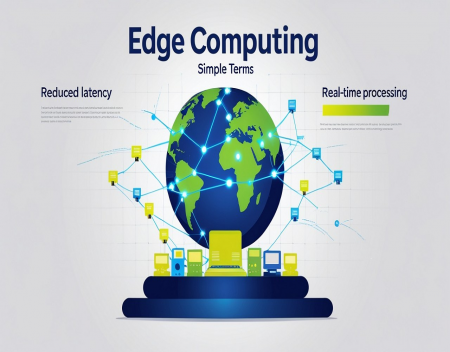
As technology continues to evolve, the amount of data generated every day has grown at an enormous pace. Smartphones, smart homes, connected vehicles, industrial sensors, and online services constantly produce and exchange information. Traditionally, much of this data has been sent to centralized cloud servers for processing and storage. However, as systems become faster and more connected, relying entirely on distant data centers can create delays and inefficiencies. This is where Edge Computing comes into play.
Edge computing is a method of processing data closer to where it is created instead of sending everything to a distant cloud server. In simple terms, it moves computing power “to the edge” of the network. Rather than transmitting every piece of information across the internet for analysis, devices or nearby local systems handle much of the work themselves. This approach reduces delays, improves responsiveness, and decreases the amount of data that must travel long distances.
To understand edge computing, it helps to compare it with traditional cloud computing. In a cloud-based system, a device such as a security camera may send video footage to a remote server where the data is analyzed and stored. The results are then sent back to the user. While this works well in many situations, it can introduce latency, especially when large amounts of data are involved.
With edge computing, some or all of that processing happens much closer to the camera itself. The camera or a nearby local device might analyze the footage in real time, identifying motion or unusual activity immediately without waiting for instructions from a distant server. Only important information may then be sent to the cloud for long-term storage or additional analysis.
One of the biggest advantages of edge computing is speed. Because data does not need to travel as far, systems can respond much more quickly. This is especially important in applications where even small delays can be problematic. Self-driving vehicles, for example, must make decisions in fractions of a second. Sending every piece of sensor data to a remote cloud server and waiting for a response would be far too slow. Edge computing allows the vehicle to process information locally and react almost instantly.
Another major benefit is reduced bandwidth usage. Modern devices generate enormous amounts of data, and transmitting all of it to centralized servers can strain networks and increase costs. By processing data locally, edge systems reduce the amount of information that needs to be sent across the internet. This makes networks more efficient and can improve performance overall.
Edge computing also improves reliability. If a device depends entirely on a cloud connection, losing internet access may prevent it from functioning properly. With edge processing, many tasks can continue even during connectivity issues because the necessary computing power is located nearby or directly within the device itself.
The growth of the Internet of Things has played a major role in the rise of edge computing. Smart thermostats, wearable devices, industrial sensors, and connected appliances all generate data continuously. Processing some of this information locally allows these devices to operate more efficiently and respond faster to user actions.
Edge computing is also becoming increasingly important for Artificial Intelligence applications. AI systems often require real-time analysis, especially in areas such as facial recognition, voice assistants, robotics, and autonomous systems. Running AI models directly on devices or nearby edge servers enables faster decisions and reduces dependence on cloud infrastructure.
Despite its advantages, edge computing is not a complete replacement for cloud computing. Instead, the two technologies often work together. The cloud remains valuable for large-scale storage, advanced analytics, and centralized management. Edge systems handle immediate processing and rapid responses, while the cloud provides deeper analysis and long-term data handling. This combination creates a more balanced and efficient computing environment.
There are also challenges associated with edge computing. Managing large numbers of distributed devices can be complex, and ensuring consistent security across many edge systems is a significant concern. Unlike centralized data centers, edge devices may operate in less controlled environments, making them more vulnerable to tampering or cyberattacks. Developers and organizations must carefully design systems to maintain reliability and security.
Looking ahead, edge computing is expected to become even more widespread as connected devices continue to grow in number and capability. Technologies such as smart cities, autonomous transportation, industrial automation, and next-generation communication networks will increasingly rely on local processing to function effectively.
In the end, edge computing is about bringing intelligence closer to where data is created. By reducing delays, improving efficiency, and enabling real-time responses, it helps modern technology operate faster and more reliably. While most users may never see it directly, edge computing is becoming one of the key technologies powering the connected world around us.
Great experience with Computer Geek. They helped with my website needs and were professional, respon . . . [MORE].

Great, quick service when my laptop went into meltdown and also needed Windows 11 installed. Also ca . . . [MORE].
It was a great experience to working with you. thank you so much. . . . [MORE].
Thank you so much for great service and over all experience is good . highly recommended for all peo . . . [MORE].
We engaged The Computer Geeks in mid-2023 as they have a reputation for API integration within the T . . . [MORE].

Why Every Business Needs
ERP Systems for Small Bus
CRM Software Explained