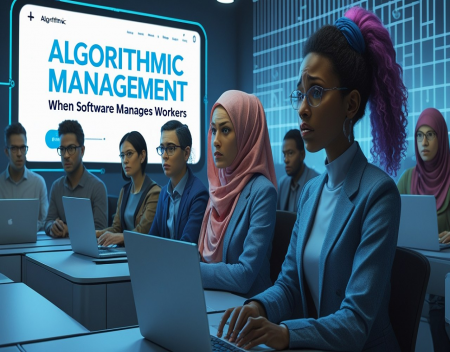
The rise of algorithmic bosses marks a significant shift in how work is organized, evaluated, and experienced. Increasingly, software systems are taking on managerial roles once filled by human supervisors. From scheduling shifts and assigning tasks to monitoring performance and determining pay, algorithms now shape the daily realities of millions of workers. While these systems promise efficiency, objectivity, and scalability, they also introduce new forms of control that challenge traditional notions of fairness, autonomy, and dignity in the workplace.
Algorithmic management is most visible in sectors such as ride sharing, delivery services, warehouses, and remote digital labor platforms. In these environments, workers often interact more with an app than with a person. Instructions arrive through notifications, performance is tracked in real time, and feedback is delivered as scores or automated warnings. Decisions about routing, pacing, and even deactivation are frequently made without human explanation. This creates a work experience that feels both highly monitored and strangely impersonal.
One of the core arguments in favor of algorithmic bosses is neutrality. Unlike human managers, software is presumed to be free from bias, favoritism, or emotion. In practice, however, algorithms reflect the values and assumptions embedded in their design. They prioritize measurable outputs, such as speed or volume, often at the expense of less quantifiable qualities like teamwork, creativity, or situational judgment. When performance metrics become the primary lens through which work is evaluated, workers may feel pressured to optimize for numbers rather than quality or safety.
The psychological impact of being managed by software is significant. Continuous monitoring can create a sense of constant surveillance, where every action is recorded and assessed. This environment can increase stress and reduce trust, as workers may not understand how decisions are made or how to contest them. The absence of a human manager also removes opportunities for dialogue, empathy, and contextual understanding. When something goes wrong, there is often no one to explain circumstances or advocate on the worker’s behalf.
Algorithmic bosses also blur lines of accountability. When a system assigns an impossible schedule or penalizes a worker unfairly, responsibility becomes difficult to locate. Employers may point to the algorithm as an objective tool, while workers experience its decisions as arbitrary and opaque. This diffusion of responsibility can weaken labor protections, as traditional mechanisms for dispute resolution are not always equipped to address automated decision making.
At the same time, algorithmic management reshapes power dynamics. Software can scale oversight across vast workforces, enabling centralized control with minimal human intervention. This efficiency can benefit organizations, but it also concentrates authority in the hands of those who design and own the systems. Workers may have little insight into how their labor is valued or how rules can change without notice. The resulting imbalance can make workers feel replaceable, reinforcing precarity in already unstable forms of employment.
There are broader social implications as well. As algorithmic bosses become normalized, expectations about work may shift. Constant availability, rapid responsiveness, and continuous optimization risk becoming standard requirements. This can erode boundaries between work and personal life, particularly when software tracks activity across devices and locations. The idea of a workday managed by mutual understanding gives way to one governed by code.
Despite these challenges, algorithmic management is not inherently harmful. When designed transparently and supplemented with human oversight, software can reduce administrative burden and support fairer scheduling or workload distribution. The key issue is not whether algorithms should play a role in management, but how that role is defined and constrained. Workers need avenues for explanation, appeal, and participation in shaping the systems that govern their labor.
Ultimately, the emergence of algorithmic bosses forces a reevaluation of what management is meant to accomplish. If leadership is reduced to optimization alone, the human aspects of work risk being sidelined. Work is not only about output; it is also about meaning, cooperation, and mutual recognition. As software takes on managerial functions, preserving these human elements becomes an intentional choice rather than an assumed norm.
Great experience with Computer Geek. They helped with my website needs and were professional, respon . . . [MORE].

Great, quick service when my laptop went into meltdown and also needed Windows 11 installed. Also ca . . . [MORE].
It was a great experience to working with you. thank you so much. . . . [MORE].
Thank you so much for great service and over all experience is good . highly recommended for all peo . . . [MORE].
We engaged The Computer Geeks in mid-2023 as they have a reputation for API integration within the T . . . [MORE].
The Evolution of Personal
The Hidden Cost of Free A

The Psychology of Notific