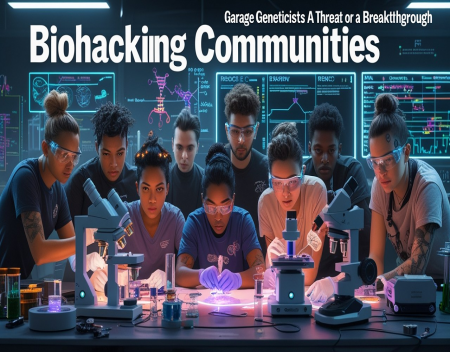
In recent years, biology has quietly joined the ranks of technologies that no longer belong exclusively to governments, universities, or multinational corporations. Cheap DNA sequencing, open-source research tools, online tutorials, and mail-order lab kits have given rise to a growing movement of independent experimenters known as biohackers. Often working in garages, shared makerspaces, or community labs, these individuals—sometimes called “garage geneticists”—are challenging traditional models of scientific research. Their rise has sparked both excitement and anxiety, raising a critical question: are biohacking communities a dangerous threat, or a transformative breakthrough?
Biohacking is a broad term that encompasses everything from personal health tracking and nutrition experiments to hands-on genetic engineering. Some biohackers focus on self-improvement, experimenting with diets, supplements, or wearable devices to optimize physical and cognitive performance. Others engage directly with biology, modifying bacteria, studying gene expression, or developing low-cost medical tools. What unites these groups is a shared belief that science should be accessible, participatory, and decentralized rather than locked behind institutional barriers.
Supporters argue that biohacking communities represent a democratization of science. Historically, innovation has often come from outsiders who challenged established norms. The personal computer revolution began in garages and hobbyist clubs, not corporate boardrooms. Biohackers see themselves as following a similar path, accelerating discovery by removing bureaucratic friction. Community labs offer affordable access to equipment, training, and collaboration, allowing people from diverse backgrounds to contribute ideas that might never emerge within traditional academic structures.
There are already examples of positive impact. Biohackers have developed low-cost diagnostic tools, open-source insulin production methods, and rapid-response research during public health crises. In regions with limited medical infrastructure, DIY biology has the potential to save lives by enabling local solutions tailored to local problems. For many participants, biohacking is not about recklessness but about empowerment—taking ownership of health, knowledge, and innovation.
However, the risks are real and cannot be dismissed. Biology is not software. Mistakes in genetic experimentation can have irreversible consequences. Critics worry that poorly trained individuals could accidentally create harmful organisms, release modified microbes into the environment, or misuse powerful tools like gene editing. Even well-intentioned experiments can go wrong if safety protocols are misunderstood or ignored. Unlike traditional laboratories, which operate under strict oversight and ethical review, community biohacking spaces often rely on self-regulation.
This lack of formal oversight fuels fears of biosecurity threats. While most biohackers are motivated by curiosity and social good, the same tools that enable innovation could be exploited by malicious actors. As gene-editing technologies become more precise and accessible, the barrier to misuse lowers. Governments and security experts worry about a future where dangerous biological experiments are conducted outside regulated environments, potentially endangering public health.
Ethical concerns also loom large. Biohacking blurs the line between research and experimentation on living beings, including humans. Some biohackers have injected themselves with unapproved gene therapies or implanted experimental devices without clinical trials. While proponents frame this as bodily autonomy, critics argue it undermines medical ethics and could normalize risky behavior. If an experiment goes wrong, the consequences may extend beyond the individual to society at large.
The debate over biohacking communities mirrors larger tensions in technological progress. Centralized systems offer control, safety, and accountability, but they can also stifle creativity and exclude marginalized voices. Decentralized innovation encourages experimentation and rapid advancement, but increases unpredictability. The challenge is finding a balance that preserves the benefits of open science while minimizing its dangers.
Some propose a middle path. Instead of banning or criminalizing biohacking, governments and institutions could engage with these communities. Providing education, safety standards, and transparent guidelines could reduce risks without suppressing innovation. Community labs could collaborate with universities and public health agencies, creating hybrid models that combine grassroots creativity with professional oversight. Trust and communication, rather than fear and prohibition, may be the most effective safeguards.
Ultimately, whether garage geneticists are a threat or a breakthrough depends on how society responds to their existence. Biohacking is not a passing trend; it is a symptom of a broader shift toward decentralized knowledge and empowerment. Attempting to stop it entirely is likely impossible—and potentially counterproductive. The real question is whether humanity can adapt its ethical, legal, and social frameworks quickly enough to keep pace with biological innovation.
Biohacking communities sit at a crossroads between promise and peril. They could accelerate medical breakthroughs, expand access to science, and inspire a new generation of innovators. Or they could expose vulnerabilities in a world unprepared for widespread biological experimentation. The outcome will not be decided by technology alone, but by the choices made now—about trust, responsibility, and who gets to shape the future of life itself.
Great experience with Computer Geek. They helped with my website needs and were professional, respon . . . [MORE].

Great, quick service when my laptop went into meltdown and also needed Windows 11 installed. Also ca . . . [MORE].
It was a great experience to working with you. thank you so much. . . . [MORE].
Thank you so much for great service and over all experience is good . highly recommended for all peo . . . [MORE].
We engaged The Computer Geeks in mid-2023 as they have a reputation for API integration within the T . . . [MORE].
CRM Software Explained
The Future of Digital Pay

How Technology Is Changin