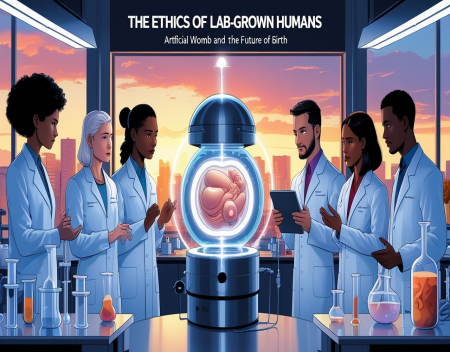
The idea of creating human life outside the body—once confined to science fiction—has quickly become a real possibility. Advances in artificial wombs, stem-cell research, and reproductive biotechnology are pushing humanity toward an era where babies may be grown entirely in laboratory environments. This potential breakthrough could revolutionize medicine, redefine parenthood, and reshape society. But with these possibilities comes an urgent question: should we do it?
Lab-grown humans, supported by artificial wombs, represent more than a technological achievement. They challenge some of the deepest assumptions about human identity, autonomy, and morality. Artificial wombs—technically called ectogenesis—are already showing results in animal trials. Scientists have sustained premature lamb fetuses in fluid-filled “biobags,” and research continues toward stabilizing extremely premature human infants. It is no longer far-fetched to imagine a future in which an embryo is conceived, gestated, and delivered entirely by machines.
Proponents argue that artificial wombs could solve several major medical and social challenges. Premature birth remains a leading cause of infant mortality worldwide. Artificial wombs could dramatically increase survival rates by providing a controlled, optimal environment. They could also help individuals who cannot carry a pregnancy for medical or biological reasons, including many women facing infertility, trans individuals, and same-sex male couples. In this sense, ectogenesis could democratize reproduction, giving more people the opportunity to have genetically related children.
Supporters also point out the potential for eliminating health risks associated with pregnancy. Gestation is physically demanding and can be dangerous. Complications such as preeclampsia, gestational diabetes, and postpartum hemorrhage create risks for millions of women every year. Biotechnology that shifts gestation outside the human body could drastically reduce these dangers. Some even argue it could advance gender equality by removing the biological burden of pregnancy from women.
But the ethical concerns are profound. Critics warn that creating humans in lab environments risks reducing babies to products—engineered, optimized, and manufactured rather than born. If artificial wombs become widely available, would there be pressure to use them for convenience? Would society begin to treat natural pregnancy as outdated or irresponsible? The fear is a slippery slope toward commodified reproduction, where parents and corporations might seek to design the “ideal” child.
There are also questions of identity and development. Human development is not purely biological; the emotional, hormonal, and physical connection between a pregnant parent and their fetus is complex. Some scientists worry that growing humans outside the womb could impact early brain development or bonding, especially if not carefully regulated. Would a child born entirely from a machine experience the world differently? Would they be seen differently?
Another concern is inequality. If artificial wombs are expensive—and they almost certainly will be—only wealthy families may initially have access. This could further widen gaps between socioeconomic classes, creating literal “designer generations” with enhanced health or genetic traits. As reproductive technologies often do, ectogenesis could reflect and amplify existing power structures unless strict policies ensure equal access.
Then there are darker possibilities. Governments or corporations could exploit lab-grown human technology for purposes far removed from family-building—such as creating specialized populations, experimenting with genetic modification, or treating humans as resources. While dystopian, these fears are not unfounded. History is full of examples where scientific advances were misused in the absence of ethical safeguards.
As with many emerging technologies, the debate over artificial wombs ultimately comes down to control. Who gets to decide how and when this technology is used? Parents? Doctors? Governments? Tech companies? Each answer leads to a different future.
Navigating these questions requires more than scientific innovation. It requires public dialogue, legal frameworks, and a willingness to address uncomfortable issues before the technology becomes mainstream. If society embraces lab-grown humans without considering the moral consequences, we risk sliding into a future shaped not by compassion and freedom, but by convenience, profit, and control.
Still, the technology has enormous potential for good—if guided by ethical foresight. With proper regulation and a commitment to human dignity, artificial wombs could save countless lives, expand reproductive freedom, and reduce suffering. But the responsibility is enormous. The decisions made today will shape not only the future of childbirth, but the definition of what it means to be human.
Great experience with Computer Geek. They helped with my website needs and were professional, respon . . . [MORE].

Great, quick service when my laptop went into meltdown and also needed Windows 11 installed. Also ca . . . [MORE].
It was a great experience to working with you. thank you so much. . . . [MORE].
Thank you so much for great service and over all experience is good . highly recommended for all peo . . . [MORE].
We engaged The Computer Geeks in mid-2023 as they have a reputation for API integration within the T . . . [MORE].
The Evolution of Personal
The Hidden Cost of Free A

The Psychology of Notific