As the world races to combat climate change and meet rising energy demands, humanity is being forced to think beyond traditional solutions. Solar panels, wind farms, and nuclear energy all play important roles, but each comes with limitations tied to land use, weather, safety concerns, or political resistance. Against this backdrop, an idea once confined to science fiction is re-entering serious discussion: space-based solar power. The concept is bold, expensive, and technologically complex—but it raises an intriguing question. Could collecting energy in orbit help save Earth?
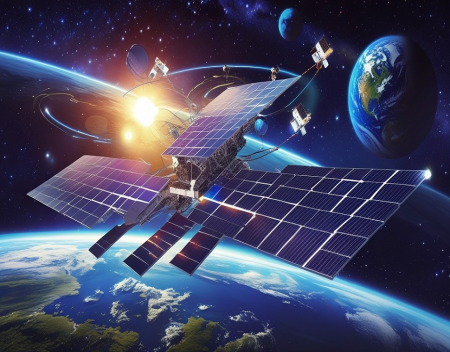
Space-based solar power works on a deceptively simple premise. Large satellites equipped with massive solar arrays would orbit Earth, capturing sunlight continuously. Unlike ground-based solar panels, these systems would not be limited by nightfall, cloud cover, or seasonal variation. In space, the sun shines nearly all the time, and solar energy is far more intense. The collected power would then be converted into microwaves or laser beams and transmitted wirelessly to receiving stations on Earth, where it would be converted back into electricity and fed into the grid.
The potential advantages are enormous. One of the biggest weaknesses of renewable energy today is intermittency. Solar panels only work when the sun is shining, and wind turbines depend on unpredictable weather. Space-based solar power promises near-constant energy production, potentially delivering clean electricity 24 hours a day. This reliability could dramatically reduce dependence on fossil fuels and help stabilize energy grids worldwide. In theory, a single large orbital solar station could supply power to millions of homes without emitting greenhouse gases.
There is also a global equity angle. Energy poverty remains a major issue in many parts of the world, particularly in remote or underdeveloped regions where building traditional power infrastructure is difficult or costly. Wireless energy transmission from space could bypass some of these barriers. Receiving stations could be placed in areas lacking extensive grid networks, potentially offering clean energy access to regions that have historically been left behind. If managed responsibly, space-based solar power could become a tool not just for sustainability, but for global development.
However, the challenges are equally massive. The first and most obvious obstacle is cost. Launching large structures into orbit remains extraordinarily expensive, even with advances in reusable rockets. A fully operational space-based solar system would require thousands of tons of material, multiple launches, and decades of maintenance. While launch costs are falling, the upfront investment would still be staggering, raising questions about who would fund such projects and who would ultimately control them.
Technical hurdles also loom large. Building and assembling enormous solar arrays in space would require advanced robotics or human crews operating in dangerous conditions. Wireless power transmission must be precise, efficient, and safe. While studies suggest that microwave transmission can be harmless at controlled levels, public concern over energy beams traveling from space is likely to be intense. Even the perception of risk could spark political resistance, protests, or misinformation campaigns.
Environmental considerations extend beyond Earth as well. Space is already becoming crowded with satellites and debris. Introducing massive solar power stations into orbit could worsen the problem of space congestion, increasing the risk of collisions that generate more debris. A single catastrophic failure could threaten other satellites, including those used for communication, navigation, and weather forecasting. Saving Earth’s environment by endangering near-Earth space presents an ethical trade-off that cannot be ignored.
There is also the geopolitical dimension. Energy has always been closely tied to power and influence. If space-based solar power becomes viable, who owns the satellites? Who controls the energy flow? A nation or corporation capable of delivering energy from orbit could wield enormous influence over global markets and political relationships. Without international agreements, this technology could deepen inequality or spark new forms of conflict rather than foster cooperation.
Despite these concerns, interest in space-based solar power continues to grow. Several countries and private companies are researching prototypes and small-scale demonstrations. The motivation is clear: humanity’s energy needs are growing faster than our ability to meet them sustainably. Climate change is accelerating, and incremental improvements may no longer be enough. Space-based solar power represents a high-risk, high-reward solution that challenges us to think on a planetary scale.
Ultimately, the question is not whether space-based solar power alone can save Earth, but whether it should be part of a broader strategy. It is unlikely to replace all other energy sources, but it could complement them, providing stable baseload power to support renewable systems on the ground. Its success would depend not only on engineering breakthroughs, but on careful governance, international cooperation, and public trust.
Collecting energy in orbit forces humanity to confront a deeper issue: whether we are willing to invest in long-term, collective solutions rather than short-term gains. Space-based solar power may not be a silver bullet, but it embodies a crucial shift in thinking. To save Earth, we may need to look beyond it—while ensuring that our reach for the stars does not repeat the mistakes we made at home.
Great experience with Computer Geek. They helped with my website needs and were professional, respon . . . [MORE].

Great, quick service when my laptop went into meltdown and also needed Windows 11 installed. Also ca . . . [MORE].
It was a great experience to working with you. thank you so much. . . . [MORE].
Thank you so much for great service and over all experience is good . highly recommended for all peo . . . [MORE].
We engaged The Computer Geeks in mid-2023 as they have a reputation for API integration within the T . . . [MORE].

The Rise of Automation in

Why Every Business Needs
ERP Systems for Small Bus