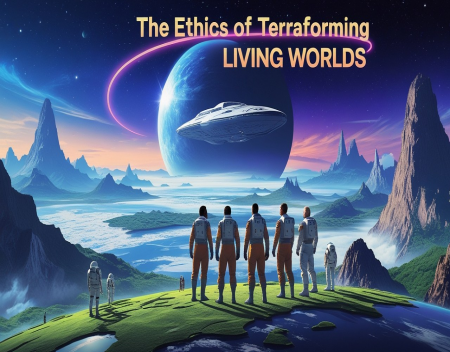
Terraforming has long captured the human imagination as a bold vision of reshaping distant planets into habitable environments. The idea promises survival beyond Earth, new frontiers for civilization, and the possibility of turning barren worlds into thriving ecosystems. Yet the concept becomes far more complicated when the target world is not lifeless but already hosts some form of native life. The ethics of terraforming living worlds raises profound questions about humanity’s role in the universe, the value of non human ecosystems, and whether expansion justifies ecological transformation on a planetary scale.
The most basic ethical dilemma begins with the recognition that even simple life forms possess intrinsic value. If scientists were to discover microbial organisms beneath the ice of a distant moon or in the atmosphere of a neighboring planet, altering that world’s environment to suit human needs could potentially wipe out entire ecosystems before they are fully understood. Unlike Earth, where biodiversity loss is already a tragedy unfolding within our own evolutionary family, alien life would represent a completely separate origin story. Destroying it for the sake of colonization might be seen as an irreversible loss not just for science but for the broader narrative of life in the universe.
Supporters of terraforming often argue that humanity has a moral obligation to expand and survive. Earth faces long term threats ranging from asteroid impacts to solar evolution, and establishing self sustaining populations on other worlds could ensure the continuity of human civilization. From this perspective, transforming a partially living world into a more habitable environment might be justified if it allows billions of future humans to exist. Advocates also suggest that terraforming could be done gradually and responsibly, preserving certain ecosystems while creating habitable zones that coexist with native life.
Opponents counter that the assumption of human priority reflects a colonial mindset projected onto space. Historically, human expansion on Earth has often led to ecological destruction and the displacement of indigenous species and cultures. Applying the same logic to alien ecosystems risks repeating these mistakes on a cosmic scale. If life exists elsewhere, even in simple forms, humanity would face a test of restraint. Instead of transforming alien environments, exploration might focus on observation, preservation, and scientific collaboration with the natural processes already unfolding there.
Another dimension of the ethical debate involves the concept of planetary rights. Some philosophers argue that entire ecosystems or biospheres deserve protection independent of their usefulness to humans. A living planet could be viewed as a complex organism with its own evolutionary trajectory, deserving respect and autonomy. Terraforming such a world might be compared to rewriting an ancient and irreplaceable story. Others believe that planets themselves are not moral agents and that ethical considerations should center primarily on conscious beings. In this view, terraforming could be acceptable if it avoids causing suffering and maximizes long term benefits.
Technological uncertainties also complicate the discussion. Terraforming would involve massive interventions such as altering atmospheres, introducing Earth based organisms, and reshaping landscapes over centuries or millennia. Even with advanced knowledge, unintended consequences would be inevitable. Introducing foreign species could disrupt delicate ecological balances, potentially leading to runaway processes that damage both native life and human settlers. The ethical responsibility to avoid irreversible harm becomes even more pressing when dealing with unfamiliar ecosystems.
There is also a cultural and philosophical aspect to consider. Discovering life beyond Earth would fundamentally change humanity’s sense of place in the universe. The decision to terraform or preserve a living world would reflect our collective values and our willingness to coexist with forms of life that are truly alien. Choosing preservation might signal a shift toward humility and stewardship, acknowledging that humanity is not the sole center of cosmic significance. Choosing transformation might emphasize human ingenuity and survival, framing expansion as a continuation of evolution itself.
International law and governance will likely play a crucial role in shaping future decisions. Existing space treaties emphasize peaceful exploration and the prevention of harmful contamination, but they were written before the possibility of discovering alien ecosystems seemed imminent. As technology advances, global agreements may need to address questions about planetary protection, ecological preservation, and the ethical limits of terraforming. Without a shared framework, competing interests among nations and private corporations could lead to rushed or conflicting actions with long term consequences.
Ultimately, the ethics of terraforming living worlds forces humanity to confront its identity as both a creative and potentially destructive force. The power to reshape entire planets carries immense responsibility, requiring careful reflection on what it means to expand beyond Earth. Whether humanity chooses preservation, cautious coexistence, or transformation, the decisions made will shape not only the future of human civilization but also the fate of life forms that may have evolved in ways we are only beginning to imagine.
Great experience with Computer Geek. They helped with my website needs and were professional, respon . . . [MORE].

Great, quick service when my laptop went into meltdown and also needed Windows 11 installed. Also ca . . . [MORE].
It was a great experience to working with you. thank you so much. . . . [MORE].
Thank you so much for great service and over all experience is good . highly recommended for all peo . . . [MORE].
We engaged The Computer Geeks in mid-2023 as they have a reputation for API integration within the T . . . [MORE].
The Evolution of Personal

The Hidden Cost of Free A

The Psychology of Notific