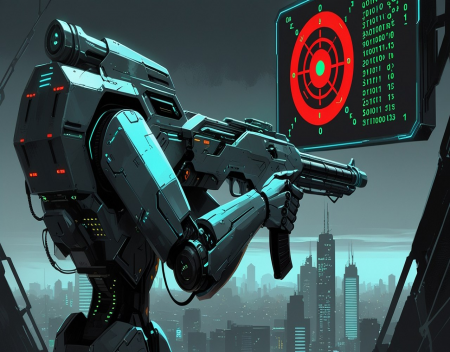
The rise of artificial intelligence has transformed nearly every aspect of modern life, from healthcare and finance to transportation and entertainment. Now, one of the most consequential frontiers of AI development lies in warfare. Autonomous weapons systems—machines capable of selecting and engaging targets without direct human control—are no longer science fiction. They already exist in limited forms, and their continued development raises a stark and unsettling question: should AI ever be allowed to pull the trigger?
Supporters of autonomous weapons argue that they are the natural evolution of military technology. Throughout history, weapons have become faster, more precise, and increasingly automated. From the bow to the rifle to the guided missile, each leap reduced human limitations and increased battlefield efficiency. AI-powered weapons, proponents claim, could make war more precise and less deadly by reducing human error, emotional decision-making, and accidental harm to civilians. Machines do not panic, seek revenge, or act out of fear. In theory, an AI system programmed with strict rules of engagement could make more rational decisions than a human soldier in the chaos of combat.
There is also a strategic argument. If rival nations are developing autonomous weapons, refusing to do so may place a country at a military disadvantage. Much like nuclear deterrence during the Cold War, the presence of autonomous weapons could reshape global power balances. Some policymakers argue that banning or restricting them is unrealistic, as the technology is too accessible and the incentives too strong. From this perspective, the focus should be on regulation and control rather than prohibition.
However, the ethical concerns surrounding autonomous weapons are profound. At the center of the debate is the issue of moral responsibility. When a human soldier commits a war crime, accountability—at least in principle—can be assigned. But when an AI system kills unlawfully, who is to blame? The programmer, the military commander, the manufacturer, or the machine itself? AI does not possess intent, conscience, or moral understanding. Allowing a machine to make life-and-death decisions risks creating a moral vacuum where responsibility is diffused and justice becomes nearly impossible.
Another major concern is the inability of AI to truly understand context. War is not just a technical problem; it is a deeply human one. Distinguishing between combatants and civilians often requires cultural awareness, empathy, and situational judgment that goes beyond data inputs. A child holding a toy gun, a civilian running in fear, or a surrendering enemy may all be misinterpreted by an algorithm trained on imperfect data. Even the most advanced AI systems are only as good as their training, and history shows that data often reflects human biases and blind spots.
There is also the fear of escalation. Autonomous weapons could lower the threshold for war by reducing the political and emotional cost of conflict. If fewer soldiers’ lives are at risk, leaders may be more willing to engage in military action. This could make conflicts more frequent, more automated, and harder to stop once initiated. In a worst-case scenario, AI systems on opposing sides could engage in rapid, self-directed combat with little human oversight, turning warfare into a feedback loop of machine-driven destruction.
Critics also warn about the democratization of violence. As AI technology becomes cheaper and more widespread, autonomous weapons could fall into the hands of non-state actors, criminal organizations, or terrorist groups. Unlike nuclear weapons, which require vast infrastructure, AI-powered drones or robotic weapons could be built or modified with relatively modest resources. This raises the risk of targeted assassinations, mass surveillance combined with lethal force, and a world where machines enforce power without accountability.
International efforts to address these dangers are ongoing but fragmented. Some nations and advocacy groups are calling for a global ban on fully autonomous weapons, arguing that meaningful human control over lethal force must be preserved. Others resist such measures, citing national security concerns and the difficulty of defining what “autonomous” truly means in an era of increasingly complex systems. The lack of consensus mirrors earlier debates over chemical and biological weapons, but the speed of AI development makes the issue more urgent.
At its core, the debate over autonomous weapons is about what kind of future humanity wants to build. Delegating the power to kill to machines forces us to confront uncomfortable questions about ethics, agency, and the value of human judgment. Even if AI can be made more accurate or efficient, efficiency alone is not a moral justification. War, tragic as it is, has always involved human choice—and human restraint.
Whether or not autonomous weapons become widespread, the decisions made today will shape the norms of tomorrow. Allowing AI to pull the trigger may promise strategic advantage, but it risks eroding accountability, escalating conflict, and redefining warfare in ways we may not be able to control. In the end, the question is not just whether machines can make lethal decisions, but whether they ever should.
Great experience with Computer Geek. They helped with my website needs and were professional, respon . . . [MORE].

Great, quick service when my laptop went into meltdown and also needed Windows 11 installed. Also ca . . . [MORE].
It was a great experience to working with you. thank you so much. . . . [MORE].
Thank you so much for great service and over all experience is good . highly recommended for all peo . . . [MORE].
We engaged The Computer Geeks in mid-2023 as they have a reputation for API integration within the T . . . [MORE].
The Rise of Automation in

Why Every Business Needs

ERP Systems for Small Bus