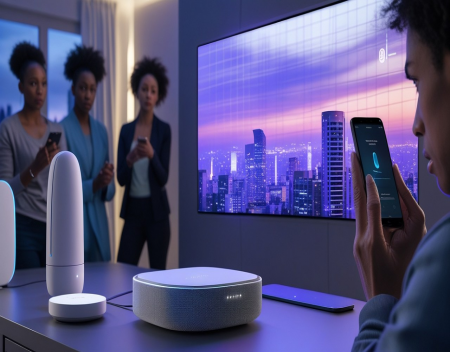
The modern home is becoming increasingly intelligent. From voice assistants and smart thermostats to connected cameras and lighting systems, technology is transforming everyday living spaces into highly automated environments. Devices tied to platforms like Amazon Alexa and Google Home promise convenience, efficiency, and control. But as these systems become more integrated into daily life, an important question emerges: is your smart home simply serving you, or is it also watching, listening, and collecting more than you realize.
At the core of every smart home is data. These devices rely on continuous streams of information to function properly. A smart thermostat learns your schedule by tracking temperature changes and occupancy patterns. A voice assistant processes spoken commands by listening for wake words. Security cameras monitor movement and store video footage. While each of these features provides clear benefits, they also require collecting and analyzing personal data in ways that were not common just a decade ago.
One of the primary concerns is how much these devices are actually listening. Voice assistants are designed to remain in a low-power listening state, waiting for a specific trigger word. In theory, they only begin recording after detecting that word. However, there have been documented cases where devices were accidentally activated by similar-sounding phrases or background noise. When this happens, snippets of conversation may be recorded and processed without the user’s intent. While companies claim these recordings are used to improve services, the idea of devices capturing unintended audio raises understandable privacy concerns.
Smart cameras and doorbells introduce another layer of complexity. These devices are often positioned in and around the home, recording video for security purposes. While they can deter crime and provide peace of mind, they also create a continuous record of activity. Depending on the settings, footage may be stored in the cloud, where it could potentially be accessed by service providers or, in some cases, law enforcement. The question is not just whether the devices are recording, but who ultimately has access to that data and under what conditions.
Data sharing is another critical issue. Many smart home devices are part of larger ecosystems, meaning data collected by one device can be combined with data from others. For example, usage patterns from a smart speaker might be linked with browsing habits or location data from other services. This creates detailed profiles that can be used for personalization, but also for targeted advertising or other purposes. Users may not always be fully aware of how their data is being aggregated and used.
Security vulnerabilities add to the concern. Any device connected to the internet can potentially be targeted by hackers. If a smart home system is not properly secured, unauthorized users could gain access to cameras, microphones, or other sensitive functions. While manufacturers implement security measures, weak passwords, outdated software, and misconfigured settings can create entry points for attackers. In such cases, the risk is not just data collection by companies, but direct intrusion by malicious individuals.
Despite these risks, it is important to recognize that smart home technology is not inherently designed to “spy” in a malicious sense. The data collection that occurs is primarily intended to enable functionality and improve user experience. The issue lies in how that data is managed, stored, and protected. Transparency and user control are key factors in determining whether a smart home feels like a helpful assistant or an invasive presence.
Users have more control than they might think. Most smart home platforms provide settings that allow individuals to review and delete stored data, disable certain features, or limit data sharing. For example, voice recordings can often be accessed and removed, and cameras can be configured to record only under specific conditions. Taking the time to explore these settings can significantly reduce privacy risks.
Network security is also essential. Using strong, unique passwords for devices and accounts, enabling multi-factor authentication, and keeping software updated can help protect against unauthorized access. Placing smart devices on a separate network or using advanced router settings can add an extra layer of protection.
There is also a broader cultural shift to consider. As technology becomes more embedded in daily life, expectations around privacy are evolving. What once seemed intrusive may become normalized, especially if the benefits are significant. However, this does not mean users should accept all forms of data collection without question. Being informed and intentional about how technology is used is more important than ever.
Ultimately, the question of whether your smart home is spying on you does not have a simple yes or no answer. These systems do collect and process data, sometimes in ways that are not immediately visible. At the same time, they offer real advantages that many users find valuable. The balance between convenience and privacy depends largely on how devices are configured and how aware users are of their capabilities.
In the end, a smart home is only as secure and private as the choices behind it. By understanding how these systems work and taking steps to manage them, users can enjoy the benefits of modern technology without giving up more privacy than they intend.
Great experience with Computer Geek. They helped with my website needs and were professional, respon . . . [MORE].

Great, quick service when my laptop went into meltdown and also needed Windows 11 installed. Also ca . . . [MORE].
It was a great experience to working with you. thank you so much. . . . [MORE].
Thank you so much for great service and over all experience is good . highly recommended for all peo . . . [MORE].
We engaged The Computer Geeks in mid-2023 as they have a reputation for API integration within the T . . . [MORE].
The Evolution of Personal
The Hidden Cost of Free A

The Psychology of Notific