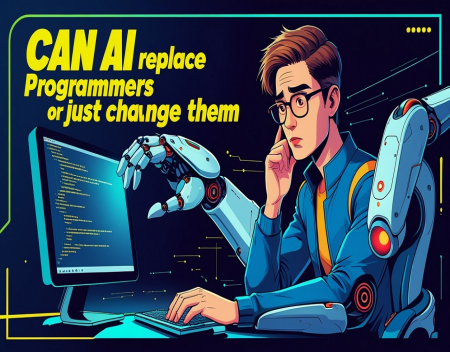
The rapid advancement of Artificial Intelligence has sparked an ongoing debate within the tech world: will AI eventually replace programmers, or will it simply transform the way they work. With the rise of code-generating tools, automated debugging systems, and intelligent assistants, the role of the programmer is clearly evolving. However, the idea of complete replacement is far more complex than it may initially appear.
At the heart of this discussion is the growing capability of Machine Learning systems to understand and generate code. Modern AI tools can write functions, suggest optimizations, and even build entire applications from high-level descriptions. For routine or repetitive tasks, this can dramatically increase productivity. A developer who once spent hours writing boilerplate code can now generate it in seconds, allowing more time for higher-level problem-solving.
This shift has led some to believe that programming as a profession may become obsolete. If machines can write code, why would we need human programmers. The answer lies in understanding what programming actually involves. Writing code is only one part of the process. Programming also includes defining problems, designing systems, making architectural decisions, and understanding the needs of users. These tasks require context, judgment, and creativity—qualities that AI, at least for now, does not fully possess.
One of the key limitations of AI-generated code is its dependence on input. AI systems do not independently decide what should be built; they respond to prompts and data. If the instructions are unclear or incomplete, the output may be flawed or irrelevant. This means that human programmers are still essential for guiding the process, refining requirements, and ensuring that the final product aligns with real-world needs. In many ways, AI shifts the focus from writing code to directing its creation.
Another important factor is reliability. While AI can produce impressive results, it is not infallible. Generated code can contain errors, inefficiencies, or security vulnerabilities. Without proper oversight, these issues can lead to significant problems, especially in critical systems. Programmers play a crucial role in reviewing, testing, and validating code, ensuring that it meets standards for performance and safety.
The rise of AI also changes the skill set required for programmers. Traditional coding skills remain important, but there is increasing emphasis on understanding systems, evaluating outputs, and working effectively with AI tools. Developers may spend less time writing every line of code and more time integrating components, managing complexity, and solving unique problems. This evolution is similar to past technological shifts, where new tools changed workflows rather than eliminating roles entirely.
There is also a creative aspect to programming that AI cannot easily replicate. Building software often involves innovation, experimentation, and the ability to think beyond existing patterns. While AI can generate solutions based on learned data, it does not truly understand the broader context or the implications of its outputs. Human programmers bring intuition and experience to the process, enabling them to create solutions that are not only functional but also meaningful.
From an industry perspective, AI is likely to increase demand for certain types of programming roles rather than reduce it. As software becomes more integrated into all aspects of life, the need for customized, secure, and scalable systems continues to grow. AI can accelerate development, but it also raises the bar for what is possible. This can lead to more ambitious projects and a greater need for skilled professionals who can manage and guide these efforts.
At the same time, entry-level programming tasks may become more automated. This could change how new developers enter the field, as traditional pathways based on simple coding tasks become less relevant. Education and training may need to adapt, focusing more on problem-solving, system design, and collaboration with AI tools. The role of the programmer may become less about writing code from scratch and more about orchestrating complex systems.
Ultimately, the question is not whether AI will replace programmers, but how it will reshape the profession. History shows that technology often transforms jobs rather than eliminating them outright. The introduction of higher-level programming languages, development frameworks, and automation tools has consistently changed how developers work, making them more productive and shifting their focus to more complex tasks.
AI represents the next step in this evolution. It has the potential to make programming more accessible, efficient, and powerful. At the same time, it requires a rethinking of what it means to be a programmer. Those who adapt, learning to work alongside AI and leverage its capabilities, will likely find new opportunities and greater impact.
In the end, AI is not replacing programmers—it is changing them. It is turning coding from a purely technical activity into a more strategic and collaborative process. The programmers of the future will not just write code; they will guide intelligent systems, solve complex problems, and shape the technology that defines the modern world.
Great experience with Computer Geek. They helped with my website needs and were professional, respon . . . [MORE].

Great, quick service when my laptop went into meltdown and also needed Windows 11 installed. Also ca . . . [MORE].
It was a great experience to working with you. thank you so much. . . . [MORE].
Thank you so much for great service and over all experience is good . highly recommended for all peo . . . [MORE].
We engaged The Computer Geeks in mid-2023 as they have a reputation for API integration within the T . . . [MORE].

The Hidden Cost of Free A
The Psychology of Notific
Why Subscription Services