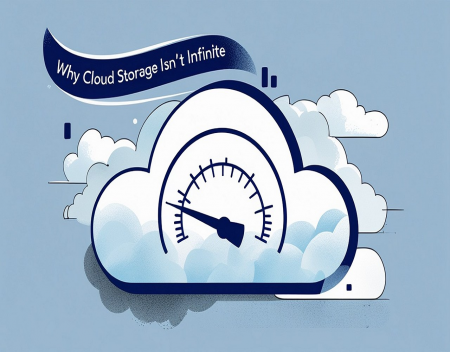
Cloud storage can sometimes feel almost limitless. Services such as online backup platforms, file-sharing services, photo storage, and business cloud platforms allow users to store enormous amounts of information without ever seeing a physical hard drive.
You can upload thousands of photographs, videos, documents, emails, and other files, and everything seems to simply disappear into the cloud.
But the cloud isn't actually infinite.
Every file stored online ultimately exists on physical storage hardware somewhere in the world. That hardware requires buildings, electricity, cooling systems, networking equipment, maintenance, and constant replacement.
As the amount of digital information created around the world continues to explode, the physical limitations of cloud storage are becoming increasingly important.
The Cloud Is Made of Physical HardwareThe term "cloud" can make online storage sound mysterious.
In reality, your cloud files are stored on physical computers.
Large data centers contain enormous collections of hard drives and solid-state drives. These storage systems can hold vast amounts of information, but they still have finite capacities.
If you upload a 10 GB video to cloud storage, that video doesn't magically exist in an unlimited digital space. It occupies physical storage somewhere.
The same is true whether you're storing one photograph or several million files.
Cloud storage providers simply operate enormous amounts of hardware and make that storage available to customers over the internet.
Storage Capacity Has LimitsEvery storage device has a maximum capacity.
A hard drive might store several terabytes of information. A solid-state drive might store several terabytes as well, with larger enterprise systems reaching considerably higher capacities.
But no individual storage device can hold an unlimited amount of data.
Cloud providers solve this problem by using enormous numbers of storage devices.
When a company has millions of customers uploading information every day, it needs to continually add more hardware.
This means cloud storage capacity has to grow alongside demand.
The Amount of Data Being Created Is ExplodingThe world is generating more digital information than ever before.
Smartphones make it easy to take thousands of photographs and record high-resolution videos. Businesses generate databases, documents, backups, emails, surveillance footage, and other digital records.
Streaming services create enormous libraries of video and audio.
Artificial intelligence is generating another massive category of digital content.
AI-generated images, videos, audio files, documents, datasets, and model information all require storage.
The result is a continuous increase in global data production.
Video Is a Storage MonsterVideo is particularly demanding.
A simple text document might only require a few kilobytes.
A photograph can require several megabytes.
A high-resolution video can consume gigabytes or even tens of gigabytes.
Modern cameras can record 4K and even higher-resolution footage. Professional video production can generate enormous files during a single project.
Consider a business that records security camera footage continuously. Hundreds of cameras operating 24 hours a day can generate enormous quantities of data.
If that footage is stored indefinitely, the storage requirements can become staggering.
This is one reason organizations often establish data retention policies.
Cloud Providers Don't Keep Only One CopyAnother important factor is redundancy.
When you upload a file to a cloud service, the provider may not store only one copy of it.
Cloud providers often replicate data across multiple storage systems to protect against hardware failures.
Depending on the service and configuration, information may be stored on multiple drives or even in different facilities.
This improves reliability but requires additional storage capacity.
A customer might upload 1 TB of information, but the cloud provider may need considerably more than 1 TB of physical storage to protect that data.
Backups Require Even More SpaceBackups add another layer of storage requirements.
Businesses often maintain multiple backups of important information.
For example, a company might maintain:
This can multiply the amount of storage required.
Deleting old backups can therefore be an important part of controlling storage costs.
However, deleting too much information can create serious risks if a business later needs to recover from a ransomware attack, hardware failure, or other disaster.
Storage Requires ElectricityStorage isn't free to operate.
Data centers require electricity to power servers, storage systems, networking equipment, cooling systems, security equipment, and other infrastructure.
Even storage devices that aren't actively processing requests still consume energy at the facility level.
The larger the storage infrastructure becomes, the more electricity and cooling capacity may be required.
This is becoming a particularly important issue as data centers expand to support cloud computing and artificial intelligence.
Cloud Storage Has a Physical LocationAnother misconception is that cloud storage exists somewhere without geographic boundaries.
In reality, cloud providers operate data centers in specific locations.
A business might choose to store information in Canada, the United States, Europe, or another region.
The physical location of data can matter for performance, privacy, legal requirements, and disaster recovery.
Large cloud providers may replicate information across multiple geographic regions, but every additional copy requires additional infrastructure.
Why Cloud Storage Can Look InfiniteIf cloud storage is limited, why does it seem infinite to users?
The answer is scale.
A cloud provider can operate enormous numbers of storage devices across many data centers.
When capacity starts getting tight, the provider can build another facility, purchase additional hardware, or expand existing infrastructure.
From the customer's perspective, the available storage can appear almost unlimited because the provider continually adds capacity behind the scenes.
It's similar to a city expanding its roads and buildings as its population grows.
There is still a physical limit, but the infrastructure is expanding continuously.
Storage Prices Depend on Supply and DemandThe physical nature of cloud storage also helps explain why prices exist.
Storage hardware costs money.
Data centers cost money to build.
Electricity costs money.
Cooling systems cost money.
Network connections cost money.
Technicians and engineers cost money.
Security and maintenance cost money.
Cloud storage providers have to recover these expenses through their pricing models.
This is why "unlimited storage" plans often have restrictions, fair-use policies, or other limitations.
Unlimited doesn't necessarily mean physically unlimited. It usually means the provider believes typical customers will remain within an acceptable range of usage.
Businesses Need Storage PoliciesFor businesses, managing cloud storage carefully can be extremely important.
Without proper policies, companies can accumulate years of unnecessary files, backups, duplicate documents, old emails, outdated databases, and other information.
Storage costs can gradually increase without anyone noticing.
Organizations should establish policies covering how long different types of information need to be retained and when old information can safely be archived or deleted.
This is sometimes called data lifecycle management.
The goal is to keep information for as long as it has value while avoiding unnecessary storage costs.
AI Could Make Storage Demand Even LargerArtificial intelligence could dramatically increase future storage requirements.
AI systems require massive datasets for training and testing. Companies may also store AI-generated content, model versions, logs, training information, and other data.
Video-generating AI could be particularly demanding because video files are much larger than ordinary text.
As AI becomes capable of producing increasingly realistic video, audio, and other media, the amount of digital content created could increase dramatically.
This means the demand for storage infrastructure is likely to continue growing.
The Future of StorageStorage technology is constantly improving.
Hard drives are becoming capable of storing more information, while solid-state storage continues becoming faster and more affordable.
Researchers are also exploring new storage technologies that could potentially provide dramatically higher capacities.
At the same time, cloud providers are becoming better at compressing, deduplicating, and managing information efficiently.
These technologies can reduce the amount of physical storage required.
However, improvements in storage technology are often accompanied by increases in the amount of data people create.
As storage becomes cheaper, people tend to store more information.
Final ThoughtsCloud storage isn't infinite because the cloud isn't a magical digital space. It is a massive collection of physical storage systems located inside real buildings around the world.
Every photograph, video, document, database, backup, and AI-generated file occupies physical storage somewhere. That storage requires hardware, electricity, cooling, networking, maintenance, and eventually replacement.
Cloud providers make storage appear almost limitless by operating enormous infrastructures and continuously adding capacity.
But there are still physical and economic limits.
As the world generates increasingly large amounts of digital information, managing that information efficiently will become more important. Businesses and consumers will need to think about what they store, how long they keep it, how many copies they need, and whether everything really needs to remain online forever.
The cloud may feel infinite from your computer screen.
Behind that screen, however, there is a finite amount of metal, silicon, electricity, and physical space making it all possible.
Great experience with Computer Geek. They helped with my website needs and were professional, respon . . . [MORE].

Great, quick service when my laptop went into meltdown and also needed Windows 11 installed. Also ca . . . [MORE].
It was a great experience to working with you. thank you so much. . . . [MORE].
Thank you so much for great service and over all experience is good . highly recommended for all peo . . . [MORE].
We engaged The Computer Geeks in mid-2023 as they have a reputation for API integration within the T . . . [MORE].

The Future of Television

How Streaming Changed Ent

Digital Minimalism in a C