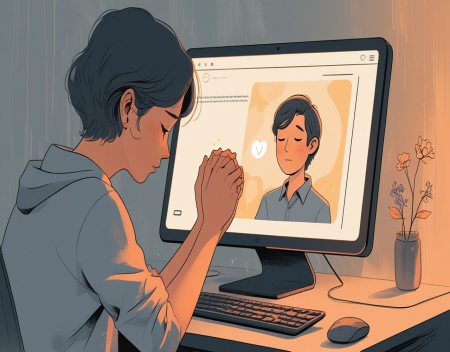
Grief has always been one of the most deeply human experiences, rooted in absence, memory, and the slow process of learning to live with loss. For most of history, mourning was shaped by ritual, storytelling, and the physical reminders left behind by the dead. In the digital age, however, grief is entering unfamiliar territory. Advances in artificial intelligence now make it possible to simulate the voices, faces, and conversational patterns of deceased loved ones, allowing the living to interact with digital avatars that echo those who are gone. This development raises profound questions about healing, memory, and the boundaries between comfort and illusion.
AI-generated avatars of the deceased are typically created using a combination of photos, videos, voice recordings, text messages, and social media data. When assembled, these fragments form an interactive representation that can speak, respond, and even exhibit personality traits associated with the person who has died. For those in mourning, the experience can feel startlingly intimate. Hearing a familiar voice or seeing a recognizable expression can evoke a sense of presence that traditional memorials cannot replicate. In moments of acute loss, this can provide genuine emotional relief.
Supporters of virtual grief technologies argue that they function as a transitional tool rather than a replacement for acceptance. In early stages of mourning, shock and disbelief often dominate emotional responses. An AI avatar can act as a bridge between presence and absence, allowing individuals to express unresolved feelings, ask lingering questions, or simply feel less alone. For some, this interaction may ease the intensity of grief and reduce the sense of abrupt separation that often accompanies sudden loss.
Yet the comfort offered by AI avatars exists alongside serious psychological and ethical concerns. Grief, by its nature, involves confronting finality. When technology softens that finality too much, it may interfere with the natural process of adaptation. There is a risk that continued interaction with a simulated presence could delay acceptance, anchoring mourners to a version of the past that cannot evolve. Instead of integrating the loss into their lives, individuals may become emotionally dependent on a digital echo that never truly changes or grows.
Another concern lies in authenticity. No matter how sophisticated, an AI avatar is ultimately a reconstruction based on available data. It cannot capture the full inner life, moral agency, or unpredictability of a human being. Over time, the avatar may say things the real person never would have said or respond in ways shaped more by algorithmic probability than lived experience. This can subtly alter memory itself, blending authentic recollection with artificial interpretation. The deceased may be remembered not as they were, but as the system reconstructs them.
Consent is also a central issue. Many people whose digital likenesses are used to create avatars never agreed to be reanimated in this way. Their messages, recordings, and images were created for specific contexts, not for posthumous simulation. The question of who owns a person’s digital identity after death remains unresolved. Family members may find comfort in these avatars, while others may view them as violations of privacy or dignity. Without clear norms, disputes over digital resurrection are likely to grow.
Culturally, virtual grief reflects a broader discomfort with death itself. Modern societies often struggle to make space for mourning, preferring efficiency and emotional control over prolonged vulnerability. AI avatars offer a way to soften loss, to make it more manageable and less final. In doing so, they may reflect a desire not just to remember the dead, but to resist the limits of mortality altogether. This impulse, while understandable, carries the risk of turning grief into a product rather than a process.
Despite these concerns, it would be inaccurate to dismiss virtual grief technologies as inherently harmful. Human relationships with memory have always evolved alongside tools, from photographs to recorded voices to video. AI avatars represent an extension of this trajectory, not a complete rupture. For some individuals, especially those facing isolation or unresolved trauma, these tools may offer meaningful support when used thoughtfully and temporarily.
The key challenge lies in intention and boundaries. When AI avatars are framed as memorial aids rather than substitutes for the living, they may serve a constructive role. When they are treated as ongoing replacements for human connection, the emotional costs become more pronounced. Grief cannot be solved or optimized. It can only be lived through, reshaped over time, and gradually woven into a new understanding of life without the person who is gone.
Virtual grief forces society to confront difficult questions about memory, technology, and what it means to let go. As AI continues to blur the line between presence and absence, the task will not be to eliminate grief, but to ensure that our tools honor the reality of loss rather than deny it. In navigating this emerging terrain, humanity must decide whether digital echoes are meant to comfort the living, preserve the dead, or simply remind us of how deeply we fear saying goodbye.
Great experience with Computer Geek. They helped with my website needs and were professional, respon . . . [MORE].

Great, quick service when my laptop went into meltdown and also needed Windows 11 installed. Also ca . . . [MORE].
It was a great experience to working with you. thank you so much. . . . [MORE].
Thank you so much for great service and over all experience is good . highly recommended for all peo . . . [MORE].
We engaged The Computer Geeks in mid-2023 as they have a reputation for API integration within the T . . . [MORE].

The Rise of Automation in

Why Every Business Needs

ERP Systems for Small Bus