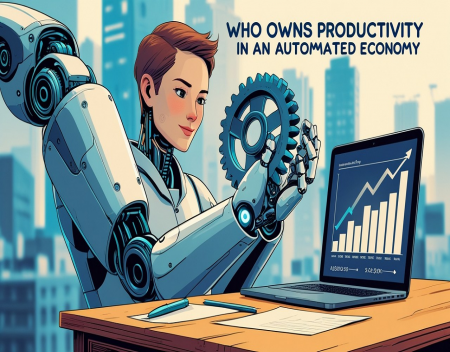
As automation and artificial intelligence reshape economies, a fundamental question is emerging beneath debates about jobs, efficiency, and innovation: who owns productivity in an automated economy. Productivity has long been understood as the output created by human labor, compensated through wages and protected by labor laws. Automation disrupts this relationship by separating value creation from human effort, raising questions about ownership, distribution, and fairness in a system where machines increasingly do the work.
In traditional economic models, productivity gains were shared, at least in theory, between workers and employers. New tools made workers more efficient, allowing wages to rise alongside profits. Over time, this balance has eroded. Even before widespread automation, productivity growth in many countries outpaced wage growth, with gains accruing primarily to capital owners. Automation accelerates this trend by further reducing the need for human labor, concentrating value in the hands of those who own machines, data, and intellectual property.
The owners of automated systems claim productivity through legal and economic frameworks that prioritize capital. Algorithms, robots, and platforms are treated as assets, and the output they generate belongs to those who finance, design, and deploy them. Workers who once contributed skill and effort may find themselves displaced or relegated to monitoring roles, while their share of productivity diminishes. This shift reframes productivity as something generated independently of society, rather than as a collective achievement built on public infrastructure, education, and historical labor.
Data plays a crucial role in this new economy. Automated systems rely on vast amounts of information generated by users, consumers, and workers. Every interaction helps refine algorithms, yet individuals rarely receive compensation for this contribution. In this sense, productivity is co produced by society at large but captured privately. The question of ownership becomes more complex when value emerges from collective behavior rather than individual effort.
Governments face a challenge in defining rights and responsibilities in this context. Tax systems are still largely designed around human labor, leaving automated productivity lightly taxed or indirectly captured. Proposals such as robot taxes or data dividends attempt to address this imbalance by recognizing that automated output depends on societal inputs. Critics argue these measures could stifle innovation, while supporters see them as necessary to maintain social cohesion and fund public goods.
There is also a moral dimension to ownership. If automation eliminates jobs, societies must decide whether displaced workers are simply unfortunate casualties of progress or rightful stakeholders in the productivity they helped enable. Many automated systems build on decades of publicly funded research, education, and infrastructure. Treating their output as exclusively private ignores these contributions and risks undermining the social contract that supports innovation.
Alternative models suggest reimagining ownership itself. Cooperative platforms, public AI systems, and shared data trusts offer ways to distribute productivity more broadly. These approaches challenge the assumption that efficiency requires centralized control and instead emphasize participation and accountability. While still experimental, they highlight the possibility of aligning technological advancement with democratic values.
Ultimately, who owns productivity in an automated economy is not a technical question but a political and ethical one. It reflects choices about power, responsibility, and the purpose of economic activity. As machines take on more work, societies must decide whether productivity will deepen inequality or become a shared resource that supports collective well being. The answer will shape not only economic outcomes but the meaning of work and value in the decades to come.
Great experience with Computer Geek. They helped with my website needs and were professional, respon . . . [MORE].

Great, quick service when my laptop went into meltdown and also needed Windows 11 installed. Also ca . . . [MORE].
It was a great experience to working with you. thank you so much. . . . [MORE].
Thank you so much for great service and over all experience is good . highly recommended for all peo . . . [MORE].
We engaged The Computer Geeks in mid-2023 as they have a reputation for API integration within the T . . . [MORE].
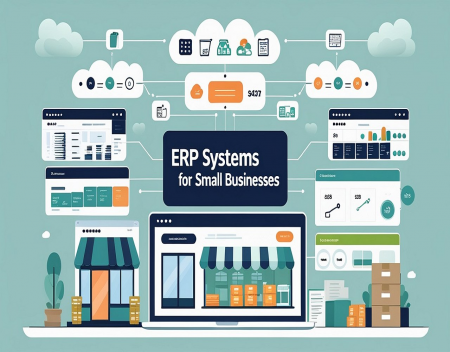
ERP Systems for Small Bus
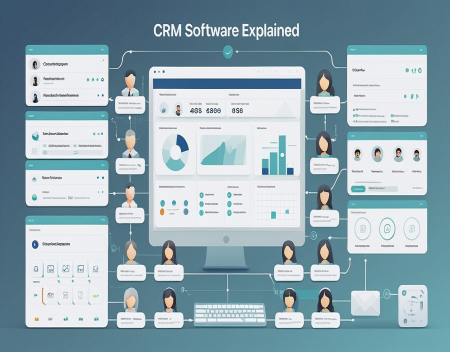
CRM Software Explained

The Future of Digital Pay