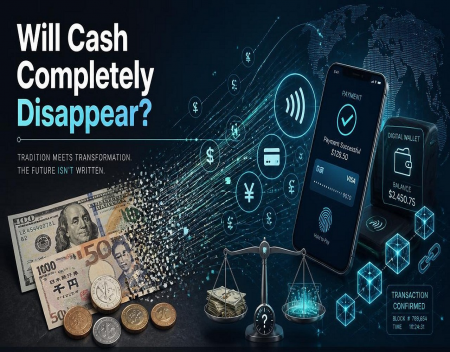
For thousands of years, cash has played an important role in human civilization. Coins and paper money have allowed people to buy goods, pay for services, save money, and conduct business without needing to exchange physical objects. Even today, despite the growing popularity of digital payments, cash remains an important part of everyday life.
However, the way people pay for things is changing rapidly. Credit cards, debit cards, mobile wallets, contactless payments, and online banking have made it possible to complete transactions without carrying physical money. In some countries, cash is already becoming increasingly uncommon, with many businesses encouraging customers to pay electronically.
This raises an interesting question: Could cash eventually disappear completely?
Although a cashless society is becoming more technologically possible, there are several reasons why physical money may survive for many years to come.
The Growth of Digital PaymentsOne of the biggest reasons cash is declining is the convenience of digital payments.
Instead of carrying bills and coins, people can use debit cards, credit cards, smartphones, or smartwatches to pay for purchases. Contactless payment systems allow transactions to be completed by simply tapping a device against a payment terminal.
Online shopping has also contributed to the decline of cash. When purchasing products through websites or mobile applications, customers generally use electronic payment methods.
Digital payments offer several advantages. Transactions can be completed quickly, purchases are automatically recorded, and consumers do not need to worry about carrying the correct amount of money.
Businesses also benefit because electronic payments can simplify accounting, reduce the amount of cash stored on premises, and make it easier to track sales.
As payment technology continues improving, more people may find that they rarely need physical money.
The Rise of Mobile WalletsMobile wallets have become an increasingly popular alternative to traditional payment methods.
Services such as Apple Pay and Google Wallet allow users to store payment card information on smartphones and compatible wearable devices. Instead of taking a physical card out of a wallet, customers can simply tap their phone or watch at a payment terminal.
Digital wallets can also store other information, including loyalty cards, tickets, and certain identification credentials.
In the future, mobile wallets may become even more sophisticated. They could combine payments, identification, banking, and digital credentials into a single application.
For many consumers, this could eliminate the need to carry a traditional wallet altogether.
However, mobile payment systems depend on compatible devices, functioning payment terminals, and secure digital infrastructure. These requirements mean they cannot replace cash in every situation.
Why Businesses Prefer Electronic PaymentsMany businesses prefer electronic payments because they can reduce the administrative work associated with handling physical money.
Cash must be counted, stored, transported, deposited, and reconciled with sales records. Businesses may also need to arrange security measures to protect employees and cash kept on the premises.
Electronic transactions can simplify many of these processes.
Digital payments also create detailed transaction records, making it easier for businesses to understand customer spending patterns and monitor financial activity.
However, electronic payment systems are not free. Businesses often pay transaction fees to payment processors and financial institutions. For smaller businesses, these costs can become significant.
Some businesses therefore continue accepting cash because it allows them to avoid certain processing fees and serve customers who prefer physical money.
The Problem with a Completely Cashless SocietyDespite the advantages of digital payments, eliminating cash would create several problems.
One major concern is accessibility. Not everyone has a bank account, credit card, smartphone, or reliable internet connection. Some people may have difficulty accessing digital financial services because of age, income, disability, or other circumstances.
Cash provides a simple payment option that does not require specialized equipment or an electronic account.
A completely cashless society could make everyday purchases more difficult for people who are already financially vulnerable.
There is also the question of personal privacy.
Cash transactions generally do not create the same detailed electronic records as card or mobile payments. When someone pays with cash, the transaction is not automatically recorded by a bank or payment processor.
Digital payments, on the other hand, can create extensive records of where people shop, what they purchase, and when they spend money.
Although these records can help prevent fraud and simplify financial management, some people are uncomfortable with the amount of personal information collected through electronic payment systems.
What Happens During a Power or Internet Outage?Another important reason cash may survive is reliability.
Digital payment systems depend on technology. Payment terminals need electricity, communication networks must function, and financial institutions must maintain operational systems.
If a major power outage or telecommunications failure occurs, electronic payments may become temporarily unavailable.
Natural disasters, cyberattacks, technical failures, and other emergencies can disrupt digital infrastructure.
Cash provides an alternative when electronic systems stop working. People can still purchase essential supplies without depending on a functioning payment network.
This makes physical money an important backup during emergencies.
Even countries with highly developed digital payment systems may have reasons to maintain cash circulation as part of their financial resilience.
Government Control and Financial PrivacyThe move toward cashless payments also raises questions about government oversight and financial freedom.
Electronic transactions are easier to monitor than cash payments. Financial institutions already maintain records of many transactions, and governments can obtain certain financial information under applicable laws.
Supporters of digital payments argue that electronic records can help combat tax evasion, money laundering, fraud, and other financial crimes.
Critics worry that eliminating cash could give governments and financial institutions greater influence over how individuals use their money.
A fully digital financial system could also create concerns about account restrictions, identity verification, and access to funds.
Cash offers a degree of independence from banking systems. People can hold physical money and use it without needing approval from a payment processor.
Maintaining cash as an option may therefore be important for people who value financial privacy and independence.
Could Digital Currencies Replace Physical Money?Central bank digital currencies, often called CBDCs, are another development that could influence the future of cash.
A CBDC would be a digital form of money issued by a country's central bank. Unlike privately issued cryptocurrencies, it would represent an official form of national currency.
Several central banks around the world have been researching or testing digital currency systems.
A CBDC could potentially allow people to make electronic payments using central bank money rather than relying entirely on commercial bank deposits or private payment companies.
However, a digital currency is not automatically a replacement for physical cash. Its design would determine how people access it, whether it can be used offline, and what privacy protections are available.
Even if CBDCs become more common, governments may choose to maintain physical currency alongside them.
Will Cash Disappear by 2040?Predicting exactly when cash might disappear is difficult, but complete elimination by 2040 seems unlikely.
Digital payments will probably continue expanding, particularly among younger consumers and people who regularly shop online.
Some businesses and communities may become almost entirely cashless, while others will continue accepting physical money.
The future may involve a combination of payment methods rather than one universal system. Smartphones, bank cards, digital currencies, and physical cash could all serve different purposes.
Cash may eventually become less convenient for everyday purchases, but it could remain valuable as an emergency payment method and an option for people who prefer not to rely entirely on electronic financial systems.
Final ThoughtsThe world is moving toward digital payments, and cash is gradually losing its position as the primary way people purchase goods and services. Mobile wallets, contactless cards, online banking, and emerging digital currencies are making electronic transactions faster and more convenient.
However, a completely cashless society would introduce serious concerns involving accessibility, privacy, financial independence, and reliability during emergencies.
Cash has survived countless changes in technology and banking. While its everyday use may continue to decline, its simplicity and independence from electronic systems give it advantages that digital payments cannot always replace.
The most likely future is not one in which cash disappears entirely, but one in which physical money becomes a less frequently used alternative alongside increasingly sophisticated digital payment systems.
Great experience with Computer Geek. They helped with my website needs and were professional, respon . . . [MORE].

Great, quick service when my laptop went into meltdown and also needed Windows 11 installed. Also ca . . . [MORE].
It was a great experience to working with you. thank you so much. . . . [MORE].
Thank you so much for great service and over all experience is good . highly recommended for all peo . . . [MORE].
We engaged The Computer Geeks in mid-2023 as they have a reputation for API integration within the T . . . [MORE].
Will Cash Completely Disa

What Will Offices Look Li
The Future of Personal Ro