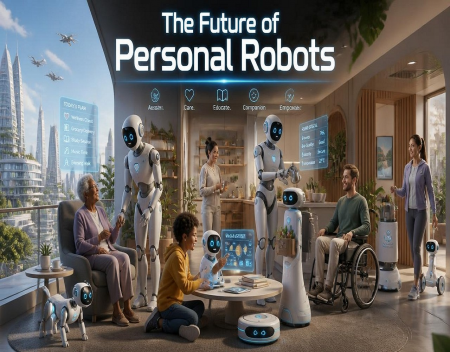
For decades, personal robots have been a popular idea in science fiction. Movies and television shows have introduced us to intelligent machines that clean homes, prepare meals, assist elderly people, perform household chores, and even act as companions. While these robots once seemed like something from the distant future, advances in artificial intelligence, sensors, computer processing, and robotics are bringing the technology closer to everyday life.
Today, robots already perform specialized tasks in homes and businesses. Robotic vacuum cleaners can navigate rooms and avoid obstacles, automated lawn mowers can maintain grass, and smart home devices can respond to voice commands. However, these machines are still relatively limited compared with the intelligent personal robots imagined in science fiction.
The next generation could be very different. Instead of purchasing separate machines for individual tasks, people may eventually own general-purpose robots capable of performing a wide variety of activities around the home.
From Single-Purpose Machines to General-Purpose RobotsMost household robots available today are designed to perform one specific job. A robotic vacuum cleaner cleans floors, while a robotic lawn mower cuts grass. These devices can operate independently, but they generally cannot perform tasks outside their original purpose.
Future personal robots may be much more versatile.
Advances in artificial intelligence and machine learning could allow robots to understand spoken instructions, recognize objects, navigate unfamiliar environments, and learn how to complete new tasks.
Imagine telling a household robot to collect dirty laundry, place dishes in the dishwasher, or bring an item from another room. Rather than following a fixed routine, the robot could interpret the request, identify the necessary objects, and determine the steps required to complete the job.
This type of flexibility is one of the biggest goals of modern robotics research.
Developing a machine that can perform multiple household tasks reliably is extremely difficult, but improvements in AI models and robotic hardware are helping researchers make progress.
Artificial Intelligence Will Make Robots SmarterArtificial intelligence will likely be the most important technology behind future personal robots.
Traditional robots typically rely on programmed instructions and carefully controlled environments. They can perform repetitive tasks very well, but unexpected situations can cause problems.
AI-powered robots have the potential to make decisions based on what they observe.
For example, a robot might recognize that a chair is blocking its path and find another route. It could identify different household objects, understand that a glass is fragile, and adjust how it handles the item.
Voice-based AI could also make interacting with robots much easier. Instead of programming a device or using complicated controls, owners could give instructions using ordinary conversation.
A personal robot might understand requests such as, "Please tidy the living room before our guests arrive," and break that instruction into smaller tasks.
AI could also allow robots to remember household routines, recognize individual family members, and adapt to the preferences of the people they assist.
However, intelligence alone is not enough. A robot must also be physically capable of carrying out its instructions safely and consistently.
Humanoid Robots in the HomeOne of the most interesting developments in robotics is the creation of humanoid machines.
Humanoid robots are designed with a body structure that resembles a human, often including a head, torso, arms, hands, and legs. This design could make them useful in environments built for people.
Homes are full of objects designed around human movement. Doors have handles, kitchen cabinets have drawers, and household appliances are designed for people standing at counters. A humanoid robot could potentially interact with these objects without requiring homeowners to redesign their living spaces.
Some companies are developing humanoid robots intended for industrial and commercial applications, while others are exploring their potential for domestic use.
A household humanoid robot might eventually be capable of loading a dishwasher, carrying groceries, organizing shelves, or helping move objects around the home.
However, humanoid robots face significant challenges. Walking on two legs, maintaining balance, handling delicate objects, and operating safely around children and pets require sophisticated engineering.
They also need to become affordable enough for ordinary households.
Robots Could Help an Aging PopulationOne of the most important applications for personal robots may be assisting older adults and people with disabilities.
As populations age, many countries face increasing demand for home care and assisted-living services. Personal robots could help people maintain independence for longer by performing physical tasks that become difficult with age.
A robot might retrieve objects, carry groceries, help prepare simple meals, or remind someone to take scheduled medication.
Robots could also provide assistance during emergencies. A system equipped with appropriate sensors might detect a fall and contact a designated caregiver or emergency service.
Some robots may focus on companionship rather than physical assistance. They could provide conversation, entertainment, reminders, and communication with family members.
These machines would not replace human relationships or professional healthcare workers. However, they could provide useful support, particularly for people who live alone or have limited access to assistance.
Privacy and reliability will be especially important in these situations because robots may operate in intimate living spaces and handle sensitive personal information.
Personal Robots and Household AutomationPersonal robots could eventually become the central control system for smart homes.
Today, homeowners often manage smart lights, thermostats, security cameras, door locks, and appliances through separate applications or voice assistants.
A more advanced personal robot could interact with these systems directly.
For example, when leaving the house, an owner might tell the robot to secure the property. It could check that doors are locked, adjust the thermostat, turn off unnecessary lights, and activate the security system.
It might also monitor the home for unusual activity, identify potential problems, and notify the owner when something requires attention.
In the future, robots could become mobile smart home assistants that move throughout the house rather than remaining in one location.
This could make home automation more practical because the robot would be able to observe and interact with its surroundings.
The Cost of Owning a Personal RobotOne major obstacle to widespread adoption will be cost.
Advanced robots require motors, sensors, cameras, processors, batteries, mechanical components, and sophisticated software. Building a machine that can safely perform a variety of household tasks is considerably more complicated than manufacturing a basic robotic vacuum cleaner.
Early general-purpose personal robots will likely be expensive. They may initially appeal to wealthy households, technology enthusiasts, and businesses.
Over time, manufacturing improvements and greater production volumes could reduce prices.
Another possibility is a subscription-based model. Instead of purchasing a robot outright, consumers might pay a monthly fee that includes the machine, software updates, maintenance, and technical support.
This approach could make personal robots more accessible, although ongoing subscription costs would need to be reasonable.
Safety, Security, and Privacy ConcernsAs personal robots become more capable, they will introduce new risks.
A robot moving around a home must be able to avoid people, pets, furniture, and other obstacles. It must also handle objects safely and recognize situations where it should stop rather than attempt a task.
Cybersecurity will be another major concern. A connected robot could potentially access cameras, microphones, home networks, and other smart devices.
If criminals gained control of such a system, the consequences could be serious.
Manufacturers will need to build strong security protections into their products, including encrypted communications, secure authentication, regular software updates, and clear privacy controls.
People should also have control over what their robots record, where information is stored, and whether data is shared with outside companies.
Trust will be essential before consumers allow increasingly intelligent machines to operate independently inside their homes.
Will Every Home Eventually Have a Robot?It is possible that personal robots could become as common as computers, smartphones, and smart televisions.
However, widespread adoption will depend on whether they provide enough practical value to justify their cost.
A robot that can only perform a few simple tasks may not be worth the investment. A machine that reliably handles cleaning, organization, basic household assistance, and other everyday activities could be much more attractive.
The most successful personal robots may not necessarily look human. Some could have wheels, specialized arms, compact bodies, or modular components designed for particular tasks.
Rather than one robot doing everything, households might eventually use several machines that work together.
Final ThoughtsThe future of personal robots could transform everyday life. Advances in artificial intelligence, robotics, sensors, and mechanical engineering are gradually making machines more capable of operating in ordinary environments.
Personal robots may eventually help with household chores, assist older adults, manage smart home equipment, and provide companionship.
There are still significant challenges involving cost, safety, reliability, privacy, and the ability to perform complicated physical tasks. These issues will need to be addressed before general-purpose robots become common household appliances.
The arrival of truly useful personal robots may not happen overnight, but the direction of technology is becoming increasingly clear. The machines of the future may do much more than respond to commands or perform repetitive tasks. They could become practical assistants that help people manage their homes and everyday lives.
Great experience with Computer Geek. They helped with my website needs and were professional, respon . . . [MORE].

Great, quick service when my laptop went into meltdown and also needed Windows 11 installed. Also ca . . . [MORE].
It was a great experience to working with you. thank you so much. . . . [MORE].
Thank you so much for great service and over all experience is good . highly recommended for all peo . . . [MORE].
We engaged The Computer Geeks in mid-2023 as they have a reputation for API integration within the T . . . [MORE].
The Future of Personal Ro
Could Holographic Display

Life After Smartphones