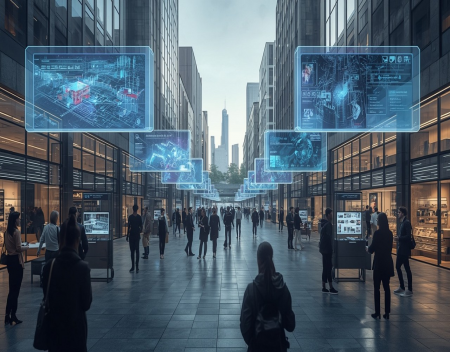
For decades, holographic displays have been a popular feature in science fiction. Movies and television shows have imagined a future where people communicate through floating three-dimensional images, examine virtual objects in midair, and interact with computers without needing traditional screens.
While those ideas once seemed like distant fantasy, advances in display technology are bringing some aspects of holographic imaging closer to reality. Researchers and technology companies are developing systems that can create three-dimensional images, project light into space, and display digital objects that appear to have depth.
But could holographic displays eventually become as common as televisions, computer monitors, and smartphones? The technology has considerable potential, although several technical and economic challenges must be overcome before it becomes a mainstream consumer product.
What Is a Holographic Display?A holographic display is a technology designed to create or reproduce images that appear three-dimensional. Unlike traditional screens, which present flat images on a physical surface, holographic systems attempt to recreate the appearance of depth.
The term holography traditionally refers to a technique that records and reconstructs light patterns to reproduce a three-dimensional image. This is different from simply displaying a 3D image on a screen.
Some modern products marketed as holographic displays use other techniques, including transparent screens, light-field displays, projection systems, and optical illusions. These technologies can create impressive visual effects, but they do not all produce true holograms.
The distinction matters because the technology used determines how realistic the image appears, whether viewers need special glasses, and how freely they can move around the displayed object.
The ultimate goal is to create digital images that look like physical objects occupying real space.
How Holographic Displays Could WorkSeveral different technologies are being explored to make holographic displays practical.
One approach is digital holography. These systems use computers and specialized optical components to calculate and reproduce the light patterns needed to create a three-dimensional image.
Another approach involves light-field displays. Instead of presenting a single flat image, these displays send different rays of light in different directions. This can create a sense of depth and allow viewers to see objects from different angles as they move.
Some systems use transparent displays combined with carefully positioned images and lighting to create the impression that objects are floating in space.
There are also volumetric displays, which generate images within a physical volume rather than on a conventional flat screen. Depending on the design, these systems may use rotating surfaces, projected light, or other specialized techniques.
Each approach has advantages and limitations. Some are better suited to large displays, while others are designed for smaller devices or specialized professional applications.
Holographic Displays in EntertainmentOne of the most obvious applications for holographic displays is entertainment.
Imagine watching a movie where certain objects appear to extend beyond the television screen. Instead of viewing a flat image of a spaceship, viewers might see a three-dimensional representation that appears to occupy space in the room.
Video games could also become more immersive. Players might interact with virtual characters and environments displayed as three-dimensional images rather than viewing everything through a traditional monitor or television.
Concerts and live performances could use holographic-style displays to create realistic visual effects. Digital performers might appear on stage alongside real musicians, while audiences could experience visual elements that change depending on their viewing position.
However, creating convincing holographic entertainment will require much more than simply making images appear three-dimensional. The displays must offer sufficient resolution, brightness, viewing angles, and smooth motion to compete with modern televisions and virtual reality systems.
Transforming Business and EducationHolographic displays could have an even greater impact in professional environments.
In education, students could examine three-dimensional representations of objects that are difficult to understand through ordinary photographs or diagrams. Medical students, for example, might explore detailed digital models of the human body, examining organs and anatomical structures from different angles.
Science classes could use holographic displays to demonstrate complex concepts such as molecular structures, planetary systems, and geological formations.
Businesses could also benefit from the ability to display products in three dimensions. A customer shopping online might examine a digital model of a vehicle, appliance, or piece of furniture without needing to visit a showroom.
Engineers and designers could collaborate around three-dimensional models of buildings, machines, and electronic components. Instead of sharing flat drawings, teams might examine digital prototypes that appear to occupy physical space.
Medical professionals could potentially use advanced three-dimensional visualization to study scans and plan complicated procedures.
These applications may become commercially viable before holographic displays reach ordinary households because businesses and institutions may be willing to pay more for specialized equipment.
Could Holographic Displays Replace Computer Monitors?The possibility of replacing traditional computer monitors is particularly interesting.
A holographic workstation could potentially display multiple virtual screens around a user. Instead of purchasing several physical monitors, someone might create a large digital workspace containing documents, applications, video calls, and other information.
This could be useful for professionals who work with complex data, engineering designs, financial information, or video production.
Imagine a video editor examining a three-dimensional virtual workspace where editing controls, video previews, and project timelines can be positioned wherever they are most convenient.
However, traditional monitors have several important advantages. They are relatively inexpensive, provide excellent image quality, consume manageable amounts of power, and are easy to use.
Holographic displays would need to match or exceed these advantages before most consumers would consider replacing their existing screens.
There may also be practical concerns involving eye strain, image clarity, available workspace, and the amount of processing power required.
The Biggest Challenges Facing the TechnologyDespite its potential, holographic display technology faces several significant obstacles.
Cost: Advanced optical components, specialized processors, and precision manufacturing can make holographic systems expensive. Mass production would be necessary to bring prices down.
Image quality: Producing bright, sharp, high-resolution three-dimensional images is technically challenging. A display that looks impressive in a laboratory may not perform as well in a brightly lit living room.
Processing requirements: Generating realistic holographic images can require enormous amounts of computing power. More efficient hardware and specialized graphics processors may be needed.
Viewing angles: Some technologies work best from specific positions. A truly mainstream display should allow multiple people to view an image from different angles without losing its three-dimensional appearance.
Physical size: Some experimental systems require large equipment or specialized environments. Consumer products will need to become smaller, lighter, and easier to install.
Content availability: Even if affordable holographic displays become available, consumers will need movies, games, applications, and other content designed specifically for them.
These challenges are not necessarily impossible to solve, but they help explain why holographic displays have not yet replaced conventional screens.
The Role of Artificial IntelligenceArtificial intelligence could accelerate the development of holographic displays.
Creating detailed three-dimensional images requires substantial processing and complex calculations. AI could help generate digital environments, convert ordinary images into three-dimensional models, and optimize the way visual information is displayed.
For example, AI software might take a collection of photographs and create a detailed digital representation of an object. That model could then be displayed using compatible three-dimensional display technology.
AI could also make holographic interfaces more interactive. Users might be able to ask an assistant to display a product, rotate a model, highlight specific components, or explain what they are seeing.
As AI-powered computers become more capable, generating and manipulating complex three-dimensional content could become easier and less expensive.
When Could Holographic Displays Become Mainstream?It is difficult to predict exactly when holographic displays will become common consumer products.
Some forms of three-dimensional display technology are already available in specialized commercial products, research environments, entertainment installations, and professional applications. However, these systems should not all be confused with the fully realistic holographic displays often portrayed in science fiction.
The most likely path toward mainstream adoption is gradual.
Professional industries may adopt specialized displays first, particularly where three-dimensional visualization provides a clear business advantage. As manufacturing improves and costs decline, smaller versions could become available to consumers.
Early household applications might include gaming displays, interactive advertising, educational devices, and premium entertainment systems.
Eventually, holographic technology could become part of televisions, computers, and other consumer electronics. Whether it replaces conventional screens or simply becomes another display option will depend on cost, quality, and convenience.
Final ThoughtsHolographic displays have the potential to change how people interact with digital information. They could make entertainment more immersive, improve education, transform product demonstrations, and provide new ways for professionals to visualize complex information.
However, creating realistic, affordable, and practical holographic displays remains a significant engineering challenge.
The technology will probably become common in specialized applications before it reaches everyday households. Improvements in artificial intelligence, computing power, optical engineering, and manufacturing could help move it forward.
For now, traditional screens remain the most practical way to display digital information. But as technology continues to evolve, the idea of watching a three-dimensional image floating in front of you may eventually become an ordinary part of everyday life rather than something reserved for science fiction.
Great experience with Computer Geek. They helped with my website needs and were professional, respon . . . [MORE].

Great, quick service when my laptop went into meltdown and also needed Windows 11 installed. Also ca . . . [MORE].
It was a great experience to working with you. thank you so much. . . . [MORE].
Thank you so much for great service and over all experience is good . highly recommended for all peo . . . [MORE].
We engaged The Computer Geeks in mid-2023 as they have a reputation for API integration within the T . . . [MORE].
Could Holographic Display

Life After Smartphones
The Future of Digital Ide