When you visit a website, stream a movie, send an email, store a photograph in the cloud, or use an artificial intelligence service, you probably don't think about where all that information is actually being processed. The internet can seem almost invisible, but behind virtually every online service is a massive amount of physical equipment.
Modern data centers are the buildings that house this infrastructure.
A data center is essentially a highly specialized facility designed to keep thousands of computers, storage systems, networking equipment, and other technologies operating continuously. These facilities are the backbone of cloud computing, online services, streaming platforms, artificial intelligence, banking systems, e-commerce, and much of the modern internet.
But what actually happens inside one?
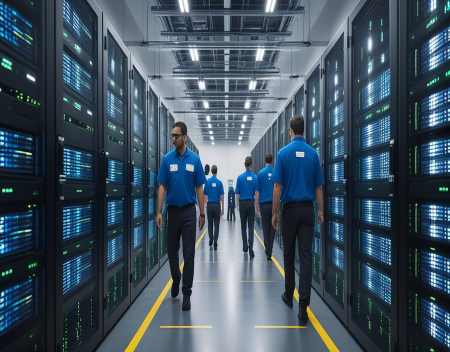
Rows of ServersThe most obvious equipment inside a data center is the servers.
Walking into a large data center can look surprisingly different from walking into a typical office. Instead of desks and employees, you will typically see long rows of server racks containing computers stacked vertically.
These servers perform different jobs.
Some may host websites, while others process databases, store files, run applications, handle online transactions, or perform complex calculations. Large technology companies can operate thousands or even millions of servers across facilities around the world.
Servers are designed to operate continuously. They are generally built with redundant components and are monitored constantly to detect potential failures.
If one server stops working, another system may automatically take over its workload.
Storage Systems Hold Enormous Amounts of DataThe internet generates an incredible amount of information every day.
Photographs, videos, emails, documents, application data, databases, backups, and countless other files all need somewhere to live.
Modern data centers use massive storage systems to manage this information.
Storage can include traditional hard disk drives, solid-state drives, specialized storage arrays, and other technologies. Some systems are optimized for speed, while others are designed to store enormous quantities of information at a lower cost.
Data is often replicated across multiple systems so that a hardware failure doesn't result in permanent data loss.
For particularly important information, copies may also be stored in completely different geographic locations.
Networking Happens at Incredible SpeedsComputers inside a data center are constantly communicating with one another.
Networking equipment connects individual servers to storage systems, databases, internet connections, and other facilities.
High-speed switches and routers move enormous amounts of information between systems.
For example, when you load a website, your request may travel through multiple networks before reaching a server inside a data center. That server processes your request and sends the necessary information back to your device.
All of this can happen in milliseconds.
Modern data centers often use extremely high-speed fiber-optic connections to handle enormous amounts of traffic.
Power Is a Critical OperationA data center cannot function without electricity.
Thousands of servers operating continuously consume substantial amounts of power. But the servers aren't the only things using electricity.
Cooling systems, networking equipment, lighting, security systems, pumps, monitoring systems, and other infrastructure all require power.
Because even a brief outage can disrupt critical services, modern data centers typically have multiple layers of power protection.
These can include connections to electrical grids, backup batteries, uninterruptible power supplies, and diesel or natural-gas generators.
If the main power supply fails, backup systems can take over almost immediately.
Keeping Everything CoolComputers produce heat.
A few desktop computers in an office might not generate enough heat to cause serious problems, but thousands of high-performance servers operating in the same building create an enormous amount of heat.
Keeping equipment at a safe temperature is therefore one of the most important jobs inside a data center.
Traditional data centers often use sophisticated air-conditioning systems to circulate cool air through server racks.
Newer facilities increasingly use liquid cooling, particularly for high-performance computing and artificial intelligence systems.
Liquid cooling can remove heat much more efficiently than traditional air-based systems, making it increasingly attractive as servers become more powerful.
Hot Aisles and Cold AislesMany data centers are carefully designed to control airflow.
Server racks are typically arranged so that the front of one row faces the front of another row, creating what is known as a cold aisle. The backs of the servers face each other, creating a hot aisle.
Servers pull cool air through their front panels and release warm air from the back.
Separating the hot and cold air helps cooling systems operate more efficiently.
Large data centers can use sophisticated sensors and automated controls to constantly adjust cooling based on the temperature and workload of different areas.
Security Is Extremely ImportantData centers contain equipment and information that could be extremely valuable to criminals, making physical security a major concern.
A modern facility may have multiple layers of security, including security guards, cameras, fences, locked doors, access cards, biometric scanners, and restricted areas.
Visitors are typically carefully controlled and may be required to provide identification and remain accompanied by authorized personnel.
The most sensitive areas can have additional security measures.
Digital security is equally important.
Networks inside data centers must be protected against hacking, malware, ransomware, unauthorized access, and other threats.
Constant MonitoringA modern data center is monitored around the clock.
Sensors and software continuously track things such as:
If something unusual happens, automated systems can generate alerts.
For example, if a server begins overheating, technicians may be notified before the problem becomes serious.
Artificial intelligence and machine learning are also increasingly being used to identify unusual patterns and predict potential hardware failures.
Redundancy Is EverywhereOne of the most important principles of data center design is redundancy.
Critical systems generally cannot depend on a single component.
A facility may have multiple power supplies, network connections, cooling systems, generators, storage systems, and servers.
If one component fails, another can continue performing the same job.
This is especially important for services that customers expect to be available 24 hours a day.
A major online service cannot simply tell millions of customers, "The server broke, so we'll be back tomorrow."
Backup and Disaster RecoveryData centers also have to prepare for major disasters.
Power failures and hardware problems are only part of the equation. Facilities can also be affected by fires, floods, extreme weather, network failures, and other unexpected events.
For this reason, important information is often backed up to separate systems and sometimes to completely different geographic locations.
Large companies may operate multiple data centers in different regions. If one facility becomes unavailable, workloads can potentially be moved to another.
This geographic redundancy is a major reason cloud services can remain operational even when serious problems occur at individual facilities.
Artificial Intelligence Is Changing Data CentersArtificial intelligence is having a major impact on modern data center design.
AI systems require enormous amounts of computing power. Specialized processors such as GPUs can consume considerably more electricity and produce more heat than traditional servers.
This means AI-focused data centers need powerful electrical systems, advanced cooling, high-speed networking, and specialized hardware.
Some facilities are being designed specifically for AI workloads rather than traditional web hosting.
As AI becomes more widespread, the physical infrastructure supporting it will become increasingly important.
Data Centers Are Becoming More Energy EfficientRunning a large data center requires a significant amount of electricity, which has increased concerns about environmental impact.
Operators are therefore looking for ways to improve efficiency.
Modern facilities may use renewable energy, more efficient processors, advanced cooling systems, improved airflow management, and sophisticated power monitoring.
Some companies are also experimenting with ways to reuse the heat generated by servers.
Reducing energy consumption isn't just an environmental goal—it can also significantly reduce operating costs.
Humans Still MatterDespite all the automation inside modern data centers, people remain essential.
Engineers and technicians install equipment, replace failed components, maintain cooling systems, monitor networks, troubleshoot problems, and respond to emergencies.
Software can detect that a server has failed, but someone may still need to physically replace the hardware.
Large data centers therefore combine highly automated systems with teams of specialized professionals.
The Future of Data CentersData centers are likely to become even more important as the world becomes increasingly dependent on digital services.
Cloud computing, artificial intelligence, streaming video, online gaming, autonomous vehicles, smart cities, connected devices, and business applications will all require more computing power and storage.
Future facilities will likely use denser servers, faster networking, advanced liquid cooling, more automation, and increasingly sophisticated energy management.
The data center of the future may look very different from today's facilities, but its basic purpose will remain the same: providing the computing infrastructure needed to keep digital services running.
Final ThoughtsModern data centers are the hidden engines of the internet.
Inside these enormous facilities, thousands of servers process information, storage systems preserve data, networking equipment moves information around the world, cooling systems remove heat, and backup power systems protect against outages.
Everything is designed around one central goal: keeping digital services available and reliable.
The next time you upload a photo, watch a video, make an online purchase, or access a cloud application, remember that the experience depends on a physical infrastructure somewhere behind the scenes.
The internet may feel invisible, but it is powered by very real computers, cables, electricity, cooling systems, and people working together inside modern data centers.
Great experience with Computer Geek. They helped with my website needs and were professional, respon . . . [MORE].

Great, quick service when my laptop went into meltdown and also needed Windows 11 installed. Also ca . . . [MORE].
It was a great experience to working with you. thank you so much. . . . [MORE].
Thank you so much for great service and over all experience is good . highly recommended for all peo . . . [MORE].
We engaged The Computer Geeks in mid-2023 as they have a reputation for API integration within the T . . . [MORE].
The Future of Television
How Streaming Changed Ent
Digital Minimalism in a C