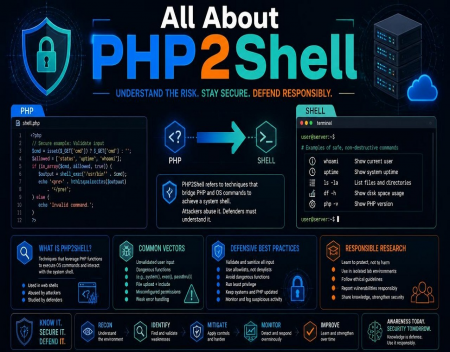
PHP is one of the most widely used programming languages on the internet. It powers millions of websites, content management systems, online stores, and web applications. Platforms such as WordPress, Drupal, and numerous custom-built websites rely on PHP to process requests and deliver dynamic content.
Unfortunately, the popularity of PHP also makes it an attractive target for cybercriminals. Vulnerabilities in PHP applications, poorly configured servers, and outdated software can provide attackers with opportunities to compromise websites.
One security term that has attracted attention is PHP2Shell. The name is associated with a class of security weaknesses and attack techniques in which an attacker can use a PHP application to execute operating system commands on the server. Understanding how these attacks work is important for website owners, developers, and server administrators.
What Is PHP2Shell?PHP2Shell generally refers to a PHP-to-shell vulnerability or exploitation technique that allows an attacker to move from interacting with a PHP application to executing commands on the underlying operating system.
The term is sometimes used broadly rather than describing one specific vulnerability. It is important to distinguish between a general PHP remote command execution weakness and a particular vulnerability or security advisory that may use a similar name.
In a typical web application, PHP code runs on a web server and responds to requests from visitors. The PHP process normally operates with restricted permissions and should only have access to the files and resources required by the application.
Problems arise when an application allows user-controlled information to influence operating system commands or other sensitive operations.
If an attacker can manipulate that information, they may be able to make the server execute commands that were never intended by the developer.
This is known as remote code execution, or RCE, when the attacker can trigger code execution remotely.
How PHP Can Interact With the Operating SystemPHP is designed to do more than generate web pages. It also provides functions that allow applications to interact with the server's operating system.
For example, developers may use PHP to perform tasks such as:
Creating and managing files.
Running background processes.
Compressing and extracting archives.
Executing maintenance utilities.
Processing uploaded documents.
Communicating with external programs.
These capabilities are useful for legitimate applications, but they can introduce security risks when used incorrectly.
Functions such as exec(), shell_exec(), system(), and passthru() can execute operating system commands. If a developer includes information supplied by a website visitor without properly validating it, an attacker may be able to manipulate the resulting command.
The underlying problem is not simply that PHP can execute commands. It is that untrusted input may be allowed to influence what the server executes.
How a PHP2Shell Attack Can HappenA typical attack begins with identifying a vulnerable PHP application.
An attacker might examine a website for outdated plugins, insecure upload functionality, exposed administrative tools, or custom PHP scripts that process user input.
If a weakness is discovered, the attacker may attempt to exploit it to execute commands on the server.
Depending on the vulnerability, successful exploitation could allow an attacker to:
Read files that the PHP process is permitted to access.
Modify website content.
Create malicious PHP scripts.
Install web shells or other backdoors.
Access database credentials stored in application files.
Collect configuration information.
Attempt to access additional systems connected to the server.
The level of access depends on the permissions available to the compromised PHP process and the security configuration of the server.
A poorly configured hosting environment can make the consequences considerably worse.
What Is a Web Shell?A web shell is a malicious script installed on a compromised website that allows an attacker to interact with the server through web requests.
In a PHP environment, a web shell may be disguised as an ordinary PHP file and placed somewhere within the website's directory structure.
Once installed, it can provide attackers with a way to execute commands, browse files, modify content, or upload additional malicious software.
Web shells are particularly dangerous because they can provide continued access even after the original vulnerability has been patched.
For example, a website owner might update an outdated plugin and assume the problem has been resolved. However, if an attacker already installed a backdoor, that access may remain available.
This is why investigating the server for suspicious files and unauthorized changes is an important part of responding to a suspected compromise.
Why WordPress Websites Can Be VulnerableWordPress is built primarily using PHP, making PHP security particularly important for WordPress administrators.
The WordPress core software is regularly updated, but many vulnerabilities originate from third-party plugins and themes.
A plugin may contain insecure file upload functionality, insufficient input validation, or an unsafe use of operating system commands. If attackers discover a weakness, they may attempt to use it to compromise websites running the affected software.
Common risk factors include:
Outdated WordPress installations.
Abandoned or poorly maintained plugins.
Themes downloaded from untrusted sources.
Weak administrative passwords.
Excessive file and directory permissions.
Insecure custom PHP scripts.
Exposed configuration files.
Poorly protected administrative accounts.
Website owners should remember that keeping WordPress updated is only one part of website security. Plugins, themes, PHP versions, server software, and database systems also need regular maintenance.
How to Protect a PHP ServerPreventing PHP command execution vulnerabilities requires a combination of secure programming practices and proper server administration.
1. Keep PHP and applications updated
Use a supported PHP version and install security updates as they become available. Update WordPress, plugins, themes, frameworks, and other software running on the server.
2. Avoid executing commands using untrusted input
Developers should avoid passing information supplied by website visitors directly into operating system commands. Whenever possible, use native PHP functions or established libraries instead of shell commands.
If command execution is genuinely necessary, inputs should be strictly validated, arguments handled safely, and operating system commands restricted to a controlled set of permitted operations.
3. Use appropriate file permissions
The PHP process should not have unnecessary access to system directories or sensitive files. Website directories should use restrictive permissions, and writable locations should be limited to those required by the application.
4. Restrict PHP capabilities where practical
Server administrators can review PHP configuration settings and disable functions that applications do not need. However, disabling functions such as exec() or shell_exec() should be treated as an additional security measure rather than a complete solution.
Some applications legitimately depend on these functions, and attackers may exploit vulnerabilities that do not require them.
5. Monitor server activity
Review web server logs, PHP error logs, authentication records, and file changes. Unexpected PHP files, unfamiliar scheduled tasks, unusual outbound connections, and unexplained changes to website content may indicate a compromise.
6. Use a web application firewall
A web application firewall can help identify and block suspicious requests before they reach vulnerable applications. It provides another layer of protection, although it cannot guarantee that every attack will be stopped.
7. Maintain reliable backups
Keep regular backups of website files, databases, and important server configurations. Store at least one backup separately from the production server so that an attacker who compromises the server cannot easily destroy every copy.
What to Do If You Suspect a PHP2Shell AttackIf you believe a PHP server has been compromised, simply updating the vulnerable software may not be enough.
The first priority should be limiting further damage. Depending on the severity of the incident, this may involve isolating the affected website or server, restricting access, and preserving relevant logs for investigation.
Administrators should examine recently modified PHP files, unfamiliar scripts, unexpected user accounts, suspicious scheduled tasks, and changes to server configuration.
Database credentials, FTP passwords, control panel credentials, and other secrets should be considered potentially exposed if the attacker had access to the relevant files. These credentials should be rotated from a clean environment.
If a web shell or other backdoor is discovered, the administrator must determine how it was installed and whether additional persistence mechanisms were created.
For important business websites, a professional security investigation may be appropriate. Restoring from a known-clean backup can sometimes be safer than attempting to remove every trace of an attacker manually.
Final ThoughtsPHP2Shell highlights an important security concern for websites and web applications: a vulnerability in a PHP script can potentially become a much larger server security problem if it allows unauthorized operating system command execution.
PHP itself is not inherently insecure. It remains a powerful and widely used programming language. The risks generally come from unsafe application code, outdated software, excessive permissions, and inadequate server protection.
For website owners and administrators, prevention requires regular updates, secure development practices, careful permission management, monitoring, and reliable backups.
As cyberattacks become increasingly sophisticated, protecting the PHP environment is essential. A single vulnerable script can provide an attacker with an opportunity to compromise an entire website, making proactive security far less expensive and disruptive than recovering from a successful attack.
Great experience with Computer Geek. They helped with my website needs and were professional, respon . . . [MORE].

Great, quick service when my laptop went into meltdown and also needed Windows 11 installed. Also ca . . . [MORE].
It was a great experience to working with you. thank you so much. . . . [MORE].
Thank you so much for great service and over all experience is good . highly recommended for all peo . . . [MORE].
We engaged The Computer Geeks in mid-2023 as they have a reputation for API integration within the T . . . [MORE].
All About PHP2Shell

What Could Replace the Mo

The Future of Smart Glass


