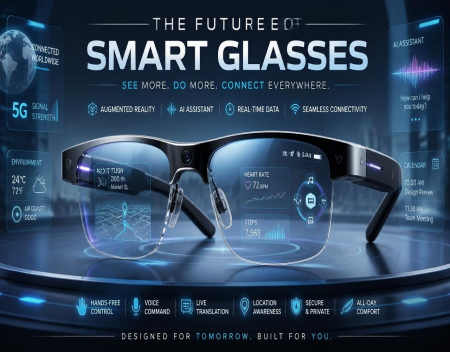
For decades, people have imagined a future where technology is integrated directly into the things they wear. Science fiction movies have shown characters using glasses to access information, communicate with others, navigate unfamiliar locations, and interact with digital environments without ever reaching for a smartphone.
That future may be closer than many people realize.
Smart glasses are evolving from experimental gadgets into increasingly sophisticated wearable computers. Modern versions can already take photographs, play audio, provide voice assistance, display notifications, and connect to artificial intelligence services. More advanced models are being developed with augmented reality displays capable of placing digital information directly into a person's field of vision.
As technology improves, smart glasses could become one of the most important developments in personal computing. They may eventually change how people communicate, work, shop, travel, and interact with the world around them.
What Are Smart Glasses?Smart glasses are wearable electronic devices designed to look and function like ordinary eyeglasses while incorporating technology.
Depending on the model, they may include cameras, microphones, speakers, wireless connectivity, touch controls, and small displays. Some are designed primarily for audio and photography, while others provide visual information through lenses or miniature projection systems.
The simplest smart glasses allow users to take pictures, listen to music, answer calls, and interact with digital assistants. More advanced models can display navigation instructions, messages, translations, and other information without requiring users to look at a smartphone.
Augmented reality is one of the most promising features. Rather than replacing the real world with a completely digital environment, augmented reality adds computer-generated information to what someone is already seeing.
For example, someone walking through a city might see navigation directions appearing over the street ahead, or a technician could view repair instructions while working on a piece of equipment.
Artificial Intelligence Will Make Smart Glasses More UsefulArtificial intelligence could be the technology that makes smart glasses truly mainstream.
Current smartphones require users to open applications, search for information, and navigate menus. AI-powered smart glasses could make many of these interactions more natural.
Imagine looking at an unfamiliar object and asking your glasses what it is. An AI assistant could analyze the image and provide an explanation. You might look at a restaurant and ask for its opening hours, menu information, or customer reviews.
Smart glasses could also help people remember information. An assistant might recognize familiar faces, retrieve relevant details from previous conversations, or remind someone about an appointment.
Real-time translation is another promising application. Someone travelling in another country could listen to a conversation in their own language while translated subtitles appear in their field of vision.
As AI systems become more capable, smart glasses could evolve into personal assistants that understand both spoken instructions and the environment around the wearer.
Could Smart Glasses Replace Smartphones?One of the biggest questions surrounding this technology is whether smart glasses could eventually replace smartphones.
Smartphones are powerful, but they require users to constantly look down at a screen. Smart glasses offer a potentially more convenient alternative by placing information directly in front of the user.
People could receive messages, check directions, make calls, take photographs, and ask questions without reaching into their pockets.
However, completely replacing smartphones will be difficult.
Modern smartphones have large displays, powerful processors, substantial storage, and batteries capable of supporting demanding applications. Putting all of these capabilities into lightweight glasses presents significant engineering challenges.
Smart glasses may initially work alongside smartphones, using them for processing, connectivity, and data storage. Over time, improvements in miniaturization and battery technology could allow more computing functions to move directly into the glasses.
The most likely outcome is a gradual transition in which smart glasses handle more everyday interactions while smartphones become less central to the experience.
Smart Glasses in Business and the WorkplaceSmart glasses could have a major impact on professional industries.
In manufacturing, employees could receive instructions, view technical diagrams, and access equipment information without stopping their work. This could improve productivity and reduce mistakes.
Technicians repairing machinery might see digital instructions displayed over the components they are working on. Remote experts could also see what the technician sees and provide guidance in real time.
Healthcare is another potential application. Medical professionals could access patient information, review medical images, or receive procedural guidance while keeping their hands free.
In logistics and warehousing, employees could receive picking instructions, locate products, and confirm inventory without carrying handheld scanners.
Construction workers and engineers could use augmented reality to compare building plans with actual structures, helping identify errors before they become expensive problems.
These professional applications may become widespread before smart glasses become a standard consumer product because businesses can measure the productivity benefits and justify the investment.
Shopping and Everyday LifeSmart glasses could also change how people shop.
Imagine walking through a store and seeing product information displayed directly beside items on the shelves. Customers might compare prices, read specifications, check availability, or receive recommendations without using a smartphone.
Online shopping could become more interactive as well. Someone considering new furniture might see a digital representation of a sofa placed in their living room before purchasing it.
Travel could become easier through automatic translation, navigation, and information about nearby attractions.
At home, smart glasses might connect to smart appliances, security cameras, lighting systems, and other connected devices. A user could check the temperature, see who is at the front door, or control household equipment through voice commands and visual interfaces.
The possibilities are extensive, although the technology will need to remain simple enough that people actually want to wear it throughout the day.
The Challenges Holding Smart Glasses BackDespite their potential, smart glasses face several significant obstacles.
Battery life: Small frames leave limited room for batteries. Supporting cameras, wireless connections, displays, and AI processing can consume considerable power.
Weight and comfort: Glasses must remain lightweight and comfortable. Consumers are unlikely to wear bulky devices throughout the day, regardless of how impressive their features might be.
Display quality: Augmented reality displays must be bright, sharp, and easy to read in different lighting conditions. They also need to work without distracting users from their surroundings.
Price: Advanced components and specialized manufacturing can make smart glasses expensive. Prices will need to become more accessible before widespread adoption is possible.
Privacy: Cameras and microphones built into glasses create concerns about people being recorded without their knowledge. Manufacturers will need clear recording indicators and strong privacy protections.
Social acceptance: People may feel uncomfortable interacting with someone wearing glasses that could be recording conversations or capturing images.
Solving these problems will be just as important as improving the technology itself.
Could Smart Glasses Become a Fashion Statement?Technology alone will not determine whether smart glasses succeed. Their appearance will matter enormously.
Traditional eyeglasses are personal accessories, and people often choose frames based on style, comfort, and appearance. Smart glasses must compete with ordinary eyewear rather than simply offering impressive technical features.
Manufacturers will likely offer different frame designs, colours, sizes, and lens options. Some models may look almost identical to conventional glasses, while others may have more futuristic designs.
Prescription lens support will also be important. If consumers can use smart glasses as their everyday eyewear, they may be more willing to adopt the technology.
The companies that successfully combine attractive designs with useful features could have a significant advantage.
What Will Smart Glasses Look Like by 2040?By 2040, smart glasses could be much smaller, lighter, and more capable than today's models.
Advances in artificial intelligence may allow them to recognize objects, understand conversations, provide instant translations, and deliver personalized information throughout the day.
Augmented reality displays could become more sophisticated, allowing digital information to appear naturally integrated with the physical environment.
Users might interact with their glasses through voice commands, subtle gestures, eye movements, or other control methods.
It is also possible that some models will operate independently, without needing a smartphone nearby.
However, the most successful products may not attempt to do everything. They may focus on a handful of useful features that make everyday activities easier without overwhelming the wearer.
Final ThoughtsSmart glasses have the potential to become one of the next major platforms in personal technology. By combining artificial intelligence, cameras, wireless connectivity, and augmented reality, they could change how people access information and interact with digital services.
They may eventually reduce our dependence on smartphones, improve workplace productivity, simplify travel, and make everyday tasks more convenient.
Significant challenges involving battery life, comfort, privacy, cost, and social acceptance remain. These issues will need to be addressed before smart glasses become as common as smartphones.
The future of computing may not involve carrying a device everywhere or constantly looking at a screen. Instead, technology could become something we wear, allowing digital information to appear exactly when and where we need it.
Great experience with Computer Geek. They helped with my website needs and were professional, respon . . . [MORE].

Great, quick service when my laptop went into meltdown and also needed Windows 11 installed. Also ca . . . [MORE].
It was a great experience to working with you. thank you so much. . . . [MORE].
Thank you so much for great service and over all experience is good . highly recommended for all peo . . . [MORE].
We engaged The Computer Geeks in mid-2023 as they have a reputation for API integration within the T . . . [MORE].
The Future of Smart Glass
The Next Evolution of Soc

Will Cash Completely Disa