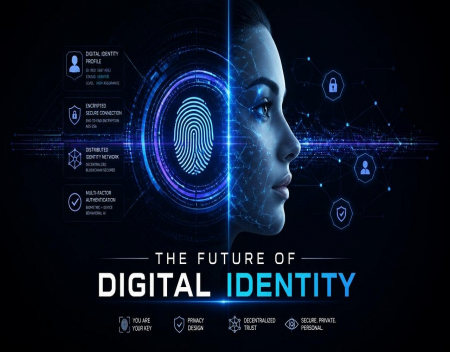
Digital identity has become an essential part of everyday life. We use it to access email accounts, manage finances, shop online, communicate with friends, access government services, and conduct business. In many ways, our digital identity is now just as important as our physical identity. Yet the systems used to prove who we are online are changing rapidly.
For years, digital identity has largely depended on usernames, passwords, security questions, and verification codes. While these methods are familiar, they have significant weaknesses. Passwords can be stolen, accounts can be hacked, and personal information can be exposed through data breaches. As technology advances, businesses and governments are exploring new ways to verify identities that are more secure, convenient, and respectful of personal privacy.
The future of digital identity could fundamentally change how people interact with the internet.
Moving Beyond PasswordsOne of the biggest changes coming to digital identity is the gradual move away from traditional passwords.
Passwords have been a basic part of internet security for decades, but they create ongoing problems. People often reuse passwords across multiple websites, choose passwords that are easy to guess, or forget them altogether. Even complicated passwords can be stolen through phishing attacks or exposed when companies suffer data breaches.
New authentication technologies are designed to make passwords less important.
Passkeys are one example. They allow users to sign in using a device's built-in security features, such as a fingerprint, facial recognition, or device PIN. Instead of sending a traditional password to a website, the device uses cryptographic technology to prove that the user is authorized to access the account.
Biometric authentication is also becoming more common. Smartphones already use fingerprints and facial recognition to unlock devices and approve payments. In the future, these technologies may become a standard way of confirming identity across a much wider range of online services.
However, biometrics are not a perfect solution. A password can be changed if compromised, but a person's fingerprint or facial characteristics cannot easily be replaced. Protecting biometric information will remain an important security challenge.
The Rise of Digital Identity WalletsAnother major development is the digital identity wallet.
A digital identity wallet is an application that stores digital credentials that can be used to prove specific facts about a person. These credentials might include a driver's licence, passport information, professional qualifications, proof of age, or government identification.
Instead of carrying physical documents or repeatedly submitting personal information to different organizations, users could present verified digital credentials directly from their smartphones.
For example, someone renting a car might use a digital driver's licence to prove they are legally allowed to drive. A person applying for a job could provide a verified professional qualification without sending copies of multiple documents. Someone purchasing an age-restricted product could prove they meet the minimum age requirement without revealing their full date of birth.
Digital identity wallets could make everyday transactions faster and reduce the amount of sensitive information people need to share.
Several governments and technology organizations are already developing systems intended to support digital credentials. The European Union, for example, has been developing its European Digital Identity Wallet initiative, which aims to give citizens and residents a secure way to identify themselves and share official documents electronically.
Self-Sovereign Identity and Personal ControlOne concept attracting considerable attention is self-sovereign identity, sometimes called decentralized identity.
Traditional digital identity systems often depend on large organizations. A bank, government agency, social media company, or technology provider may maintain information about a person and control how that information is accessed.
Self-sovereign identity proposes a different approach. Individuals would have greater control over their digital credentials and decide when and with whom to share them.
Rather than relying on a single company to manage every aspect of an identity, users could hold credentials issued by trusted organizations in a digital wallet. A university might issue a digital diploma, a government agency might issue an identity credential, and a professional organization might verify a licence.
The user could then present the appropriate credential when needed.
This approach could reduce dependence on centralized identity databases and give individuals more control over their personal information. However, it also introduces difficult questions. People need a way to recover their credentials if a device is lost, stolen, or damaged. Organizations must also agree on common technical standards so that credentials work across different systems.
The Role of Blockchain TechnologyBlockchain is frequently discussed as a possible foundation for future digital identity systems.
A blockchain is a distributed digital ledger that records information across multiple computers. Because records are protected through cryptographic methods, changing previously recorded information can be extremely difficult.
In digital identity applications, blockchain technology could help verify that credentials were issued by legitimate organizations without requiring every organization to maintain its own copy of a person's identity records.
However, a digital identity system does not necessarily need to store personal information directly on a blockchain. In fact, storing sensitive personal data permanently on a public blockchain could create serious privacy problems.
More practical approaches use cryptographic proofs, digital signatures, and decentralized identifiers. These technologies can help verify credentials while keeping the underlying personal information under the user's control.
Blockchain may play a role in some future identity systems, but it is not a universal solution. Security, privacy, usability, and compatibility will matter more than the specific technology used.
Artificial Intelligence and Identity VerificationArtificial intelligence is also changing how digital identities are verified.
AI-powered systems can analyze facial images, compare identification documents, detect suspicious login behavior, and identify unusual account activity. Financial institutions and online businesses increasingly rely on automated verification systems to help prevent fraud.
These tools could become more sophisticated as AI technology improves. For example, systems may be able to recognize patterns associated with stolen identities, synthetic identities, or fraudulent account applications.
Unfortunately, artificial intelligence also creates new threats.
Deepfake technology can generate convincing images, videos, and voices that imitate real people. Criminals can use these tools to impersonate customers, bypass poorly designed identity checks, or deceive employees into approving fraudulent transactions.
This means future identity systems will need to distinguish between genuine individuals and convincing digital imitations. Simply recognizing someone's face or voice may no longer be enough.
Stronger verification will likely combine multiple factors, including secure devices, cryptographic credentials, biometric checks, and behavioral analysis.
Privacy and the Right to Control Personal InformationAs digital identity systems become more widespread, privacy will become one of the most important issues.
Every time someone creates an online account, applies for a service, or verifies their identity, personal information may be collected and stored. Over time, this information can create a detailed picture of someone's life, including their financial activity, location, employment, shopping habits, and personal interests.
Future identity systems should aim to reduce unnecessary data collection.
One promising technology is called zero-knowledge proof. It allows someone to demonstrate that a statement is true without revealing all the information behind it.
For example, a person could prove they are over 18 without sharing their exact birth date. They could demonstrate that they meet a financial requirement without exposing their complete financial records.
This type of technology could make online verification more private while still allowing businesses and governments to confirm important information.
However, privacy protections must be built into these systems from the beginning. A digital identity should not become a tool for tracking every activity a person performs online.
The Challenges AheadDespite its potential, the future of digital identity faces several obstacles.
First, different countries and organizations must agree on standards. A digital identity credential issued in one country may not automatically be accepted by a business or government agency somewhere else.
Second, security will remain a constant concern. If a digital identity wallet becomes the key to accessing financial accounts, government services, and personal records, protecting it becomes extremely important.
Third, not everyone has access to a modern smartphone, reliable internet service, or the technical knowledge required to use digital identity tools. Governments and businesses must ensure that people can still access essential services without being forced to rely entirely on digital credentials.
There are also concerns about centralized control. If a government or private company becomes the gatekeeper for a person's digital identity, questions arise about who controls access, how mistakes are corrected, and what happens if an account is suspended.
Trust will be essential. People must understand how their information is used and have meaningful control over their identities.
Final ThoughtsThe future of digital identity will likely be very different from the username-and-password systems that have defined the internet for decades. Digital wallets, passkeys, biometric authentication, cryptographic credentials, and artificial intelligence could make identity verification faster, more secure, and more convenient.
The biggest opportunity is giving people greater control over their personal information while making it easier to prove who they are when necessary.
But convenience should never come at the expense of privacy or personal freedom. A digital identity system must be secure, accessible, transparent, and designed to protect the individual.
As more of our lives move online, the ability to prove our identity safely will become one of the most important parts of the digital world. The challenge will be building systems that allow us to trust the technology without giving up control of who we are.
Great experience with Computer Geek. They helped with my website needs and were professional, respon . . . [MORE].

Great, quick service when my laptop went into meltdown and also needed Windows 11 installed. Also ca . . . [MORE].
It was a great experience to working with you. thank you so much. . . . [MORE].
Thank you so much for great service and over all experience is good . highly recommended for all peo . . . [MORE].
We engaged The Computer Geeks in mid-2023 as they have a reputation for API integration within the T . . . [MORE].
The Future of Digital Ide
Will We Ever Build a Quan
The Evolution of Operatin