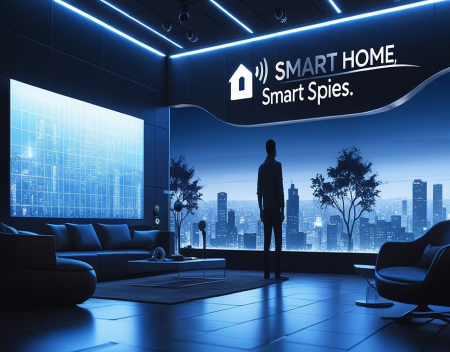
The modern smart home promises comfort, efficiency, and control. Lights adjust automatically. Thermostats learn preferences. Voice assistants answer questions, play music, and manage schedules. Doorbells recognize faces. Appliances communicate with one another seamlessly. What once felt futuristic is now ordinary. Yet behind this convenience lies an uncomfortable reality. The same systems that make homes smarter also make them more observable, vulnerable, and exposed.
Smart homes are built on constant data collection. Sensors monitor movement, temperature, sound, energy use, and device interactions. Voice assistants listen for wake words, but often record snippets of conversation. Cameras watch entrances and living spaces. These devices generate an intimate behavioral map of daily life. When people wake up, when they leave, who visits, what they say, and how they move are all potentially captured.
This data is rarely stored only within the home. Most smart devices rely on cloud services to function. Information is transmitted to remote servers for processing, analysis, and storage. While companies promise security, centralized data creates attractive targets for hackers, criminals, and unauthorized surveillance. A compromised smart home account can reveal far more than a traditional burglary ever could.
The risk is not limited to external attackers. Manufacturers and service providers themselves have access to this data. Privacy policies often allow broad usage, including product improvement, analytics, and third party sharing. Few users read these agreements in detail, and fewer still understand their implications. Consent becomes a formality rather than an informed choice.
Smart homes also blur the boundary between private and public space. Devices designed for convenience can be activated remotely. Microphones and cameras may remain functional even when users believe they are off. Updates can change behavior without clear notification. A living room becomes a monitored environment rather than a personal refuge.
Law enforcement access raises additional concerns. In some cases, companies have shared smart home data with authorities during investigations. While such cooperation can aid justice, it also sets precedents. A doorbell camera or voice assistant recording can become evidence without the homeowner ever intending it to be so. Private spaces become extensions of surveillance infrastructure.
The psychological impact is subtle but significant. Knowing that devices may be listening or watching alters behavior. Conversations become guarded. Movement becomes self conscious. Home, traditionally a place of privacy and relaxation, takes on an undercurrent of observation. The very technology meant to increase comfort introduces a low level of constant tension.
There is also the issue of digital inequality. Households with more smart devices generate more data and face greater exposure. Renters may inherit surveillance systems installed by landlords. Guests and family members are often recorded without their explicit consent. Privacy becomes fragmented, dependent on who controls the devices rather than who occupies the space.
Security updates and strong passwords can reduce risk, but they do not address the core issue. Smart homes are designed to collect data by default. The business model depends on it. Convenience is the incentive offered in exchange for access. Over time, exposure becomes normalized.
The challenge is not to abandon smart technology entirely, but to rethink its design and governance. Local data processing, clearer controls, meaningful opt out options, and strict limits on data retention can reduce harm. Transparency about what is collected and who can access it must become standard rather than exceptional.
Smart homes reflect a broader pattern in modern technology. Comfort is exchanged for visibility. Efficiency is traded for exposure. When convenience becomes the primary value, privacy becomes negotiable. The question is not whether smart homes can spy, but whether society is willing to accept that risk as the price of ease.
Great experience with Computer Geek. They helped with my website needs and were professional, respon . . . [MORE].

Great, quick service when my laptop went into meltdown and also needed Windows 11 installed. Also ca . . . [MORE].
It was a great experience to working with you. thank you so much. . . . [MORE].
Thank you so much for great service and over all experience is good . highly recommended for all peo . . . [MORE].
We engaged The Computer Geeks in mid-2023 as they have a reputation for API integration within the T . . . [MORE].
The Rise of Automation in

Why Every Business Needs

ERP Systems for Small Bus