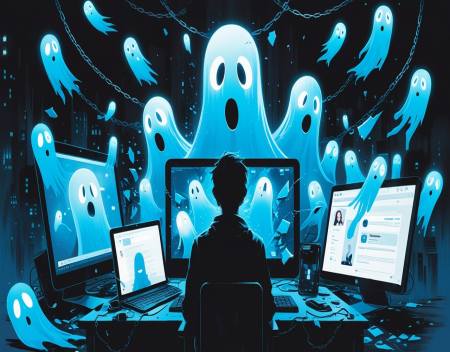
In the modern world, death no longer marks a clean ending. Long after a person’s body is buried or cremated, their digital presence often continues to exist—sometimes indefinitely. Social media profiles remain active, email accounts persist, cloud storage holds photos and messages, and algorithms continue to recommend, resurface, and even simulate aspects of the deceased. These remnants form what many now call “digital ghosts”: online identities that outlive the people who created them. As this phenomenon becomes increasingly common, it raises a complex and unsettling question. Who owns your online identity after you die?
For most of human history, legacy was physical or cultural—property, written records, or memories carried by the living. Today, however, a person’s life is deeply embedded in digital systems. A single individual may leave behind terabytes of data, including private conversations, creative work, biometric identifiers, and behavioral patterns. This data has emotional value to loved ones, legal value to estates, and financial value to corporations. The clash between these interests creates a legal and ethical gray zone that societies are only beginning to confront.
Social media platforms sit at the center of this issue. Many companies now offer “memorialization” options, allowing accounts to remain visible but frozen after death. While this can provide comfort to grieving families, it also raises questions of control. The platforms, not the families, ultimately decide what happens to these accounts. Terms of service—rarely read in full—often grant companies broad rights over user data, even after death. In effect, a person’s digital identity may become corporate property the moment their biological life ends.
This creates a troubling imbalance. On one hand, families may want access to photos, messages, or posts as part of the grieving process. On the other hand, those same accounts may contain private conversations the deceased never intended to share. Should a spouse be allowed to read private messages? Should children inherit social media accounts? The digital world collapses boundaries that death once enforced, forcing us to reconsider the meaning of privacy when the subject can no longer give consent.
The issue becomes even more complex when artificial intelligence enters the picture. AI systems are now capable of analyzing a person’s digital footprint and generating responses that mimic their speech patterns, personality, and beliefs. Some services already offer AI chatbots trained on the data of deceased loved ones, allowing people to “talk” to them after death. While this can be comforting, it also blurs the line between remembrance and replication. Is an AI-generated version of a deceased person still part of their identity, or is it something new—and potentially exploitative?
From an ethical standpoint, digital resurrection raises serious concerns. The dead cannot consent to being simulated, nor can they control how accurately—or inaccurately—they are represented. An AI trained on incomplete or biased data could distort a person’s values, opinions, or character. In extreme cases, a digital ghost could be used to promote ideas or products the real person would have opposed, effectively hijacking their identity for purposes they never approved.
Legal systems are struggling to keep up. Traditional inheritance laws were designed for physical assets, not digital ones. Some jurisdictions allow digital assets to be included in wills, but enforcement is inconsistent, especially across international platforms. Meanwhile, corporations often operate under their own rules, prioritizing intellectual property rights and data ownership over individual legacy. The result is a fragmented landscape where ownership of a digital identity depends more on corporate policy than on personal wishes.
There is also a broader societal concern. As digital ghosts accumulate, the internet becomes increasingly populated by the dead. Algorithms do not distinguish between living and deceased users unless explicitly instructed to do so. This means that digital ghosts can influence trends, memories, and narratives long after their creators are gone. Over time, this could distort collective memory, allowing the past to exert an artificial influence on the present.
So who should own your online identity after you die? One argument is that it should belong entirely to the individual, governed by clear digital wills that specify what happens to each account and dataset. Another suggests shared stewardship, where families manage emotional content while platforms retain technical control. A more radical view argues that digital identities should expire entirely, allowing people to fade from the digital world as they do from the physical one.
Ultimately, the question forces us to rethink what identity means in a digital age. If our thoughts, memories, and personalities are stored online, death no longer represents an endpoint—it becomes a transition. Whether digital ghosts are acts of remembrance or tools of exploitation will depend on the ethical frameworks we build now.
As technology continues to blur the boundary between life and legacy, one truth becomes clear. In the digital era, dying is no longer just a biological event. It is a data problem—and one humanity can no longer afford to ignore.
Great experience with Computer Geek. They helped with my website needs and were professional, respon . . . [MORE].

Great, quick service when my laptop went into meltdown and also needed Windows 11 installed. Also ca . . . [MORE].
It was a great experience to working with you. thank you so much. . . . [MORE].
Thank you so much for great service and over all experience is good . highly recommended for all peo . . . [MORE].
We engaged The Computer Geeks in mid-2023 as they have a reputation for API integration within the T . . . [MORE].
The Hidden Cost of Free A
The Psychology of Notific
Why Subscription Services