
Modern life is inseparable from smartphones. They wake us up, guide our routes, remind us of appointments, store memories, and answer questions before we even finish asking them. As these devices assume more cognitive tasks, a new concern has emerged: are smartphones making us less intelligent? The concept at the center of this debate is called cognitive offloading, the process of shifting mental tasks onto external tools. Humans have always used aids—writing, maps, calculators—but the scale and intimacy of smartphone dependence raise unique questions about memory, problem-solving, and even identity.
Cognitive offloading is not inherently harmful. In fact, it can be deeply beneficial. When we write information down or use tools to automate tasks, we free mental space for creativity and critical thinking. Smartphones perform this function incredibly well. They store massive amounts of information, giving us mental room to focus on more complex matters. They help us navigate unfamiliar areas without stress, eliminate the need to remember lengthy contact lists, and provide instant access to global knowledge. In theory, this should enhance human intelligence by removing mundane cognitive burdens.
The concern, however, lies in the trade-offs. While smartphones expand external capabilities, they may weaken internal ones. Memory is a primary example. Studies suggest that when people rely heavily on digital devices to store information, they are less likely to encode that information into long-term memory. This phenomenon, sometimes called “digital amnesia,” doesn’t mean people become unable to remember, but rather that they stop trying. When answers are a tap away, why struggle to recall them? Over time, this can subtly erode the brain’s instinct to memorize details, causing a reliance loop where the device becomes the default memory.
Navigation skills may be facing a similar decline. Before GPS, people used landmarks, maps, and intuition to navigate. Today, many follow turn-by-turn directions without ever forming a mental picture of their surroundings. If the device fails, they are often left disoriented. This raises concerns about the weakening of spatial reasoning, a fundamental part of problem-solving and cognitive development.
Even basic problem-solving may suffer. Smartphones offer immediate answers, bypassing the slow, often frustrating process of thinking deeply about a question. While this shortcut is efficient, it can discourage critical thinking. When people rely on quick online explanations rather than wrestling with complex ideas, they may miss opportunities to strengthen their analytical abilities. The device becomes not just a tool but a crutch.
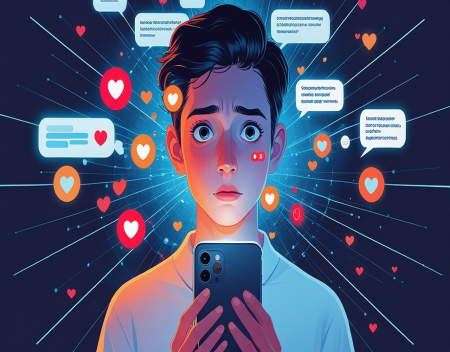
There are also emotional and psychological consequences. Constant connectivity can reduce attention spans, making sustained focus more difficult. Notifications fragment thought, pulling attention away from tasks that require depth. Over time, this can weaken the brain’s ability to stay engaged with challenging material. In extreme cases, chronic distraction may undermine both productivity and emotional well-being.
However, it would be simplistic to declare smartphones purely harmful. Intelligence is not a fixed resource but an evolving interplay between mind and environment. Offloading basic tasks to devices could enable humans to tackle more complex problems—provided the technology is used intentionally. The key lies in balance. Smartphones can be powerful tools for learning, creativity, and connection when used mindfully. They only become detrimental when they replace cognitive effort entirely.
A reasonable comparison is the introduction of calculators. Many feared students would lose basic arithmetic skills. In reality, calculators allowed people to focus on higher-level math once foundational skills were secured. The same principle can apply to smartphones—but only if we maintain active mental engagement. Using GPS is fine, but practicing navigation occasionally is still valuable. Using a search engine is efficient, but pausing to recall an answer first can strengthen memory. Setting reminders is useful, but remembering key events independently keeps the mind sharp.
Perhaps the most important question is not whether smartphones make us less intelligent but whether they shift the nature of intelligence itself. As society moves into a world where information is instantly accessible, perhaps future intelligence will be measured less by what we know and more by how well we use the tools available to us. Adaptability, discernment, creativity, and digital literacy may become the new pillars of smartness.
Cognitive offloading is unavoidable in a technological society. The challenge is ensuring we offload only what we choose to—not everything by default. Smartphones can support human intelligence or weaken it. The difference depends on whether we remain the thinkers or let the devices think in our place.
Great experience with Computer Geek. They helped with my website needs and were professional, respon . . . [MORE].

Great, quick service when my laptop went into meltdown and also needed Windows 11 installed. Also ca . . . [MORE].
It was a great experience to working with you. thank you so much. . . . [MORE].
Thank you so much for great service and over all experience is good . highly recommended for all peo . . . [MORE].
We engaged The Computer Geeks in mid-2023 as they have a reputation for API integration within the T . . . [MORE].
The Evolution of Personal
The Hidden Cost of Free A
The Psychology of Notific