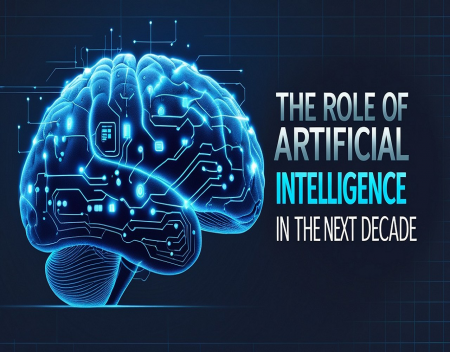
Artificial intelligence has rapidly evolved from a niche area of computer science into one of the most influential technologies of the modern era. What was once largely confined to research laboratories and science fiction has become part of everyday life. AI now helps power search engines, recommendation systems, navigation apps, customer service chatbots, language translation tools, and a growing number of business applications. As impressive as current AI systems may seem, many experts believe we are only at the beginning of a much larger transformation.
Over the next decade, artificial intelligence is expected to play an increasingly important role in nearly every aspect of society. From healthcare and education to transportation and business, AI technologies are likely to reshape industries, create new opportunities, and introduce challenges that governments, organizations, and individuals will need to address.
One of the most significant impacts of AI will likely be in the workplace. Many routine and repetitive tasks are already being automated, allowing employees to focus on higher-value activities. Over the next ten years, AI systems will likely become even more capable of handling administrative work, data analysis, scheduling, customer support, and content generation.
This does not necessarily mean that jobs will disappear entirely. History shows that technological advances often change jobs rather than eliminate them. Just as computers transformed office work rather than replacing office workers, AI may shift employee responsibilities toward oversight, decision-making, creativity, and interpersonal communication. New career paths related to AI development, management, ethics, and maintenance are also expected to emerge.
Healthcare is another area where artificial intelligence could have a profound impact. AI-powered diagnostic tools are already assisting medical professionals in analyzing medical images, identifying patterns, and supporting clinical decision-making. Future systems may help doctors detect diseases earlier, develop more personalized treatment plans, and improve patient outcomes.
AI may also play a role in drug discovery, helping researchers analyze enormous datasets and identify promising compounds more quickly than traditional methods. While human expertise will remain essential, AI could significantly accelerate medical research and innovation.
Education is likely to undergo substantial changes as well. Personalized learning systems powered by AI may adapt educational content to individual students based on their strengths, weaknesses, and learning styles. Students may receive customized explanations, practice exercises, and feedback designed specifically for their needs.
Teachers could benefit from AI tools that help automate grading, lesson planning, and administrative tasks, allowing them to spend more time interacting directly with students. However, educators will need to ensure that technology enhances learning rather than replacing important human elements of education.
Transportation may experience some of the most visible changes. Advances in artificial intelligence are expected to improve vehicle safety, traffic management, logistics, and navigation systems. While fully autonomous vehicles remain a complex challenge, AI-assisted driving technologies are becoming increasingly sophisticated and may continue reducing accidents caused by human error.
Businesses of all sizes are expected to adopt AI tools more extensively. Small businesses may gain access to capabilities that were once available only to large corporations, including advanced analytics, automated customer support, marketing optimization, and content creation. This democratization of technology could increase competition and innovation across many industries.
Cybersecurity will also become increasingly dependent on artificial intelligence. Security systems already use machine learning to detect suspicious activity, identify malware, and respond to threats more quickly than traditional methods. As cyberattacks grow more sophisticated, AI may become one of the most important tools for protecting digital infrastructure.
At the same time, cybercriminals are beginning to use AI as well. This creates an ongoing technological arms race in which defenders and attackers continuously develop more advanced techniques. The next decade will likely see significant advancements on both sides.
Consumer technology will continue evolving through AI integration. Virtual assistants, smart home systems, wearable devices, and personal productivity tools are expected to become more intelligent and capable. Instead of simply responding to commands, future systems may proactively assist users by anticipating needs and offering relevant recommendations.
The creative industries are also experiencing major changes. AI can already generate images, music, videos, software code, and written content. Over the next decade, these capabilities will likely improve dramatically. Rather than replacing human creativity, many professionals may use AI as a collaborative tool that enhances productivity and expands creative possibilities.
However, the growing influence of artificial intelligence also raises important concerns. Privacy, bias, transparency, accountability, and security will remain central issues. AI systems are only as reliable as the data and design choices behind them. Ensuring fairness and preventing misuse will require ongoing attention from developers, regulators, and society as a whole.
Questions about employment, data ownership, intellectual property, and decision-making authority are also likely to become increasingly important. Policymakers around the world will face difficult decisions about how to regulate AI while still encouraging innovation and economic growth.
Another challenge involves public trust. As AI systems become more capable, people will need confidence that these technologies operate safely and responsibly. Transparency regarding how AI systems make decisions may become a critical factor in maintaining that trust.
Despite these challenges, artificial intelligence has the potential to become one of the most transformative technologies of the twenty-first century. Like previous technological revolutions involving electricity, automobiles, and the internet, AI is expected to reshape society in ways that are difficult to fully predict today.
The next decade will likely be defined not by whether artificial intelligence becomes important, but by how effectively individuals, businesses, and governments adapt to its growing influence. Those who learn to work alongside AI, understand its capabilities, and recognize its limitations will be better positioned to benefit from the opportunities it creates.
As artificial intelligence continues to mature, its role will extend far beyond simple automation. It is poised to become a fundamental tool for problem-solving, innovation, and productivity across nearly every sector of society. The coming years may reveal that the AI revolution is not merely another technological trend, but one of the defining developments of the modern age.
Great experience with Computer Geek. They helped with my website needs and were professional, respon . . . [MORE].

Great, quick service when my laptop went into meltdown and also needed Windows 11 installed. Also ca . . . [MORE].
It was a great experience to working with you. thank you so much. . . . [MORE].
Thank you so much for great service and over all experience is good . highly recommended for all peo . . . [MORE].
We engaged The Computer Geeks in mid-2023 as they have a reputation for API integration within the T . . . [MORE].
The Future of Television
How Streaming Changed Ent

Digital Minimalism in a C