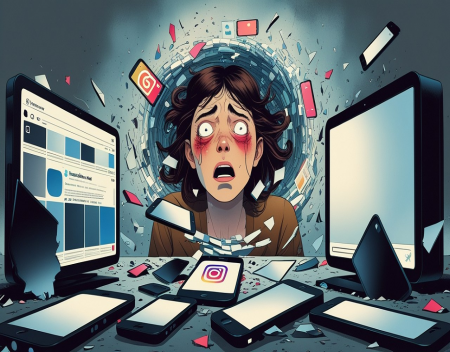
We are living in an era where content is no longer scarce. With the rise of platforms like TikTok, YouTube, and Netflix, the modern individual has access to an effectively endless stream of videos, shows, music, and ideas. At any given moment, there is always something new to watch, scroll, or listen to. While this abundance might seem like a golden age of entertainment and expression, it comes with a hidden cost—one that is cultural, psychological, and deeply human.
One of the most immediate consequences of infinite content is the erosion of shared cultural experiences. In previous decades, large audiences gathered around the same television broadcasts, movies, or songs. Moments were collective. Entire generations could reference the same scenes, characters, or events because they experienced them together. Today, content consumption is fragmented. Algorithms tailor feeds so precisely that no two people experience culture in quite the same way. While personalization increases engagement, it reduces the sense of cultural unity. The idea of a “common culture” begins to dissolve into millions of individualized streams.
This shift is driven largely by recommendation systems, which prioritize content based on engagement metrics rather than cultural value. These systems are designed to keep users watching, not necessarily to expose them to meaningful or challenging material. As a result, content that is quick, emotionally stimulating, or addictive tends to rise to the top. Over time, this creates a feedback loop where creators are incentivized to produce material that fits these patterns, often at the expense of depth, originality, or nuance. Culture becomes shaped not by artistic vision, but by algorithmic preference.
Another major cost is the shortening of attention spans. Infinite content encourages constant switching—one video after another, one episode after the next. The moment something feels slow or demanding, there is always an alternative just a swipe away. This conditions the brain to expect immediate stimulation and reduces the patience required for more complex or demanding forms of art. Long novels, slow films, and thoughtful discussions begin to feel less accessible, not because they have lost value, but because our habits have changed. The result is a cultural environment that favors immediacy over reflection.
The pressure on creators is equally significant. In a world of infinite content, visibility becomes the ultimate currency. Standing out in an ocean of material requires constant production, adaptation, and optimization. Many creators find themselves trapped in a cycle of chasing trends, analyzing metrics, and adjusting their work to fit algorithmic expectations. This can lead to burnout and a loss of creative identity. Instead of creating what they truly want to express, creators often produce what they believe will perform well. The line between art and content becomes increasingly blurred.
There is also a paradox at the heart of infinite content: more choice does not always lead to more satisfaction. In fact, it can have the opposite effect. When faced with endless options, people often struggle to decide what to engage with, leading to decision fatigue. Even after choosing something, there is a lingering sense that a better option might exist elsewhere. This can diminish the enjoyment of the content itself, turning consumption into a restless and unsatisfying experience. The abundance that promises fulfillment instead creates a subtle form of anxiety.
Culturally, infinite content can lead to homogenization. While it appears that there is more diversity than ever, algorithmic systems often push similar types of content because they have proven to perform well. Trends spread rapidly, and creators across the world begin to replicate the same formats, styles, and ideas. What starts as diversity gradually converges into repetition. Unique voices can struggle to break through unless they conform to established patterns, limiting the true range of cultural expression.
At the same time, infinite content does offer undeniable benefits. It democratizes creation, allowing individuals from all backgrounds to share their voices and reach global audiences. Niche communities can form around specific interests, fostering connections that would have been impossible in earlier eras. The problem is not the existence of infinite content itself, but the systems that govern how it is distributed and consumed.
The cultural cost, then, lies in imbalance. When quantity overwhelms quality, when algorithms overshadow intention, and when consumption replaces reflection, something essential is lost. Culture is not just about what is available, but about what is valued, shared, and remembered. Infinite content risks turning culture into a constant stream of disposable moments rather than a collection of meaningful experiences.
Moving forward, the challenge will be finding ways to engage with this abundance more consciously. This might involve curating our own consumption, supporting creators who prioritize depth over virality, and seeking out experiences that require time and attention. It may also require greater transparency and responsibility from the platforms that shape our digital environments.
In the end, infinite content is both a gift and a burden. It expands what is possible while quietly reshaping how we think, feel, and connect. The question is not whether we will continue to produce and consume more content—we will—but whether we can do so in a way that preserves the richness and depth that make culture worth having in the first place.
Great experience with Computer Geek. They helped with my website needs and were professional, respon . . . [MORE].

Great, quick service when my laptop went into meltdown and also needed Windows 11 installed. Also ca . . . [MORE].
It was a great experience to working with you. thank you so much. . . . [MORE].
Thank you so much for great service and over all experience is good . highly recommended for all peo . . . [MORE].
We engaged The Computer Geeks in mid-2023 as they have a reputation for API integration within the T . . . [MORE].

How Technology Is Changin
What Comes After Silicon

The Future of Batteries