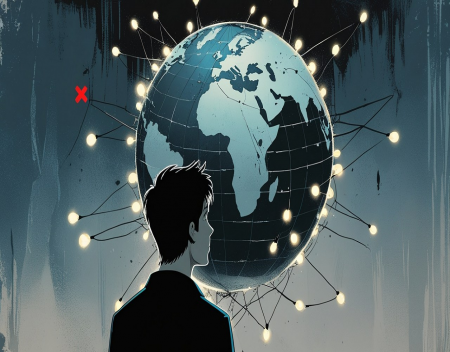
For much of its history, the internet was defined by openness. Anyone could create a website, publish ideas, and reach a global audience with relatively few barriers. The World Wide Web was built on decentralized principles, allowing information to flow freely across borders and platforms. Today, however, many observers argue that this open internet is gradually shrinking. While it has not disappeared, the way people access and interact with it is changing in ways that concentrate control and limit visibility.
One of the most significant drivers of this shift is the rise of centralized platforms. Apps like Facebook and TikTok have become primary gateways to content. Instead of browsing independent websites, users spend much of their time within these ecosystems, where content is curated and delivered through algorithms. While this provides convenience and personalization, it also means that a large portion of online activity is mediated by a handful of companies.
These platforms operate as closed environments, often referred to as “walled gardens.” Content within them is not always easily accessible from the broader web, and interactions are governed by platform-specific rules. This limits the openness that once defined the internet, as visibility depends on algorithmic decisions rather than direct access. Creators who rely on these platforms must adapt to changing policies and algorithms, which can affect their reach and influence without warning.
Another factor contributing to the shrinking open internet is the evolution of search and discovery. Advances in Artificial Intelligence are changing how people find information. Instead of navigating through multiple websites, users can now receive direct answers generated by AI systems. While this increases efficiency, it reduces the need to explore the web itself. Content is still being created, but it is often consumed through intermediaries rather than visited directly.
Economic incentives also play a role. Running a website requires resources, and many content creators rely on advertising or subscriptions to sustain their work. As traffic shifts toward platforms and AI-driven interfaces, traditional revenue models become less reliable. This can discourage the creation of independent websites and push creators toward platforms that offer built-in audiences and monetization tools. Over time, this consolidates content within fewer spaces.
Regulation and policy changes are another contributing factor. Governments around the world are increasingly involved in regulating online content, data privacy, and platform behavior. While many of these regulations are designed to protect users, they can also create barriers for smaller websites and independent creators. Compliance requirements may be easier for large companies to meet, further reinforcing their dominance.
There is also a cultural shift in how people use the internet. For many users, especially younger generations, the idea of “surfing the web” has been replaced by scrolling through feeds or interacting with apps. The habit of exploring independent sites, following links, and discovering new content organically is less common. Instead, content is delivered in a continuous stream, shaped by algorithms that prioritize engagement.
Security and privacy concerns have also influenced the structure of the internet. As cyber threats increase, users and organizations are more cautious about where they share information and how they interact online. This has led to the growth of private communities, encrypted messaging platforms, and restricted-access content. While these developments enhance security, they also reduce the openness and accessibility of the broader web.
Despite these trends, it is important to recognize that the open internet is not disappearing entirely. Millions of websites still exist, and new ones are created every day. Open standards, protocols, and communities continue to support the foundational principles of the web. However, the way people engage with this open layer is changing, and its relative influence is diminishing compared to more controlled environments.
There are also efforts to preserve and expand the open internet. Open-source projects, decentralized platforms, and alternative publishing models aim to maintain the accessibility and independence that have long defined the web. These initiatives face challenges, particularly in competing with the scale and convenience of major platforms, but they represent an important counterbalance.
Ultimately, the shrinking of the open internet is not a single event, but a gradual shift driven by technology, economics, and user behavior. It reflects a tension between convenience and control, efficiency and openness. Centralized systems offer streamlined experiences, but they come at the cost of reduced independence and diversity.
The future of the internet will likely involve a balance between these forces. The open web may become less dominant, but it will remain a critical foundation for innovation, expression, and access to information. Preserving its core values will require conscious effort from developers, creators, and users alike.
In the end, the open internet is not just a technical system—it is an idea. Whether it continues to thrive depends on how that idea is supported and adapted in a rapidly changing digital landscape.
Great experience with Computer Geek. They helped with my website needs and were professional, respon . . . [MORE].

Great, quick service when my laptop went into meltdown and also needed Windows 11 installed. Also ca . . . [MORE].
It was a great experience to working with you. thank you so much. . . . [MORE].
Thank you so much for great service and over all experience is good . highly recommended for all peo . . . [MORE].
We engaged The Computer Geeks in mid-2023 as they have a reputation for API integration within the T . . . [MORE].
The Evolution of Personal

The Hidden Cost of Free A

The Psychology of Notific