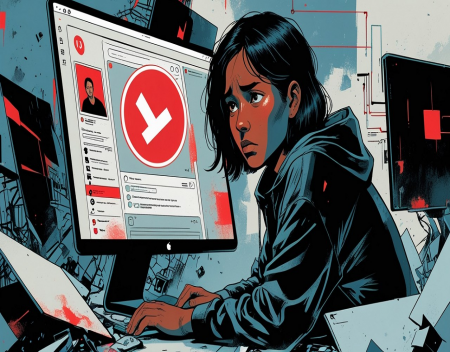
In the digital age, access to online platforms has become closely tied to participation in public life. Social media platforms such as X, Facebook, and YouTube are no longer just tools for communication—they function as modern public squares, marketplaces of ideas, and gateways to influence. When individuals or groups are banned from these platforms, the consequences can extend far beyond the loss of an account. In many cases, it amounts to a form of digital exile, raising complex political, ethical, and societal questions.
Platform bans are typically justified as necessary measures to enforce community guidelines. These rules are designed to limit harmful behavior such as harassment, misinformation, or incitement to violence. In principle, moderation is essential. Without it, platforms can become chaotic, unsafe, and dominated by the loudest or most extreme voices. However, the power to ban users places enormous authority in the hands of private companies. These companies effectively determine who gets to speak, who gets amplified, and who is removed from the conversation.
This concentration of power is one of the central political issues surrounding platform bans. Unlike governments, which are subject to public accountability and legal constraints, technology companies operate with a mix of internal policies and external pressures. Their decisions can be influenced by public opinion, advertiser concerns, or political environments, but they are not always transparent or consistent. As a result, bans can sometimes appear arbitrary or unevenly applied, leading to accusations of bias or censorship.
The concept of digital exile becomes particularly significant when considering the role these platforms play in shaping visibility. For many individuals, especially journalists, activists, and creators, social media is a primary means of reaching an audience. Being banned can sever that connection almost instantly. It can mean losing followers, income, and influence, often without a clear path to appeal or reinstatement. In extreme cases, it can effectively remove a person from public discourse, even if they remain active elsewhere.
At the same time, the issue is not simply about individual rights. Platform bans also intersect with broader societal concerns about harm and responsibility. Misinformation campaigns, coordinated harassment, and extremist content can have real-world consequences. Platforms face pressure to act quickly and decisively to prevent such harms, especially during sensitive moments like elections or public health crises. In these contexts, bans can be seen as protective measures rather than punitive ones.
The tension lies in balancing these competing priorities. On one hand, there is a need to protect users and maintain a healthy information environment. On the other, there is a risk of overreach, where moderation decisions suppress legitimate expression or disproportionately affect certain groups. This balance is difficult to achieve, particularly at the scale of global platforms where cultural norms and legal standards vary widely.
Another layer of complexity comes from the lack of clear alternatives. While banned users can sometimes move to smaller or decentralized platforms, these spaces often lack the reach and influence of major networks. This creates a kind of digital hierarchy, where a few dominant platforms hold the majority of attention and engagement. Being excluded from them is not just an inconvenience—it is a significant loss of social and cultural capital.
There is also the question of due process. In traditional legal systems, penalties are typically accompanied by clear procedures, evidence, and opportunities for defense. Platform bans, by contrast, can be implemented rapidly, sometimes with limited explanation. While some companies have introduced appeal mechanisms or oversight boards, these systems are still evolving and do not always provide the level of transparency or accountability that users expect.
From a political perspective, platform bans can influence narratives and power dynamics. Removing a prominent figure from a platform can reduce their visibility and impact, potentially altering public discourse. At the same time, bans can also reinforce certain narratives, such as claims of suppression or bias, which may resonate with specific audiences. In this way, moderation decisions can have unintended political consequences, shaping not just what is said, but how it is perceived.
Looking ahead, the politics of platform bans will likely become even more prominent as digital spaces continue to expand. Governments may seek greater regulatory control, while platforms may develop more sophisticated moderation tools. There may also be increased interest in decentralized or user-governed platforms that distribute decision-making more broadly.
Ultimately, the issue of digital exile highlights a fundamental shift in how power operates in the modern world. Access to communication platforms is no longer just a matter of convenience—it is a key component of participation in society. As such, decisions about who is allowed to remain in these spaces carry significant weight.
The challenge is not simply to decide when bans are justified, but to create systems that are fair, transparent, and accountable. Because in a world where so much of life takes place online, being excluded from digital spaces is not just about losing a platform—it is about losing a voice.
Great experience with Computer Geek. They helped with my website needs and were professional, respon . . . [MORE].

Great, quick service when my laptop went into meltdown and also needed Windows 11 installed. Also ca . . . [MORE].
It was a great experience to working with you. thank you so much. . . . [MORE].
Thank you so much for great service and over all experience is good . highly recommended for all peo . . . [MORE].
We engaged The Computer Geeks in mid-2023 as they have a reputation for API integration within the T . . . [MORE].

ERP Systems for Small Bus

CRM Software Explained
The Future of Digital Pay