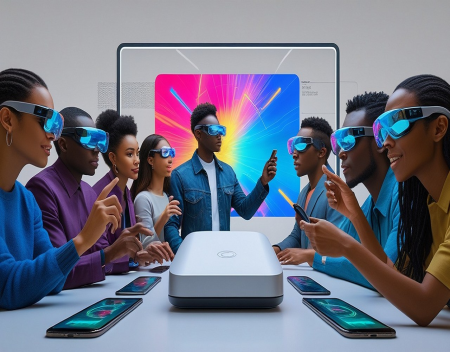
The relationship between humans and computers has changed dramatically over the past several decades. Early computers required users to enter commands through punch cards or complex command-line interfaces that only trained specialists could operate. Today, nearly everyone interacts with computers using touchscreens, voice assistants, wireless devices, and increasingly sophisticated artificial intelligence. As technology continues to evolve, the way people communicate with computers is likely to change just as dramatically over the next decade.
Human-computer interaction, often referred to as HCI, is the study and design of how people communicate with digital systems. Its goal is to make technology more natural, efficient, and accessible. Rather than forcing people to learn complicated computer commands, modern design focuses on making computers adapt to the way humans naturally think and communicate.
One of the biggest changes in recent years has been the rise of conversational interfaces. Voice assistants and AI-powered chat systems allow users to ask questions or issue commands using everyday language instead of clicking through menus or memorizing commands. Instead of searching through multiple websites or navigating complex software, users can increasingly describe what they want and allow AI systems to perform much of the work.
This trend is expected to continue. Future computers may rely less on traditional icons, menus, and buttons, replacing them with intelligent assistants capable of understanding context, preferences, and natural conversation. Rather than opening several different applications to complete a project, users may simply explain their goal while the computer coordinates the necessary tasks behind the scenes.
Artificial intelligence will likely become the foundation of future human-computer interaction. Instead of waiting for users to issue every command, AI systems may anticipate needs based on context and previous behavior. For example, a computer might prepare documents before a scheduled meeting, organize files automatically, summarize emails, or suggest useful information without being asked.
These proactive systems could significantly improve productivity by reducing repetitive work. Rather than acting solely as tools, computers may increasingly function as digital assistants that collaborate with users throughout the day.
Voice recognition technology is also becoming more accurate and capable. While typing remains essential for many tasks, voice interaction continues to improve rapidly. Future systems may allow users to dictate reports, edit documents, control software, and perform complex operations entirely through natural conversation.
This evolution could make technology more accessible for individuals with physical disabilities, visual impairments, or limited mobility. It may also simplify computing for users who are less comfortable with traditional interfaces.
Gesture recognition represents another promising area of development. Cameras and sensors are becoming capable of interpreting hand movements, facial expressions, eye movements, and body language. Rather than relying exclusively on keyboards and mice, users may interact with digital content using simple gestures.
Virtual reality and augmented reality could further transform how people interact with computers. Instead of viewing information on flat screens, users may work with digital objects positioned within three-dimensional environments. Architects could manipulate building designs in virtual space, engineers could inspect machinery using augmented reality overlays, and medical professionals could visualize complex anatomical structures during procedures.
These immersive technologies may eventually reduce dependence on traditional monitors for certain types of work, although conventional displays will likely remain practical for many everyday tasks.
Wearable technology is expected to play an increasingly important role as well. Smart glasses, advanced smartwatches, health-monitoring devices, and lightweight augmented reality systems could provide continuous access to information without requiring users to constantly interact with smartphones or computers.
Rather than pulling out a phone to check directions, receive notifications, or translate languages, users may receive this information seamlessly through wearable devices integrated into their daily lives.
Brain-computer interfaces represent one of the most ambitious areas of research. Scientists are exploring methods that allow computers to communicate directly with the human nervous system. Current research primarily focuses on helping individuals with paralysis or neurological disorders regain communication and control over assistive devices.
Although consumer brain-computer interfaces remain in the early stages of development, future advances could eventually allow more direct interaction between humans and computers. Such technology would require significant breakthroughs in neuroscience, engineering, safety, and ethics before becoming widely available.
Accessibility will remain a major focus of future interface design. Advances in artificial intelligence are making computers more capable of recognizing speech, describing images, translating languages in real time, generating captions, and adapting interfaces to meet individual user needs. These improvements can make technology more inclusive for people with a wide range of abilities.
Personalization is also expected to become increasingly sophisticated. Rather than presenting identical interfaces to every user, future operating systems may automatically adapt layouts, shortcuts, recommendations, and workflows based on individual preferences and work habits. Computers may learn which tools users rely on most frequently and present information in ways that improve efficiency.
Despite these exciting developments, several challenges remain. Privacy will become increasingly important as computers collect more contextual information to improve personalization. Users will need confidence that personal data is being handled securely and transparently.
Security will also become more complex. As interfaces rely more heavily on voice recognition, facial recognition, biometric authentication, and AI decision-making, protecting these systems from misuse will be essential.
Another challenge involves maintaining human control. As artificial intelligence becomes more capable of making decisions and automating tasks, designers must ensure that users remain informed and able to override automated systems when necessary. Convenience should never come at the expense of transparency or accountability.
The future of human-computer interaction is not simply about faster processors or better graphics. It is about creating technology that feels more intuitive, responsive, and capable of understanding human intentions. Computers are gradually shifting from machines that require detailed instructions to systems that can interpret goals, provide intelligent assistance, and collaborate with users in increasingly natural ways.
While keyboards, mice, and touchscreens are unlikely to disappear entirely, they may eventually become just one of many ways people communicate with technology. Voice, gestures, augmented reality, wearable devices, and artificial intelligence are all expanding the possibilities for how humans and computers interact.
As these technologies continue to mature, the boundary between people and the digital world may become increasingly seamless. The ultimate goal of human-computer interaction is not to make humans think more like computers, but to make computers understand humans more naturally. If current trends continue, the next decade could bring some of the most significant changes in computing since the invention of the graphical user interface itself.
Great experience with Computer Geek. They helped with my website needs and were professional, respon . . . [MORE].

Great, quick service when my laptop went into meltdown and also needed Windows 11 installed. Also ca . . . [MORE].
It was a great experience to working with you. thank you so much. . . . [MORE].
Thank you so much for great service and over all experience is good . highly recommended for all peo . . . [MORE].
We engaged The Computer Geeks in mid-2023 as they have a reputation for API integration within the T . . . [MORE].
The Hidden Cost of Free A
The Psychology of Notific
Why Subscription Services