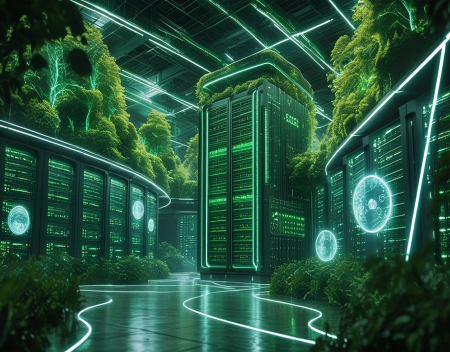
The digital world may seem almost invisible, but the technology behind it has a very real physical footprint. Every website we visit, video we stream, file we upload, and artificial intelligence system we use depends on computers, networking equipment, storage systems, and data centers.
All of that equipment requires electricity.
As cloud computing, artificial intelligence, streaming services, and connected devices continue to grow, the amount of energy required to operate the world's digital infrastructure is becoming an increasingly important issue. This has led to growing interest in green data centers and sustainable computing.
The goal isn't to stop using technology. Instead, the goal is to find ways to make technology more energy efficient while reducing its environmental impact.
What Is a Green Data Center?A green data center is a facility designed and operated with energy efficiency and environmental sustainability in mind.
Traditional data centers can consume enormous amounts of electricity because they contain thousands of computers operating continuously. They also require significant cooling systems to remove the heat generated by that equipment.
Green data centers attempt to reduce this environmental impact through more efficient hardware, improved cooling, renewable energy, better building design, and smarter management systems.
Even small improvements can have a significant effect when applied to facilities operating around the clock.
Why Data Centers Use So Much EnergyServers are the primary source of electricity consumption inside a data center, but they aren't the only ones.
Electricity is also required for:
Cooling can represent a significant portion of a facility's energy consumption.
Thousands of powerful processors operating continuously generate substantial amounts of heat. That heat has to be removed to keep equipment operating safely.
As servers become more powerful, particularly those used for artificial intelligence, cooling requirements can become even more demanding.
Renewable EnergyOne of the most important strategies for creating greener data centers is using renewable energy.
Solar, wind, hydroelectric, and other renewable sources can reduce dependence on electricity generated from fossil fuels.
Some technology companies purchase renewable energy directly or enter into agreements with renewable energy producers.
Others build facilities in regions where large amounts of renewable electricity are available.
For example, a data center located in an area with abundant hydroelectric power may have access to relatively low-carbon electricity compared with a facility operating primarily on fossil-fuel-generated electricity.
The source of electricity therefore matters almost as much as the amount of electricity being consumed.
More Efficient ServersComputer hardware continues to become more powerful and energy efficient.
Modern processors can perform significantly more calculations using less electricity than older generations of hardware.
Data centers can improve efficiency by replacing outdated servers with newer equipment.
However, simply buying new hardware isn't always the answer. Producing computers requires raw materials, manufacturing, transportation, and energy.
The most sustainable approach is therefore often a balance between using efficient modern hardware and maximizing the useful lifespan of existing equipment.
Smarter CoolingCooling technology is undergoing significant changes.
Traditional data centers often rely heavily on air conditioning and large ventilation systems.
Newer facilities can use more efficient approaches, including advanced airflow management and liquid cooling.
Liquid cooling is particularly important for artificial intelligence infrastructure.
High-performance AI processors can generate enormous amounts of heat. Moving heat away from these processors with liquid can be considerably more efficient than relying entirely on air.
Better cooling doesn't just reduce energy consumption. It can also allow data centers to operate higher-density computing equipment in smaller spaces.
Using Outside AirIn some geographic locations, data centers can take advantage of naturally cool outdoor air.
Instead of relying entirely on mechanical refrigeration, facilities can use outside air to help cool equipment when environmental conditions are suitable.
This technique is sometimes called free cooling or economization.
A facility located in a naturally cold climate may be able to reduce its cooling requirements significantly during certain parts of the year.
This is one reason location is an important consideration when building a data center.
Reducing Water ConsumptionEnergy isn't the only environmental concern.
Some data centers use significant quantities of water as part of their cooling systems.
As water becomes increasingly important in regions experiencing drought or water shortages, reducing data center water consumption is becoming a major consideration.
Operators are experimenting with more efficient cooling systems, closed-loop systems, and technologies that reduce dependence on fresh water.
The environmental impact of a data center therefore needs to be evaluated beyond simply looking at its electricity usage.
Artificial Intelligence Creates New ChallengesArtificial intelligence is changing the sustainability conversation.
Training and operating advanced AI models can require substantial amounts of computing power.
AI processors are often extremely powerful and can consume significant amounts of electricity.
Large AI systems may require thousands of specialized processors operating simultaneously.
This creates additional demand for electricity, cooling, networking, and data center capacity.
At the same time, AI could potentially help improve sustainability.
AI systems can analyze data center operations and optimize cooling, predict equipment failures, balance workloads, and reduce wasted computing capacity.
In other words, AI is both part of the energy challenge and potentially part of the solution.
Making Software More EfficientSustainable computing isn't only about hardware.
Software efficiency matters too.
Poorly designed software can require unnecessary computing power. Inefficient applications may consume more processor time, memory, storage, and network bandwidth than necessary.
Developers can reduce energy consumption by optimizing code, minimizing unnecessary processing, reducing data transfers, and designing applications that use resources efficiently.
A small improvement in software efficiency can become significant when that software is running on thousands or millions of devices.
Extending Hardware LifespansOne of the simplest ways to make computing more sustainable is to avoid replacing hardware unnecessarily.
Manufacturing computers requires raw materials and energy.
If a device can continue operating effectively, keeping it in service longer can reduce the environmental impact associated with manufacturing a replacement.
Businesses can also refurbish and repurpose older equipment.
Servers that are no longer suitable for demanding applications may still be useful for less intensive workloads.
Responsible recycling is also important when hardware reaches the end of its useful life.
Sustainable Cloud ComputingCloud computing can actually improve efficiency in certain circumstances.
A traditional business might operate its own servers at relatively low utilization. The machines still consume electricity even when they aren't doing much work.
Large cloud providers can consolidate workloads across enormous facilities and dynamically allocate computing resources where they are needed.
This can potentially result in better hardware utilization.
However, cloud computing isn't automatically environmentally friendly.
The environmental impact depends on the efficiency of the data centers, the source of their electricity, the hardware being used, and how efficiently customers use the resources.
Reducing Digital WasteThere is also a less obvious form of sustainability: reducing unnecessary digital information.
Businesses often keep enormous quantities of old files, duplicate data, outdated backups, unused accounts, and other information indefinitely.
All of that data requires storage.
Deleting information that no longer has business or legal value can reduce storage requirements and potentially reduce the infrastructure needed to maintain it.
Good data management can therefore be part of a company's sustainability strategy.
Measuring SustainabilityBusinesses need accurate measurements to determine whether their sustainability efforts are actually working.
Data center operators can track electricity consumption, cooling efficiency, water usage, renewable energy use, hardware utilization, and other metrics.
One commonly discussed measurement is Power Usage Effectiveness, or PUE, which compares the total energy used by a data center with the energy consumed by its computing equipment.
A lower PUE generally indicates that less energy is being spent on supporting infrastructure relative to the computing equipment itself.
Metrics like these allow operators to identify areas where improvements can be made.
The Future of Sustainable ComputingSustainability is likely to become increasingly important as the world's dependence on computing continues to grow.
Future data centers will likely use more efficient processors, advanced liquid cooling, renewable energy, automated power management, and increasingly sophisticated monitoring systems.
Computing may also become more distributed.
Edge computing can allow certain workloads to be processed closer to where data is generated, potentially reducing the amount of information that needs to travel long distances to centralized data centers.
At the same time, advances in chip design and software optimization could allow more computing to be performed using less energy.
Final ThoughtsTechnology has become an essential part of modern life, but that doesn't mean its environmental impact should be ignored.
Green data centers and sustainable computing offer ways to reduce the energy, water, and material requirements associated with our increasingly digital world.
The challenge will become even greater as artificial intelligence, cloud computing, streaming, and connected devices continue expanding.
There is no single solution.
Sustainable computing will require more efficient hardware, better software, renewable energy, improved cooling, responsible data management, longer hardware lifespans, and smarter use of computing resources.
The goal isn't to use less technology.
It's to make the technology we use more efficient and more sustainable.
The future of computing will undoubtedly require more processing power and more data storage. The real challenge is ensuring that the digital world can continue growing without creating an equally massive increase in its environmental footprint.
Great experience with Computer Geek. They helped with my website needs and were professional, respon . . . [MORE].

Great, quick service when my laptop went into meltdown and also needed Windows 11 installed. Also ca . . . [MORE].
It was a great experience to working with you. thank you so much. . . . [MORE].
Thank you so much for great service and over all experience is good . highly recommended for all peo . . . [MORE].
We engaged The Computer Geeks in mid-2023 as they have a reputation for API integration within the T . . . [MORE].
The Evolution of Personal
The Hidden Cost of Free A

The Psychology of Notific