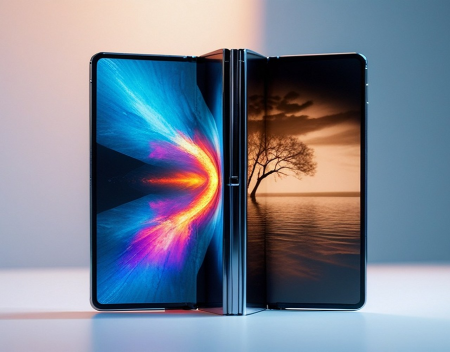
For decades, the basic design of the smartphone barely changed. Phones became faster, thinner, and more powerful, but the basic formula remained the same: a rectangular device with a glass screen on the front.
Foldable phones challenged that formula.
Instead of accepting that a smartphone has to be a fixed rectangle, manufacturers began developing displays that can bend and fold. The result is a new category of mobile devices that can transform from a traditional smartphone into something resembling a small tablet, or in some designs, fold down into a much smaller device.
But are foldable phones simply an expensive technology trend, or do they represent the future of smartphones?
What Is a Foldable Phone?A foldable phone uses a flexible display that allows part or all of the device to fold.
There are two major designs.
The first is the book-style foldable. It looks like a conventional smartphone when closed but opens vertically to reveal a much larger screen. When opened, the device can provide a tablet-like experience while still fitting into a pocket when closed.
The second design is the flip phone. It resembles the classic flip phones of the past, but instead of a small screen and keypad, it contains a large flexible display. The phone folds vertically, making it significantly smaller when closed.
Both designs attempt to solve the same basic problem: how can manufacturers provide a larger display without making the phone itself permanently larger?
More Screen in Your PocketThe biggest advantage of foldable phones is obvious: more screen space.
A traditional smartphone can only get so large before it becomes uncomfortable to carry.
A foldable device can provide a much larger display when needed while remaining relatively compact when folded.
This can be particularly useful for watching videos, browsing websites, reading documents, viewing photographs, and working with multiple applications.
A book-style foldable can essentially function as a smartphone and small tablet in one device.
For people who frequently use their phones for productivity, that extra screen space can be extremely useful.
MultitaskingLarge foldable displays also make multitasking more practical.
On a conventional smartphone, switching between applications can become tedious.
A larger foldable display can allow two applications to appear simultaneously. You might have a web browser open alongside a messaging application, or a document displayed beside an email.
This makes foldable phones particularly interesting for business users and people who use their smartphones as productivity devices.
As software becomes better optimized for larger displays, this advantage could become even more significant.
The Flip Phone AdvantageFlip-style foldables offer a different benefit.
Instead of providing a huge screen, they make the phone smaller when it isn't being used.
A large smartphone can take up considerable space in a pocket or purse.
A flip phone folds in half, making it much easier to carry.
The outer display can also allow users to check notifications, control music, take photographs, or perform simple tasks without opening the phone.
This makes the flip design appealing to people who want a full-sized smartphone but don't want to carry one around all the time.
Durability Remains a ConcernOne of the biggest questions surrounding foldable phones is durability.
Traditional smartphone screens are rigid. Foldable displays have to bend repeatedly without developing problems.
The hinge is another mechanical component that doesn't exist on a conventional smartphone.
Manufacturers have made significant improvements, but foldable devices still have more moving parts and more complicated displays than traditional phones.
Dust, impacts, drops, and repeated folding can potentially create problems.
For consumers spending a substantial amount of money on a smartphone, long-term durability is an important consideration.
The CreaseAnother characteristic of foldable phones is the visible or noticeable crease where the display folds.
Manufacturers have worked to reduce the appearance and feel of the crease, and newer designs have made considerable progress.
However, depending on the device and viewing angle, users may still notice it.
For some people, the crease is barely an issue.
For others, it is a reminder that the technology is still different from a traditional flat display.
Future improvements in flexible materials could eventually make the crease much less noticeable.
Foldables Can Be ExpensivePrice is another major obstacle.
Foldable phones typically cost more than conventional smartphones with similar specifications.
The flexible display, specialized hinge, engineering requirements, and smaller production volumes contribute to higher prices.
As the technology matures and production increases, prices could fall.
This has happened with many technologies over time.
However, foldable phones remain a premium category, and price will likely continue influencing whether consumers choose them over traditional smartphones.
Battery Life and ThicknessDesigning a phone that folds also creates engineering challenges.
Manufacturers have to fit batteries, processors, cameras, cooling systems, and other components into a device that has a hinge running through it.
A foldable phone also needs to be thin enough to remain comfortable when folded.
Some foldables therefore have different battery capacities or thickness characteristics than conventional smartphones.
As technology improves, manufacturers should be able to make thinner hinges, more efficient processors, and higher-density batteries.
Software Is Just as ImportantHardware alone won't make foldable phones successful.
Software needs to take advantage of the flexible design.
Applications need to adapt when the device is opened or closed. Interfaces need to work on different screen sizes. Multitasking features need to be intuitive rather than complicated.
This is one of the areas where foldable phones have enormous potential.
Instead of simply making an existing smartphone interface larger, manufacturers can create entirely new ways of interacting with applications.
Cameras Are Improving TooFoldable phones are also becoming increasingly capable photography devices.
Manufacturers have to deal with the same space limitations that affect other components, but premium foldables can include sophisticated camera systems.
The folding design can also create interesting possibilities.
For example, a partially folded phone can act somewhat like its own stand, allowing users to take photographs or record video without holding the device.
The outer display can also be used as a viewfinder when taking photographs with the main cameras.
Could Foldables Replace Tablets?This is one of the most interesting possibilities.
A book-style foldable can provide a large display without requiring a separate tablet.
For some users, that could eliminate the need to carry both a smartphone and tablet.
However, tablets still offer larger displays, more comfortable viewing, and often better battery life.
Foldables may therefore reduce the need for tablets for some consumers rather than completely replacing them.
What About Traditional Smartphones?Traditional smartphones aren't going away anytime soon.
They remain thinner, simpler, generally more durable, and often less expensive.
Many consumers don't need a larger screen and have no problem with the conventional smartphone design.
For those users, paying extra for a foldable may not make much sense.
This is one reason foldables are more likely to coexist with traditional smartphones for the foreseeable future.
The Future of Foldable TechnologyThe technology behind foldable displays could eventually lead to devices that look very different from today's phones.
Screens may become thinner and more durable. Hinges could become nearly invisible. Creases may eventually become difficult to detect.
Manufacturers are also experimenting with other flexible form factors.
Future devices could potentially roll, slide, expand, or transform in ways that seem unusual today.
The underlying idea is simple: instead of making a device permanently larger, make the display capable of changing size.
Final ThoughtsFoldable phones are no longer just a futuristic concept. They have become a legitimate category of smartphones, and manufacturers continue investing heavily in the technology.
They offer genuine advantages, particularly for people who want a larger screen without carrying a tablet or those who prefer a phone that becomes smaller when folded.
However, they also come with compromises. Higher prices, durability concerns, thicker designs, battery limitations, and software compatibility remain issues.
So, are foldable phones a trend or the future?
They are probably both.
The current generation of foldables may still represent an early stage of the technology, but the basic idea has considerable potential. As manufacturing improves, prices fall, durability increases, and software becomes better optimized, foldable phones could become much more common.
The traditional smartphone design has served us well for years, but it may not be the final form of the mobile phone.
The next major smartphone revolution may not be about making phones faster.
It may be about making them change shape.
Great experience with Computer Geek. They helped with my website needs and were professional, respon . . . [MORE].

Great, quick service when my laptop went into meltdown and also needed Windows 11 installed. Also ca . . . [MORE].
It was a great experience to working with you. thank you so much. . . . [MORE].
Thank you so much for great service and over all experience is good . highly recommended for all peo . . . [MORE].
We engaged The Computer Geeks in mid-2023 as they have a reputation for API integration within the T . . . [MORE].
The Hidden Cost of Free A

The Psychology of Notific
Why Subscription Services