Cloud computing has become an essential part of modern technology. Businesses of all sizes now use cloud services to store information, run applications, host websites, perform backups, analyze data, and support employees working from virtually anywhere.
As organizations move more of their technology infrastructure into the cloud, they face an important question: Should they use multiple cloud providers, combine cloud services with their own infrastructure, or do both?
This is where the terms multi-cloud and hybrid cloud come into play.
Although they sound similar, multi-cloud and hybrid cloud describe two different approaches to managing computing resources. Understanding the difference can help businesses choose an infrastructure strategy that fits their needs.
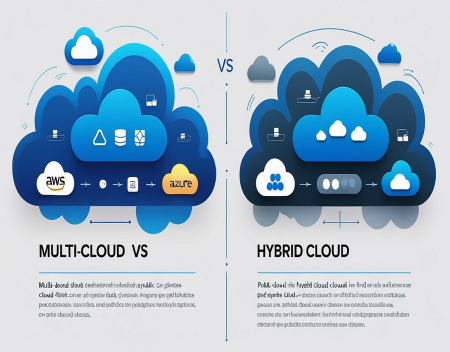
What Is a Hybrid Cloud?A hybrid cloud combines private infrastructure with public cloud services.
A business might operate its own servers in a physical data center while also using cloud platforms for additional computing power, storage, applications, or backups.
For example, a company could keep sensitive customer information on its own servers while running its public-facing website through a cloud provider.
The two environments can be connected so that applications and data can move between them when necessary.
Hybrid cloud environments are particularly attractive to organizations that already have significant investments in physical infrastructure but want to take advantage of cloud computing.
What Is Multi-Cloud?Multi-cloud means using multiple cloud providers rather than relying on a single cloud company.
For example, a business might use one provider for cloud storage, another for artificial intelligence services, and a third for hosting certain applications.
The organization doesn't necessarily operate its own physical servers.
The key difference is that multi-cloud focuses on using multiple cloud platforms, while hybrid cloud focuses on combining different types of infrastructure.
A company can also use both strategies at the same time.
For example, an organization could operate its own private data center while using services from several different public cloud providers. This would be both hybrid and multi-cloud.
Why Would a Business Choose Multi-Cloud?One of the biggest advantages of a multi-cloud strategy is flexibility.
Different cloud providers offer different strengths.
One may have excellent artificial intelligence tools, another may offer particularly strong database services, and another might provide competitive pricing for large-scale storage.
Instead of putting everything with one provider, businesses can choose the service that best fits each workload.
Multi-cloud can also reduce dependence on a single vendor.
If a company relies entirely on one cloud provider, moving away from that provider later can be difficult and expensive. This is commonly known as vendor lock-in.
Using multiple providers can give businesses more negotiating power and additional options if pricing, policies, or services change.
Why Would a Business Choose Hybrid Cloud?Hybrid cloud is often attractive to businesses that have specific reasons for keeping some systems on private infrastructure.
There may be regulatory requirements, security concerns, legacy applications, or performance considerations that make moving everything to the public cloud impractical.
A company might therefore keep certain workloads on its own servers while using the public cloud for other applications.
Hybrid cloud can also provide additional capacity during periods of high demand.
For example, an online retailer could maintain its core systems internally but temporarily use cloud computing resources during a major sales event.
This approach is sometimes referred to as cloud bursting.
Security ConsiderationsSecurity is an important consideration for both strategies.
With a hybrid cloud environment, organizations must secure both their private infrastructure and their cloud services. This creates additional complexity because information may move between different environments.
Multi-cloud introduces a different challenge. Every cloud provider has its own security tools, policies, authentication systems, and management interfaces.
Managing security across multiple platforms can therefore become complicated.
Businesses need centralized monitoring, strong identity management, multi-factor authentication, encryption, access controls, and regular security assessments.
The more complicated an organization's infrastructure becomes, the more important consistent security policies become.
Performance and ReliabilityBoth approaches can improve reliability when designed properly.
A multi-cloud strategy can allow businesses to distribute workloads between different providers. If one provider experiences an outage, certain applications may be able to continue operating elsewhere.
Hybrid cloud can provide similar resilience by allowing organizations to maintain critical systems on private infrastructure while using public cloud resources as additional capacity or backup.
However, simply using multiple environments doesn't automatically make a business more reliable.
Proper architecture, backups, monitoring, redundancy, and disaster recovery planning are still required.
Cost ConsiderationsCost is another major factor.
Cloud computing can reduce the need for businesses to purchase and maintain large amounts of physical hardware. However, cloud costs can become surprisingly complicated.
Organizations may pay for computing resources, storage, bandwidth, databases, backups, security services, and other features.
Using multiple providers can make cost management even more difficult.
Hybrid cloud also has expenses because businesses still need to purchase, maintain, secure, and eventually replace their own hardware.
Companies need to analyze the total cost of ownership rather than simply comparing monthly cloud subscription prices.
Managing Multiple EnvironmentsOne of the biggest disadvantages of both multi-cloud and hybrid cloud is complexity.
Managing servers, cloud accounts, databases, applications, networks, security policies, and backups across different environments requires specialized knowledge.
Employees may need to learn multiple cloud platforms and management tools.
Organizations may also need centralized monitoring systems that provide a single view of their entire infrastructure.
Automation can help significantly.
Infrastructure-as-code, automated deployment systems, centralized logging, and cloud management platforms can reduce the amount of manual work required to manage complex environments.
Which Is More Secure?There is no simple answer.
Neither multi-cloud nor hybrid cloud is automatically more secure.
Security depends on how the environment is designed, configured, monitored, and maintained.
A poorly configured cloud environment can be vulnerable regardless of whether an organization uses one provider or five.
Likewise, keeping servers in a private data center doesn't automatically make them safer.
In many cases, major cloud providers have enormous security teams and resources that smaller organizations could never afford to maintain themselves.
The important issue is implementing appropriate security controls regardless of where the data and applications reside.
Which Strategy Is Right for Your Business?The answer depends on the organization's requirements.
A hybrid cloud strategy may make sense if:
A multi-cloud strategy may make sense if:
Some organizations will benefit from combining both approaches.
The Future of Cloud ComputingCloud computing is becoming increasingly diverse.
Businesses are no longer simply deciding whether to move to the cloud. They are deciding which combination of cloud, private infrastructure, edge computing, and specialized services makes the most sense.
Artificial intelligence is accelerating this trend.
AI workloads can require enormous amounts of computing power, specialized processors, and large amounts of storage. Organizations may use different cloud providers depending on which AI hardware and services are available.
Edge computing is also becoming more important, particularly for applications that require extremely fast response times.
This means future IT environments are likely to become increasingly distributed rather than relying on a single location.
Final ThoughtsMulti-cloud and hybrid cloud are not competing technologies so much as different strategies for managing modern IT infrastructure.
Hybrid cloud combines private infrastructure with public cloud services, while multi-cloud involves using services from multiple cloud providers.
Both approaches offer advantages in flexibility, reliability, scalability, and cost management, but both also introduce additional complexity.
For smaller businesses, keeping infrastructure simple may be more valuable than adopting an elaborate multi-cloud strategy. For larger organizations with complex requirements, using multiple environments may provide significant benefits.
The most important thing is to choose a strategy based on actual business requirements rather than simply following technology trends.
Cloud computing isn't about where your servers happen to be located. It's about creating an infrastructure that is reliable, secure, scalable, manageable, and capable of supporting the organization's goals.
For many businesses, the future won't be entirely public cloud or entirely private infrastructure. Instead, it will be a carefully designed combination of technologies working together.
Great experience with Computer Geek. They helped with my website needs and were professional, respon . . . [MORE].

Great, quick service when my laptop went into meltdown and also needed Windows 11 installed. Also ca . . . [MORE].
It was a great experience to working with you. thank you so much. . . . [MORE].
Thank you so much for great service and over all experience is good . highly recommended for all peo . . . [MORE].
We engaged The Computer Geeks in mid-2023 as they have a reputation for API integration within the T . . . [MORE].

The Future of Smart Homes
Technology Trends Every S
The Hidden Costs of Legac