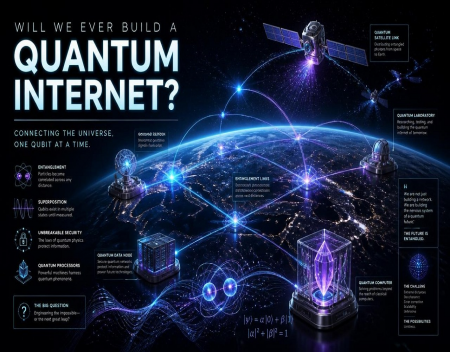
For decades, the internet has connected computers, businesses, governments, and billions of people around the world. It has transformed communication, entertainment, education, commerce, and nearly every aspect of modern life. But what if the next generation of the internet worked in a completely different way?
Scientists are currently researching something known as the quantum internet. Rather than simply transferring ordinary digital information between computers, a quantum internet would use the unusual properties of quantum physics to connect specialized devices and share quantum information.
It sounds like science fiction, but researchers have already demonstrated important pieces of the technology. Although a fully developed quantum internet is still years away, the possibilities are attracting considerable attention from universities, governments, and technology companies.
So what exactly is a quantum internet, how would it work, and will we ever see one become a reality?
What Is a Quantum Internet?Today's internet works by transmitting information using electrical signals, radio waves, or light. Data is represented as bits, with each bit having a value of either zero or one.
A quantum internet would use quantum bits, commonly called qubits. Unlike ordinary bits, qubits can exist in a quantum state that combines possibilities of zero and one. This property is known as superposition.
Another important quantum phenomenon is entanglement. When two particles become entangled, their quantum states are correlated in ways that cannot be explained by ordinary classical physics. Measurements of one particle are related to measurements of the other, even when they are separated by considerable distances.
Scientists believe these properties could allow quantum networks to perform certain tasks that are difficult or impossible with conventional communication systems.
Importantly, a quantum internet would not replace the existing internet. It would likely operate alongside traditional networks, providing specialized capabilities for applications that require quantum communication.
How Would a Quantum Internet Work?Building a quantum internet requires a completely different approach to transmitting information.
One of the most important technologies is quantum entanglement. Researchers are working on methods to create entangled particles and distribute them between distant locations.
For example, two specialized quantum devices could share an entangled pair of particles. These devices could then use the shared quantum state as part of a communication or computing process.
However, quantum information cannot simply be copied and amplified like ordinary digital information. This is because of a fundamental principle known as the no-cloning theorem, which prevents an unknown quantum state from being perfectly copied.
This creates a major engineering challenge. Traditional internet infrastructure uses amplifiers and repeaters to strengthen signals over long distances. Quantum networks need a different solution.
Researchers are developing devices known as quantum repeaters. These systems are intended to extend the distance over which entanglement can be distributed without directly copying the original quantum information.
Quantum repeaters remain an active area of research, and developing practical, reliable versions is one of the major obstacles to building a large-scale quantum internet.
Quantum Cryptography and Better SecurityOne of the most promising applications of quantum networking is secure communication.
Quantum physics offers methods for detecting certain types of interception. Quantum key distribution, or QKD, allows two parties to establish a shared encryption key using quantum states.
If an unauthorized party attempts to measure the quantum information being transmitted, that interference can introduce detectable changes.
This does not mean that quantum communication automatically makes every message secure. QKD protects the process of distributing encryption keys under specific conditions, but the devices, software, authentication systems, and computers involved can still have vulnerabilities.
Nevertheless, quantum key distribution could become valuable for organizations that need highly secure communication, including government agencies, financial institutions, research facilities, and critical infrastructure operators.
As quantum computers develop, there is also growing interest in protecting existing communication systems against future attacks. Some researchers are investigating how quantum networks and post-quantum cryptography could contribute to long-term cybersecurity strategies.
Connecting Quantum ComputersAnother major reason for developing a quantum internet is the possibility of connecting quantum computers.
Quantum computers process information differently from traditional computers and may eventually solve certain specialized problems much more efficiently.
However, building powerful and reliable quantum computers is extremely difficult. Current systems are sensitive to environmental interference and can experience errors that disrupt calculations.
A quantum internet could potentially allow multiple quantum computers to share entanglement and work together on certain distributed computing tasks.
Instead of relying on one extremely large quantum computer, researchers may eventually be able to connect smaller systems across different locations.
This could open opportunities in scientific research, chemistry, materials science, and other fields where quantum computing may offer significant advantages.
For example, researchers could potentially use interconnected quantum systems to study complex molecular interactions or investigate new materials.
These applications remain largely experimental, but they represent an exciting reason to continue developing quantum networks.
The Challenges of Building a Quantum InternetDespite its potential, creating a practical quantum internet presents enormous technical challenges.
Maintaining entanglement: Quantum states are extremely sensitive to interference from their surroundings. Noise, temperature changes, and interactions with the environment can destroy the delicate relationships required for quantum communication. This problem is known as decoherence.
Long-distance communication: Sending quantum information over long distances is difficult because optical signals weaken as they travel through fiber-optic cables. Quantum repeaters are needed to extend communication distances, but practical systems are still being developed.
Specialized equipment: Quantum networks require advanced hardware, including single-photon sources, highly sensitive detectors, quantum memories, and specialized processing equipment. These systems are expensive and difficult to manufacture.
Network management: Traditional internet networks rely on established protocols for routing information, managing connections, and correcting errors. Quantum networks will require new approaches to coordinate quantum devices and distribute entanglement.
Scalability: Demonstrating a quantum connection between two laboratories is very different from connecting thousands or millions of devices across a continent. Building a network that can operate reliably on a large scale will require substantial engineering advances.
Are Researchers Already Building Quantum Networks?Yes. Quantum networking is no longer just a theoretical idea.
Researchers in several countries have demonstrated quantum communication experiments using optical fibers, free-space links, and satellite technology.
China has been particularly active in this area. Its Micius satellite, launched in 2016, was used in experiments demonstrating quantum communication over long distances, including quantum key distribution between ground stations.
Universities and research institutions in Europe and North America are also developing experimental quantum networks.
In the United States, research initiatives have explored how quantum devices could be connected through specialized fiber-optic infrastructure. The Chicago Quantum Exchange, for example, has supported research into quantum networking and related technologies.
These projects are important because they allow scientists to test individual components of a future quantum internet under real-world conditions.
However, today's experimental networks are still limited compared with the global internet. They generally connect a relatively small number of specialized facilities rather than ordinary consumer devices.
When Could We See a Quantum Internet?Predicting when a fully operational quantum internet will become available is difficult.
The technology is still developing, and major breakthroughs are needed before large-scale deployment becomes practical.
In the nearer term, we are more likely to see specialized quantum networks connecting research laboratories, government facilities, and organizations involved in advanced scientific computing.
Over time, improvements in quantum repeaters, quantum memories, photon sources, and network protocols could allow these systems to expand into regional and eventually larger networks.
A global quantum internet comparable to today's internet may take decades to develop, if it becomes technically and economically practical at all.
It is also possible that quantum networking will remain a specialized infrastructure used for particular applications rather than something ordinary consumers interact with directly.
Final ThoughtsThe quantum internet represents one of the most ambitious developments in modern communication technology.
By using quantum phenomena such as superposition and entanglement, researchers hope to create networks capable of secure quantum communication and connections between quantum computers.
The technology faces substantial challenges, particularly when it comes to maintaining entanglement, transmitting quantum information over long distances, and building equipment that can operate reliably on a large scale.
Nevertheless, important experiments have already demonstrated that parts of the concept are possible.
We may not see a quantum internet replacing today's networks anytime soon, but it could eventually become an important part of the world's digital infrastructure.
Just as the early internet began as a relatively small network connecting research institutions before expanding into a global communication system, the quantum internet may follow a similar path. Its ultimate impact remains uncertain, but the technology could open an entirely new chapter in the history of computing and communication.
Great experience with Computer Geek. They helped with my website needs and were professional, respon . . . [MORE].

Great, quick service when my laptop went into meltdown and also needed Windows 11 installed. Also ca . . . [MORE].
It was a great experience to working with you. thank you so much. . . . [MORE].
Thank you so much for great service and over all experience is good . highly recommended for all peo . . . [MORE].
We engaged The Computer Geeks in mid-2023 as they have a reputation for API integration within the T . . . [MORE].
Will We Ever Build a Quan
The Evolution of Operatin
How Search Engines Change