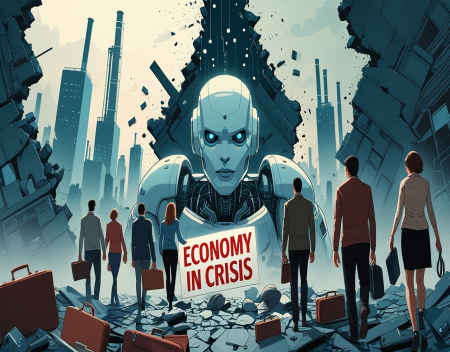
The rise of artificial intelligence is often described as the next industrial revolution, promising increased productivity, faster innovation, and entirely new industries. Yet beneath the optimism lies a growing concern that AI driven automation could accelerate the erosion of the middle class. Historically, the middle class has been sustained by stable jobs that require moderate to advanced skills, offer reliable wages, and provide pathways for upward mobility. As AI becomes capable of performing both routine and complex cognitive tasks, many of these traditional pillars of middle class stability face unprecedented pressure.
One of the most immediate threats comes from the automation of white collar professions. Previous waves of technological change largely targeted manual labor, but AI is now encroaching on fields such as accounting, legal research, customer service, journalism, design, and software development. Roles that once required years of training and offered strong salaries are increasingly supported or replaced by intelligent systems that can analyze data, generate reports, and produce content at scale. While some workers transition into higher level positions that supervise or collaborate with AI, many find themselves competing against tools that operate continuously and at a fraction of the cost.
The gig economy further complicates the picture. AI driven platforms can break complex jobs into smaller tasks, distributing work across large pools of contractors rather than maintaining traditional full time staff. This shift undermines job security and benefits such as healthcare, pensions, and paid leave that historically helped define middle class life. Workers may experience increased flexibility, but that freedom often comes with financial instability and the need to juggle multiple income streams to maintain the same standard of living.
Income inequality is another factor contributing to middle class decline. AI technologies tend to concentrate wealth among companies that control data, infrastructure, and algorithms. High level executives, investors, and highly specialized engineers may see substantial gains, while a broad swath of workers experiences stagnant wages or job displacement. This widening gap challenges the traditional economic model in which productivity gains translate into widespread prosperity. Instead, economic growth risks becoming increasingly decoupled from the financial well being of average households.
Education and skill development are often presented as solutions, but they may not fully offset the structural changes brought by AI. While reskilling programs can help workers transition into new roles, the pace of technological advancement may outstrip the ability of individuals and institutions to adapt. Moreover, not all displaced workers can easily move into highly technical fields, and many communities lack access to affordable education or training resources. The expectation that workers must continually reinvent themselves can create stress and insecurity, particularly for those with families or financial obligations.
Housing, healthcare, and cost of living pressures also interact with AI driven economic shifts. As stable middle income jobs become less common, families may struggle to afford home ownership, education for their children, or long term savings. Economic precarity can lead to delayed life milestones, reduced birth rates, and a growing sense that traditional markers of success are becoming unattainable for large segments of the population. The psychological impact of this uncertainty may manifest in declining trust in institutions, increased social polarization, and a general sense of economic vulnerability.
Despite these challenges, the future of the middle class in an AI economy is not predetermined. Policymakers, businesses, and communities have opportunities to shape outcomes through thoughtful intervention. Ideas such as universal basic income, portable benefits for gig workers, stronger labor protections, and public investment in education could help buffer the effects of automation. Additionally, fostering industries that rely on uniquely human skills such as empathy, creativity, and complex interpersonal interaction may preserve and even expand new forms of middle class employment.
The key question is not whether AI will transform the economy, but how societies choose to manage that transformation. If technological progress is paired with inclusive policies and a commitment to shared prosperity, the middle class may evolve rather than collapse. However, if innovation continues to prioritize efficiency and profit without addressing social consequences, the traditional economic backbone that has supported millions of families could erode further. The coming decades will likely determine whether AI becomes a tool for widespread empowerment or a force that accelerates economic stratification and reshapes the meaning of middle class life altogether.
Great experience with Computer Geek. They helped with my website needs and were professional, respon . . . [MORE].

Great, quick service when my laptop went into meltdown and also needed Windows 11 installed. Also ca . . . [MORE].
It was a great experience to working with you. thank you so much. . . . [MORE].
Thank you so much for great service and over all experience is good . highly recommended for all peo . . . [MORE].
We engaged The Computer Geeks in mid-2023 as they have a reputation for API integration within the T . . . [MORE].
The Rise of Automation in

Why Every Business Needs
ERP Systems for Small Bus