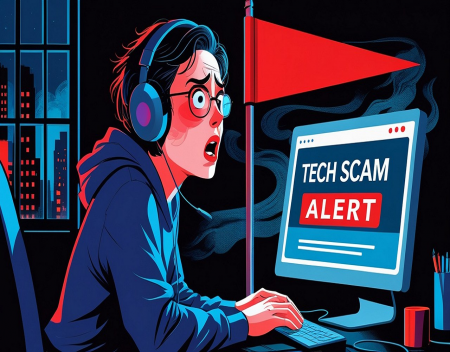
Technology has made life more convenient in countless ways. We can shop online, manage our finances, communicate instantly with people around the world, and access nearly unlimited information from our computers and smartphones. Unfortunately, criminals have embraced these same technologies and have become increasingly skilled at using them to scam unsuspecting victims.
Tech scams have evolved dramatically over the past decade. Modern scammers use sophisticated websites, convincing emails, artificial intelligence, fake customer support centers, and social engineering techniques to trick people into giving away money, passwords, or sensitive information. The good news is that most scams share common warning signs. Learning to recognize these red flags can help you avoid becoming a victim.
One of the most common tech scams involves fake urgency. Scammers want victims to act quickly before they have time to think critically about the situation. You may receive an email claiming your account has been compromised, a text message stating that a package cannot be delivered, or a pop-up warning that your computer is infected with viruses.
These messages often include alarming language such as "Immediate Action Required," "Your Account Will Be Suspended," or "Security Breach Detected." The goal is to create panic and pressure you into clicking a link or calling a phone number before verifying the information.
Legitimate companies rarely demand immediate action through threatening messages. If you receive an urgent notification, it is usually best to visit the company's official website directly rather than clicking links contained in the message.
Another major warning sign is requests for personal information. Reputable organizations generally do not ask customers to provide passwords, banking information, Social Insurance Numbers, Social Security Numbers, or credit card details through unsolicited emails or text messages.
If someone contacts you unexpectedly and asks for sensitive information, proceed with extreme caution. Even if the message appears to come from a familiar company, verify the request independently before responding.
Tech support scams remain one of the most successful forms of online fraud. In these scams, victims may receive a phone call, email, or pop-up message claiming that their computer has been infected with malware. The scammer then offers to fix the problem, often requesting remote access to the victim's computer.
Once access is granted, scammers may install malicious software, steal files, collect passwords, or demand payment for unnecessary repairs. Remember that legitimate companies generally do not monitor personal computers and will not contact you out of the blue to report technical problems.
Fake websites are becoming increasingly convincing as well. Criminals often create websites that closely resemble legitimate businesses, banks, online stores, or government agencies. These sites may use copied logos, professional designs, and realistic content to appear trustworthy.
Before entering sensitive information, always examine the website address carefully. Scammers frequently register domain names that closely resemble legitimate websites but contain subtle differences such as misspellings, extra characters, or unusual extensions.
Phishing emails continue to be one of the most common attack methods. These messages are designed to trick recipients into clicking malicious links, downloading infected attachments, or revealing personal information.
Modern phishing attacks can be highly sophisticated. Scammers may impersonate coworkers, family members, financial institutions, delivery companies, or government agencies. Some phishing emails are so convincing that even experienced users can be fooled.
Poor grammar and spelling were once reliable indicators of fraud, but modern scammers increasingly use professional writing tools and artificial intelligence to create polished messages. As a result, users should focus more on verifying the sender and the request rather than relying solely on language quality.
Online shopping scams have also become widespread. Fraudulent stores may advertise products at prices that seem too good to be true. In many cases, customers either receive counterfeit products or receive nothing at all after payment.
When shopping online, research unfamiliar retailers before making purchases. Look for customer reviews, contact information, return policies, and secure payment options. If a deal appears dramatically cheaper than every other retailer, caution is warranted.
Artificial intelligence has introduced new challenges. Scammers can now generate realistic emails, fake customer support chats, cloned voices, and even convincing videos. These technologies make impersonation attacks more believable than ever before.
For example, some criminals use AI-generated voice cloning to imitate family members or business executives. Victims may receive phone calls that appear to come from someone they know and trust. Because of this, it is increasingly important to verify unusual requests through secondary communication methods.
Social media platforms have become popular hunting grounds for scammers. Fake giveaways, investment opportunities, cryptocurrency schemes, romance scams, and impersonation accounts are common. Users should be skeptical of unsolicited offers, especially those promising guaranteed profits or requiring upfront payments.
Strong passwords and multi-factor authentication provide valuable protection against many scams. Even if attackers obtain login credentials, additional authentication requirements can make unauthorized access significantly more difficult.
Keeping software updated is equally important. Security updates often patch vulnerabilities that cybercriminals attempt to exploit. Operating systems, web browsers, antivirus programs, and mobile apps should all be kept current.
Perhaps the most effective defense against tech scams is simply slowing down. Scammers thrive on urgency, emotion, and impulsive decision-making. Taking a few moments to verify information, examine links, confirm identities, and think critically can prevent many attacks from succeeding.
In today's digital world, scams are likely to become more sophisticated rather than less. However, understanding common scam tactics can dramatically reduce your risk. By staying alert, questioning unexpected requests, and verifying information before taking action, you can protect your personal information, finances, and devices from increasingly sophisticated online threats. The best defense is not advanced technology—it is an informed and cautious user.
Great experience with Computer Geek. They helped with my website needs and were professional, respon . . . [MORE].

Great, quick service when my laptop went into meltdown and also needed Windows 11 installed. Also ca . . . [MORE].
It was a great experience to working with you. thank you so much. . . . [MORE].
Thank you so much for great service and over all experience is good . highly recommended for all peo . . . [MORE].
We engaged The Computer Geeks in mid-2023 as they have a reputation for API integration within the T . . . [MORE].

How Streaming Changed Ent

Digital Minimalism in a C

Are We Becoming Too Depen