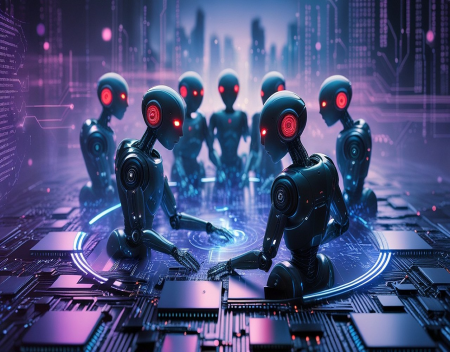
Artificial intelligence has evolved rapidly over the past few years. Early AI systems were primarily designed to answer questions, recognize images, translate languages, or automate individual tasks. While these capabilities were impressive, they still required people to provide instructions for nearly every action. A new generation of AI technology is beginning to change that model through the development of autonomous AI agents.
Unlike traditional AI assistants that simply respond to prompts, autonomous AI agents are designed to pursue goals, make decisions, and complete multi-step tasks with limited human supervision. Rather than acting as tools that perform one request at a time, AI agents are intended to function more like digital assistants capable of planning, adapting, and executing entire workflows.
Although this technology is still developing, autonomous AI agents are expected to become one of the most significant trends in artificial intelligence over the next decade.
At its core, an AI agent is a software system that can observe information, make decisions, perform actions, and evaluate the results of those actions. Instead of waiting for continuous instructions, an agent receives an objective and determines many of the necessary steps independently.
For example, instead of asking an AI to summarize a single report, a user might instruct an autonomous agent to research a market, collect competitor information, analyze trends, prepare charts, write a presentation, and notify the user when everything is complete. The agent determines how to organize these tasks, gathers the required information, and works through the project with minimal additional input.
This represents a major shift in how people interact with computers. Traditional software requires users to operate individual applications step by step. Autonomous agents aim to coordinate multiple tools, websites, databases, and software systems automatically.
Businesses are already exploring numerous applications for AI agents. Customer service is one of the most obvious examples. Instead of simply answering common questions, future AI agents may manage entire customer interactions, verify account information, schedule appointments, process refunds, update databases, and escalate complex cases to human representatives when necessary.
In software development, autonomous AI agents are beginning to assist programmers by generating code, testing applications, identifying bugs, writing documentation, and suggesting performance improvements. Developers remain responsible for reviewing and approving changes, but AI can significantly reduce the amount of repetitive work involved in software projects.
Marketing departments are also experimenting with AI agents. A marketing agent could monitor website traffic, analyze advertising campaigns, recommend budget adjustments, generate social media content, prepare monthly reports, and identify new opportunities based on changing customer behavior.
Small businesses may benefit significantly from autonomous AI agents because they often have limited staff and resources. Tasks that once required several employees could eventually be managed by a single business owner working alongside AI systems that automate scheduling, bookkeeping, inventory management, customer communication, and administrative work.
Personal productivity is another area where AI agents may become increasingly valuable. Imagine asking a digital assistant to organize an upcoming business trip. Instead of simply providing travel recommendations, the agent could compare flights, reserve accommodations, schedule transportation, monitor weather forecasts, update your calendar, prepare travel documents, and notify colleagues of your availability.
This ability to coordinate multiple tasks across different services could save considerable time and reduce administrative burdens for many users.
Artificial intelligence is also becoming more capable of learning from previous interactions. Over time, AI agents may understand individual preferences, work habits, communication styles, and recurring tasks, allowing them to make increasingly useful recommendations and decisions.
However, greater autonomy also introduces new challenges. One of the most important concerns involves accuracy. AI agents that perform multiple tasks independently must make decisions based on available information. If the information is incomplete or incorrect, errors can occur that affect the entire workflow.
For this reason, many organizations currently use AI agents with human oversight rather than allowing them to operate entirely independently. Human review remains essential for important decisions involving finance, healthcare, legal matters, and other high-risk situations.
Security represents another significant challenge. Autonomous agents often require access to email accounts, calendars, databases, cloud storage, financial systems, and other sensitive resources in order to complete tasks effectively. Protecting these systems from unauthorized access becomes increasingly important as AI agents gain greater capabilities.
Privacy is closely related to security. AI agents may process large amounts of personal or business information while performing their work. Organizations must ensure that appropriate safeguards are in place to protect confidential data and comply with privacy regulations.
Another important consideration is accountability. If an autonomous AI agent makes an incorrect decision, who is responsible? Is it the user, the software developer, the organization deploying the system, or the AI itself? These questions remain the subject of ongoing legal and ethical discussions around the world.
There are also technical limitations. While AI agents are becoming increasingly capable, they are not infallible. They may misunderstand instructions, make poor assumptions, encounter unexpected situations, or fail to recognize when additional human input is required. As a result, current AI agents generally perform best when assigned well-defined tasks with clear objectives.
Despite these limitations, rapid progress continues. Improvements in reasoning, planning, memory, and integration with external software are making AI agents more capable each year. Many experts believe that future operating systems and productivity platforms will include built-in AI agents capable of managing routine tasks automatically.
This evolution may fundamentally change how people use computers. Rather than opening multiple applications and completing dozens of manual steps, users may simply describe their goals while AI agents coordinate the necessary work behind the scenes.
The rise of autonomous AI agents does not necessarily mean humans will become obsolete. Instead, these systems are more likely to function as collaborative partners that handle repetitive, time-consuming work while people focus on creativity, strategy, critical thinking, and interpersonal communication.
Much like spreadsheets transformed accounting or search engines transformed information retrieval, autonomous AI agents have the potential to redefine digital productivity. They represent the next stage in the evolution of artificial intelligence, moving beyond answering questions toward actively accomplishing meaningful work.
As businesses, software developers, and consumers continue exploring this technology, autonomous AI agents are poised to become an increasingly common part of everyday computing. While challenges involving security, privacy, accuracy, and oversight remain, their ability to automate complex workflows could make them one of the most influential technological developments of the coming decade.
Great experience with Computer Geek. They helped with my website needs and were professional, respon . . . [MORE].

Great, quick service when my laptop went into meltdown and also needed Windows 11 installed. Also ca . . . [MORE].
It was a great experience to working with you. thank you so much. . . . [MORE].
Thank you so much for great service and over all experience is good . highly recommended for all peo . . . [MORE].
We engaged The Computer Geeks in mid-2023 as they have a reputation for API integration within the T . . . [MORE].

Digital Minimalism in a C

Are We Becoming Too Depen

E-Waste: The Growing Glob