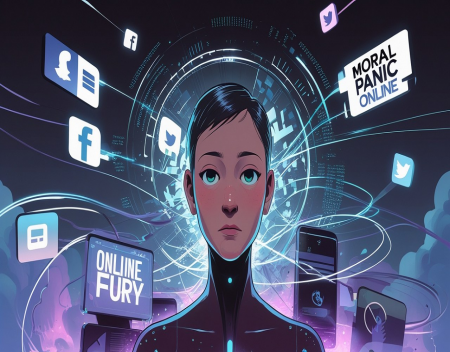
In the digital era, public outrage has become both a cultural force and an economic engine. Social media platforms amplify emotional reactions at unprecedented speed, transforming individual grievances into global controversies within hours. While collective indignation can expose injustice and hold powerful actors accountable, it can also become cyclical, performative, and strategically manipulated. The phenomenon of digital outrage cycles raises difficult questions about how morality is expressed, enforced, and sometimes manufactured in online spaces.
Outrage is not new. Societies have always reacted strongly to perceived violations of norms. What has changed is the speed, scale, and structure of those reactions. On social media, a controversial statement, video clip, or rumor can circulate instantly across networks of millions. Algorithms prioritize content that generates high engagement, and anger is one of the most engaging emotions. Posts that provoke shock or moral condemnation are more likely to be shared, commented on, and debated. As a result, platforms may inadvertently incentivize outrage by amplifying emotionally charged content.
Digital outrage often follows a predictable pattern. A triggering event emerges, sometimes stripped of context. Influential accounts frame the issue in moral terms, encouraging followers to respond. Hashtags consolidate attention, while commentary proliferates across platforms. Within hours, reputations may be damaged, employment threatened, or institutions pressured to respond. Eventually, attention shifts to the next controversy, leaving behind a trail of unresolved tension and fragmented narratives.
This cycle can create what might be called manufactured morality. In such cases, moral judgments are shaped less by careful deliberation and more by viral momentum. Complex situations are reduced to simplified binaries of good and evil. Nuance becomes risky, as hesitation may be interpreted as complicity. Public declarations of condemnation function as signals of belonging within particular online communities. The performance of outrage can become as important as the underlying issue itself.
Manufactured morality does not necessarily imply that the issues involved are trivial. Many digital campaigns have drawn attention to genuine injustices and systemic problems. However, the structure of online discourse can distort priorities. Some incidents receive overwhelming attention due to their viral potential, while equally serious issues remain largely invisible. Visibility may depend less on moral weight and more on algorithmic suitability, emotional intensity, or the involvement of high profile individuals.
Another dimension of digital outrage cycles is their susceptibility to manipulation. Coordinated campaigns can artificially inflate controversy through bots, strategic reposting, or selective editing of content. Political actors, interest groups, and even rival communities may exploit outrage dynamics to distract from other issues or to damage opponents. In such cases, moral language becomes a tactical instrument rather than an authentic expression of ethical concern.
The psychological impact of constant outrage should not be underestimated. Continuous exposure to moral emergencies can create fatigue, anxiety, and cynicism. When every week brings a new crisis demanding immediate judgment, individuals may struggle to distinguish between urgent structural problems and fleeting online storms. This environment can erode trust in institutions and in one another, as public discourse becomes dominated by accusation and defense rather than dialogue.
Cancel culture debates often arise within this context. Some argue that digital outrage provides a necessary mechanism for accountability, especially when traditional institutions fail to respond to harm. Others contend that rapid collective condemnation can bypass due process and encourage disproportionate punishment. The tension reflects a broader struggle over how justice and morality should function in decentralized digital spaces.
Platforms themselves play a significant role in shaping outrage cycles. Recommendation systems, trending lists, and engagement metrics influence which controversies gain traction. Yet platforms often claim neutrality, presenting themselves as facilitators rather than participants in moral discourse. This stance overlooks how design choices structure interaction. Decisions about moderation policies, content visibility, and algorithmic ranking shape the contours of public debate.
Addressing the challenges of digital outrage requires cultural as well as technological responses. Encouraging media literacy can help users recognize how emotional content spreads and why certain narratives gain prominence. Platforms might experiment with friction mechanisms that slow down sharing of unverified claims. Journalistic standards emphasizing context and verification remain essential in an environment prone to rapid escalation.
Ultimately, moral discourse is a fundamental part of democratic society. The goal is not to eliminate outrage but to cultivate forms of accountability that balance passion with reflection. In a connected world where information moves instantly, preserving space for nuance and deliberation becomes increasingly difficult yet increasingly necessary. Without such balance, morality risks becoming another commodity in the attention economy, shaped less by principle than by virality.
Great experience with Computer Geek. They helped with my website needs and were professional, respon . . . [MORE].

Great, quick service when my laptop went into meltdown and also needed Windows 11 installed. Also ca . . . [MORE].
It was a great experience to working with you. thank you so much. . . . [MORE].
Thank you so much for great service and over all experience is good . highly recommended for all peo . . . [MORE].
We engaged The Computer Geeks in mid-2023 as they have a reputation for API integration within the T . . . [MORE].

The Rise of Automation in

Why Every Business Needs

ERP Systems for Small Bus