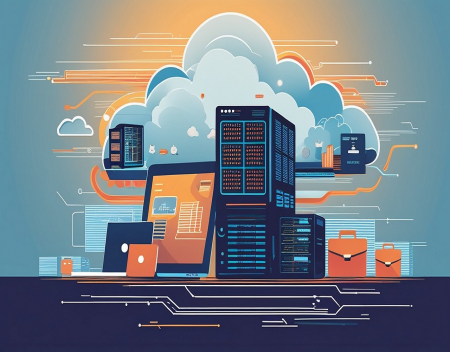
For more than a decade, businesses were told that the future of computing was in the cloud. Companies moved servers, applications, databases, storage, and backups away from their own offices and into massive data centers operated by cloud providers.
The reasons seemed obvious. Cloud computing offered scalability, flexibility, remote access, reduced hardware requirements, and the ability to pay for computing resources as they were needed.
But something interesting is happening.
While businesses are still adopting cloud services at a rapid pace, some organizations are moving certain workloads back out of the public cloud and onto their own servers or private infrastructure. This process is sometimes called cloud repatriation.
It doesn't necessarily mean businesses believe cloud computing was a mistake. Instead, many companies are discovering that the cloud isn't always the cheapest, simplest, or most appropriate place for every workload.
The Cloud Isn't Always CheaperOne of the biggest reasons businesses are reconsidering the cloud is cost.
Cloud computing is often promoted as a way to reduce infrastructure expenses. Businesses don't have to purchase servers, maintain a data center, or replace hardware every few years.
However, cloud bills can become surprisingly expensive.
Companies may pay separately for computing power, storage, database services, backups, data transfers, security features, monitoring, and other services. As an organization grows, these costs can become substantial.
A business running predictable workloads 24 hours a day may eventually discover that renting computing resources indefinitely costs more than purchasing and operating its own hardware.
In other words, the cloud can be extremely economical for some workloads, but not necessarily for all of them.
Data Transfer Can Become ExpensiveAnother concern is data transfer.
Moving data into the cloud may be relatively inexpensive, but moving large quantities of data out of a cloud provider can sometimes involve additional charges.
For businesses that constantly move large amounts of information, these costs can add up.
Consider a company that generates enormous video files, scientific datasets, backups, or AI-related data. If that information is constantly being transferred between cloud services and local systems, bandwidth charges can become a significant part of the technology budget.
Keeping frequently accessed data closer to where it is being used can sometimes make more financial sense.
Predictable Workloads Change the EquationCloud computing is particularly attractive when workloads fluctuate.
A business can increase its computing capacity during busy periods and reduce it when demand falls.
But what happens when a company has a workload that remains relatively constant?
A server that needs to operate continuously may be cheaper to own than continuously renting an equivalent amount of cloud computing capacity.
For example, a business that knows it needs a certain amount of processing power every hour of every day for several years may find that dedicated hardware offers better long-term economics.
This is one reason some organizations are bringing predictable workloads back in-house.
Performance MattersCloud computing requires data to travel across networks.
For many applications, this isn't a problem. But some workloads require extremely fast response times.
Applications involving manufacturing equipment, financial systems, scientific instruments, video processing, or real-time analytics may benefit from having computing resources physically close to the equipment generating the data.
Moving the workload back to local infrastructure can reduce network latency and provide more predictable performance.
This is also one reason edge computing is becoming increasingly important.
Instead of sending every piece of information to a distant cloud data center, businesses can process some data locally and send only the information that actually needs to reach the cloud.
Data Sovereignty and PrivacyData location is another important consideration.
Businesses may have legal, regulatory, or contractual requirements concerning where information can be stored and processed.
Some organizations handle highly sensitive customer, financial, medical, government, or intellectual property data.
Keeping certain information on privately controlled infrastructure can provide greater control over where that data resides and who can access it.
Cloud providers offer extensive security and compliance capabilities, but some organizations still prefer to maintain direct control over particularly sensitive systems.
Vendor Lock-InVendor lock-in is another concern.
Once a business builds its technology environment around a particular cloud provider, moving away can become difficult.
Applications may depend on proprietary databases, storage systems, APIs, authentication services, and other cloud-specific technologies.
The more deeply an organization becomes integrated with a provider, the more expensive and complicated migration can become.
Some companies are therefore taking a more cautious approach by keeping certain systems on infrastructure they control.
Businesses Are Learning That "Hybrid" May Be the AnswerThe trend isn't necessarily about abandoning the cloud completely.
In many cases, businesses are moving toward a hybrid infrastructure.
Some applications remain in the cloud while others run on company-owned servers.
For example, a business might keep its customer-facing website and collaboration tools in the cloud while maintaining its databases or specialized applications on private infrastructure.
This approach allows companies to choose the best environment for each workload rather than forcing everything into one model.
Cloud Repatriation Doesn't Mean Going Back to the Old DaysMoving workloads back from the cloud doesn't necessarily mean returning to the traditional IT environment of the past.
Modern private infrastructure can be dramatically different from the server rooms businesses operated decades ago.
Companies can now use virtualization, automation, containerization, software-defined networking, high-speed storage, and modern management platforms to create highly flexible private environments.
Some businesses are essentially building their own private clouds.
These systems can provide many of the benefits associated with public cloud computing while giving organizations greater control over their infrastructure.
Artificial Intelligence Is Changing the CalculationArtificial intelligence is adding another dimension to the cloud debate.
AI workloads can require enormous amounts of computing power and generate massive amounts of data.
Running AI workloads continuously in a public cloud can become expensive, particularly when specialized hardware such as GPUs is required.
For organizations with predictable AI workloads, purchasing dedicated hardware may eventually make financial sense.
At the same time, cloud platforms remain extremely useful for companies that need temporary access to large amounts of computing power.
This makes AI an excellent example of why businesses may choose a combination of cloud and local infrastructure rather than relying exclusively on one approach.
Security Is More Complicated Than LocationIt's important to understand that moving systems back in-house does not automatically make them more secure.
Cloud providers invest enormous amounts of money in security, monitoring, physical protection, and cybersecurity personnel.
A small business operating its own servers may not have comparable resources.
Private infrastructure can provide greater control, but that control also comes with responsibility.
Businesses that bring workloads back from the cloud must be prepared to manage security updates, backups, monitoring, access control, hardware failures, and disaster recovery themselves.
The Future May Be a Mix of EverythingThe debate over cloud versus on-premises infrastructure is sometimes presented as an either-or decision.
In reality, the future is likely to involve a mixture of technologies.
Businesses may use public cloud services for some applications, private cloud infrastructure for others, local servers for predictable workloads, and edge computing for systems requiring extremely low latency.
The important question isn't "Should everything be in the cloud?"
Instead, businesses should ask:
Where should each workload run to provide the best combination of cost, performance, security, reliability, and flexibility?
Final ThoughtsThe cloud isn't going away.
Cloud computing remains one of the most important technologies in modern business, and millions of organizations continue moving applications and infrastructure into cloud environments.
However, businesses are becoming more sophisticated about how they use the cloud.
After years of moving almost everything into public cloud platforms, some organizations are discovering that certain workloads may be cheaper, faster, or easier to control on private infrastructure.
Cloud repatriation isn't necessarily a rejection of cloud computing. It's a sign that businesses are becoming more careful about where their technology investments make the most sense.
The future of business computing probably won't be entirely in the cloud or entirely on-premises.
Instead, companies will increasingly choose the right environment for each job—using the cloud where it provides clear advantages and keeping workloads on private infrastructure when doing so makes better technical and financial sense.
The cloud was never supposed to be the answer to every computing problem. It's simply another tool—and businesses are learning how to use that tool more strategically.
Great experience with Computer Geek. They helped with my website needs and were professional, respon . . . [MORE].

Great, quick service when my laptop went into meltdown and also needed Windows 11 installed. Also ca . . . [MORE].
It was a great experience to working with you. thank you so much. . . . [MORE].
Thank you so much for great service and over all experience is good . highly recommended for all peo . . . [MORE].
We engaged The Computer Geeks in mid-2023 as they have a reputation for API integration within the T . . . [MORE].
The Evolution of Personal
The Hidden Cost of Free A

The Psychology of Notific