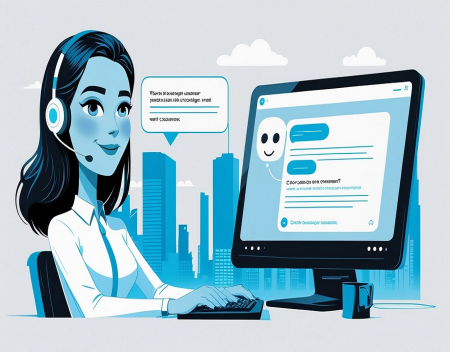
Customer service has always been one of the most important aspects of running a successful business. Whether customers are asking questions, requesting technical support, tracking orders, or resolving billing issues, the quality of customer service often determines whether they remain loyal to a company. In recent years, artificial intelligence has begun transforming this area of business by making customer support faster, more efficient, and available around the clock. While human representatives remain essential for many situations, AI is becoming an increasingly valuable tool that helps businesses serve customers more effectively.
One of the most visible examples of AI in customer service is the modern chatbot. Early chatbots were often limited to answering a small number of predefined questions and could quickly become frustrating when a customer asked something unexpected. Today's AI-powered chatbots are far more advanced. They can understand natural language, maintain conversations, recognize customer intent, and provide detailed responses to a wide variety of questions.
Instead of forcing customers to search through lengthy help pages, AI chatbots can quickly provide answers about products, shipping, returns, warranties, account information, and troubleshooting steps. This reduces wait times while allowing customers to receive assistance whenever they need it, regardless of business hours.
One of the biggest advantages of AI customer service is its availability. Unlike human support teams that work scheduled shifts, AI systems can operate 24 hours a day, seven days a week. Customers who encounter problems during evenings, weekends, or holidays no longer have to wait until the next business day for basic assistance.
This continuous availability is particularly valuable for companies that serve customers across multiple countries and time zones. Instead of maintaining large overnight support teams, businesses can rely on AI to handle routine inquiries while human agents focus on more complex situations during normal working hours.
Artificial intelligence is also improving response times. Many customer questions involve common issues that have standard solutions. Examples include password resets, order tracking, shipping information, account updates, and frequently asked questions. AI systems can answer these requests almost instantly, allowing customers to solve problems within minutes instead of waiting in telephone queues or email backlogs.
For businesses, faster response times often lead to improved customer satisfaction while reducing operating costs.
Another important benefit is consistency. Human representatives naturally vary in experience, training, and communication style. AI systems, on the other hand, provide standardized responses based on current company policies and knowledge bases. This helps ensure that customers receive consistent information regardless of when they contact support.
Artificial intelligence is also assisting human customer service representatives rather than replacing them entirely. During live support conversations, AI can quickly search internal documentation, suggest possible solutions, summarize previous customer interactions, and recommend appropriate responses.
For example, when a customer contacts technical support, an AI assistant may automatically retrieve the customer's purchase history, previous support tickets, warranty status, and known product issues before the representative even answers the call. This allows the human agent to focus on solving the problem instead of spending valuable time gathering information.
Language translation is another area where AI is making customer service more accessible. Modern AI translation systems allow businesses to communicate with customers in multiple languages without requiring large multilingual support teams. While complex conversations may still benefit from human translators, AI has significantly improved the quality and speed of multilingual customer support.
Voice recognition technology has also advanced considerably. AI-powered phone systems can now understand spoken requests, identify customer intentions, and route calls to the appropriate department more accurately than traditional automated telephone menus. In many cases, customers can simply explain their issue in plain language instead of navigating through multiple layers of menu options.
Predictive customer service is another emerging application of artificial intelligence. Rather than waiting for customers to report problems, AI systems can analyze data to identify potential issues before they occur. For example, if a shipment is delayed, an AI system may automatically notify the customer, explain the situation, and provide updated delivery information before the customer contacts support.
Similarly, AI can detect unusual account activity, identify service outages, or recognize product failures, allowing businesses to address problems proactively.
Artificial intelligence is also helping companies analyze customer feedback on a much larger scale. AI systems can review thousands of customer emails, online reviews, survey responses, and social media comments to identify common complaints, product issues, or emerging trends. This information allows businesses to improve products and services based on real customer experiences.
Small businesses are benefiting from AI as well. In the past, advanced customer support technology was often affordable only for large corporations. Today, cloud-based AI services allow smaller companies to deploy intelligent chatbots, automated appointment scheduling, customer relationship management tools, and virtual assistants at relatively affordable costs.
Despite these advantages, AI customer service also has limitations. Some problems require empathy, negotiation, creativity, or complex decision-making that current AI systems cannot fully replicate. Customers dealing with sensitive financial issues, emotional situations, or unusual technical problems often prefer speaking with a knowledgeable human representative.
For this reason, many organizations use a hybrid approach. AI handles routine requests and gathers initial information, while more complicated issues are transferred to experienced human agents. This combination allows businesses to improve efficiency without sacrificing personalized customer care.
Privacy is another important consideration. AI customer service systems often process personal information, purchase histories, payment details, and communication records. Businesses must ensure that customer data is handled securely and in compliance with applicable privacy regulations.
There are also concerns about transparency. Customers should know whether they are communicating with an AI system or a human representative. Clear communication helps establish appropriate expectations and allows customers to request human assistance when necessary.
Looking ahead, AI is likely to become even more integrated into customer service. Future systems may better understand emotions, recognize frustration, adapt their communication style, and provide increasingly personalized assistance based on previous interactions. Improvements in voice technology, natural language understanding, and autonomous AI agents may allow support systems to resolve increasingly complex issues without human intervention.
However, the future of customer service is unlikely to be entirely automated. Human representatives will continue to play a critical role in handling exceptional situations, building customer relationships, exercising judgment, and demonstrating empathy when it matters most.
Artificial intelligence is not replacing customer service; it is reshaping it. By automating repetitive tasks, reducing response times, improving consistency, and supporting human representatives, AI is helping businesses deliver faster and more effective support than ever before. As the technology continues to evolve, customers can expect more personalized, efficient, and accessible service while businesses benefit from improved productivity and stronger customer relationships.
Great experience with Computer Geek. They helped with my website needs and were professional, respon . . . [MORE].

Great, quick service when my laptop went into meltdown and also needed Windows 11 installed. Also ca . . . [MORE].
It was a great experience to working with you. thank you so much. . . . [MORE].
Thank you so much for great service and over all experience is good . highly recommended for all peo . . . [MORE].
We engaged The Computer Geeks in mid-2023 as they have a reputation for API integration within the T . . . [MORE].

The Rise and Fall of Flas
The History of the Intern
The Evolution of Personal