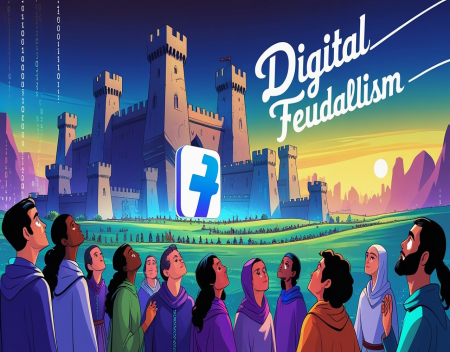
In medieval societies, power was structured through a system of feudal relationships. Land was controlled by a small class of lords, and those who lived on it depended on them for protection, livelihood, and access to resources. In return, peasants and workers offered labor, loyalty, and a share of what they produced. While modern economies are vastly different in structure and scale, some observers argue that a similar dynamic is emerging in the digital age. This concept, often described as digital feudalism, suggests that large technology platforms have become the new “lords,” controlling the infrastructure on which individuals and businesses depend.
At the center of this idea are digital platforms that provide essential services such as communication, commerce, entertainment, and information. Social media networks connect billions of users, online marketplaces facilitate global trade, and cloud services host critical data and applications. These platforms are not merely tools; they are environments in which economic and social activity takes place. For many individuals and businesses, participation in these platforms is no longer optional but necessary.
The power of digital platforms lies in their control over access. Just as landowners in feudal systems determined who could use their land, platform operators set the rules that govern participation. These rules can include terms of service, content policies, algorithmic visibility, and monetization structures. Users agree to these conditions, often without negotiation, in order to gain access to the platform’s network and opportunities.
For creators, entrepreneurs, and workers, this arrangement can create both opportunity and dependency. A small business can reach global audiences through an online marketplace, a content creator can build a following through social media, and a freelancer can find work through digital platforms. These opportunities have lowered barriers to entry and enabled new forms of economic participation. However, they also tie success to the policies and algorithms of the platforms themselves.
Algorithmic systems play a particularly important role in shaping digital feudalism. Visibility on a platform—whether it is a social media feed, a search engine result, or a product listing—often depends on algorithms that prioritize certain types of content or behavior. Changes to these algorithms can dramatically affect who is seen and who is not. For individuals and businesses that rely on platform visibility, these changes can have immediate economic consequences.
This dynamic creates a form of dependency that resembles feudal relationships. Users invest time, effort, and resources into building their presence within a platform, but they do not control the underlying infrastructure. Their success depends on maintaining favor within the system, adhering to rules that may change without warning. If a platform modifies its policies, suspends an account, or declines in popularity, those who rely on it may lose access to their audience or income.
Data is another key element in this structure. Platforms collect vast amounts of information about user behavior, preferences, and interactions. This data is used to refine algorithms, target advertisements, and develop new services. While users generate this data through their activity, they often have limited control over how it is used or monetized. In this sense, data becomes a form of digital labor that contributes to the platform’s value.
The concentration of power within a small number of platforms raises concerns about competition and innovation. When a few companies dominate key areas of the digital economy, they can influence market conditions, set standards, and shape the direction of technological development. New entrants may find it difficult to compete with established platforms that already control large user bases and data resources.
Despite these challenges, digital feudalism is not a perfect analogy. Unlike medieval systems, individuals can often choose between multiple platforms, and regulatory frameworks exist to address issues such as monopolistic behavior and consumer protection. Additionally, the digital economy continues to evolve, with new technologies and decentralized systems offering potential alternatives to centralized platforms.
Efforts to reduce dependency on dominant platforms are already underway. Some developers are exploring decentralized networks that distribute control among users rather than concentrating it within a single entity. Others advocate for stronger data ownership rights, allowing individuals to retain greater control over the information they generate. Regulatory approaches may also play a role in ensuring fair competition and protecting user interests.
Ultimately, the concept of digital feudalism highlights the importance of examining power relationships in the digital age. Platforms have created unprecedented opportunities for connection and economic activity, but they have also introduced new forms of dependency. Understanding these dynamics is essential for shaping a digital future that balances innovation with fairness and autonomy.
As technology continues to redefine how people work, communicate, and create, the question is not whether platforms will remain influential, but how their power will be structured. The challenge lies in ensuring that individuals are not merely participants in digital systems, but active stakeholders with meaningful control over their digital lives.
Great experience with Computer Geek. They helped with my website needs and were professional, respon . . . [MORE].

Great, quick service when my laptop went into meltdown and also needed Windows 11 installed. Also ca . . . [MORE].
It was a great experience to working with you. thank you so much. . . . [MORE].
Thank you so much for great service and over all experience is good . highly recommended for all peo . . . [MORE].
We engaged The Computer Geeks in mid-2023 as they have a reputation for API integration within the T . . . [MORE].
The Evolution of Personal

The Hidden Cost of Free A

The Psychology of Notific