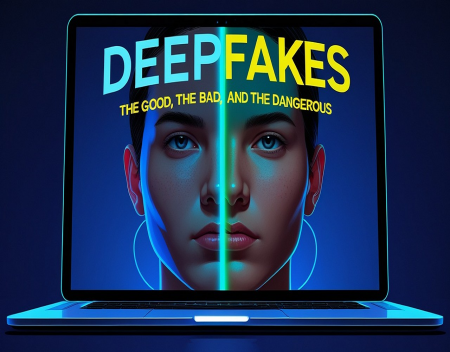
Artificial intelligence has made remarkable advances in recent years, enabling computers to generate realistic images, videos, voices, and even entire conversations. Among the most controversial developments is a technology known as deepfakes. Using advanced machine learning techniques, deepfakes can create highly convincing digital content that appears to show people saying or doing things that never actually happened. While this technology has many legitimate and creative applications, it also raises serious concerns about misinformation, fraud, privacy, and security.
The term "deepfake" combines "deep learning," a branch of artificial intelligence, with the word "fake." Deep learning models are trained using large collections of images, videos, or audio recordings to learn how a person's face, voice, and mannerisms appear under different conditions. Once trained, these models can generate new content that closely mimics the original person.
Only a few years ago, creating convincing fake videos required large teams of visual effects artists and expensive software. Today, advances in AI have dramatically lowered the barrier to entry. Powerful software tools can generate surprisingly realistic videos or voice recordings in a matter of minutes, making the technology accessible to businesses, content creators, and unfortunately, cybercriminals as well.
Not all deepfakes are harmful. In fact, there are several positive and innovative uses for the technology. The entertainment industry has embraced AI-generated visual effects to de-age actors, recreate historical figures, and complete unfinished scenes when actors are unavailable. Filmmakers can restore old footage, improve dubbing for international audiences, or create realistic special effects more efficiently than ever before.
Education is another field benefiting from deepfake technology. Museums and educational institutions have begun using AI to create interactive historical presentations where famous figures appear to speak directly to visitors. Imagine learning about science from a realistic digital version of Albert Einstein or exploring ancient history through lifelike recreations of historical leaders. While these presentations are clearly identified as simulations, they can make education more engaging and memorable.
Businesses are also finding practical uses for synthetic media. AI-generated training videos allow companies to update instructional content without repeatedly filming presenters. Marketing teams can create multilingual videos by accurately synchronizing speech and facial movements, reducing production costs while reaching global audiences.
Accessibility is another promising application. AI voice generation can help individuals who have lost their ability to speak due to illness or injury. By training models using recordings of their original voice, some patients can communicate using digital voices that sound remarkably similar to their own. This represents one of the most meaningful humanitarian uses of deepfake technology.
Despite these positive applications, deepfakes have created significant challenges. One of the most concerning issues is misinformation. Convincing fake videos of politicians, public figures, or news events can spread rapidly across social media before they are identified as false. Even if the deception is eventually exposed, the damage to public trust may already have occurred.
As AI-generated content becomes increasingly realistic, distinguishing genuine media from fabricated material becomes more difficult. This has contributed to growing concerns about election interference, political manipulation, and the spread of false information during major events.
Fraud is another rapidly growing concern. Cybercriminals have begun using AI-generated voices to impersonate company executives, family members, or financial institutions. In some cases, scammers have successfully convinced employees to authorize fraudulent bank transfers after receiving what appeared to be legitimate phone calls from senior executives.
Voice cloning technology has become so convincing that hearing a familiar voice can no longer be considered definitive proof of a person's identity. Businesses are increasingly adopting additional verification procedures to protect against these sophisticated attacks.
Identity theft is also evolving. Deepfake technology can be used to create fake identification videos, bypass identity verification systems, or impersonate individuals during online meetings. As organizations increasingly rely on remote communication and digital authentication, protecting against AI-generated impersonation becomes more important.
Privacy presents another major challenge. Publicly available photographs, videos, and voice recordings can often provide enough material to train AI systems without a person's knowledge or consent. This has raised important ethical questions about ownership, consent, and the responsible use of personal data.
One of the most harmful uses of deepfake technology involves non-consensual content. AI has unfortunately been used to create fake videos and images that violate personal privacy and damage reputations. Many governments are now introducing legislation that specifically targets these abuses while attempting to preserve legitimate artistic and educational uses of the technology.
Businesses must also prepare for the risks posed by synthetic media. Employees should be trained to verify unusual financial requests through multiple communication channels rather than relying solely on email, voice calls, or video meetings. Multi-factor authentication, secure communication protocols, and internal verification procedures are becoming increasingly important as AI impersonation techniques improve.
Technology companies are working on solutions as well. Researchers are developing AI systems capable of detecting manipulated videos, identifying artificially generated voices, and verifying the authenticity of digital media. Some organizations are also exploring digital watermarking techniques that embed invisible markers into AI-generated content to help distinguish synthetic media from authentic recordings.
However, this has become something of an arms race. As detection systems improve, AI generation technology also continues advancing, making manipulated content increasingly difficult to identify. The challenge is likely to remain an ongoing competition between content creators and detection technologies.
Public awareness will play a critical role in addressing these challenges. People should become increasingly skeptical of sensational videos or audio recordings, particularly those that appear suddenly during major news events or political campaigns. Verifying information through multiple trusted sources is becoming more important than ever.
Looking ahead, deepfake technology will continue improving. Future AI systems may generate content that is nearly impossible to distinguish from genuine recordings without specialized detection tools. This reality makes digital literacy an essential skill for both individuals and organizations.
Despite the risks, deepfakes are not inherently good or bad. Like many technological innovations, their impact depends on how they are used. The same technology that enables educational simulations, medical assistance, and creative filmmaking can also be exploited for fraud, misinformation, and identity theft.
The future will likely involve balancing innovation with responsibility. Governments, technology companies, researchers, businesses, and consumers all have important roles to play in developing ethical guidelines, improving detection methods, strengthening security practices, and educating the public about AI-generated media.
Deepfakes represent one of the most powerful examples of artificial intelligence's potential. They demonstrate both the remarkable capabilities of modern AI and the equally important need to use that technology responsibly. As synthetic media becomes an increasingly common part of the digital world, understanding both its benefits and its dangers will be essential for navigating the future of online information and communication.
Great experience with Computer Geek. They helped with my website needs and were professional, respon . . . [MORE].

Great, quick service when my laptop went into meltdown and also needed Windows 11 installed. Also ca . . . [MORE].
It was a great experience to working with you. thank you so much. . . . [MORE].
Thank you so much for great service and over all experience is good . highly recommended for all peo . . . [MORE].
We engaged The Computer Geeks in mid-2023 as they have a reputation for API integration within the T . . . [MORE].

The Browser Wars Revisite

The Rise and Fall of Flas
The History of the Intern