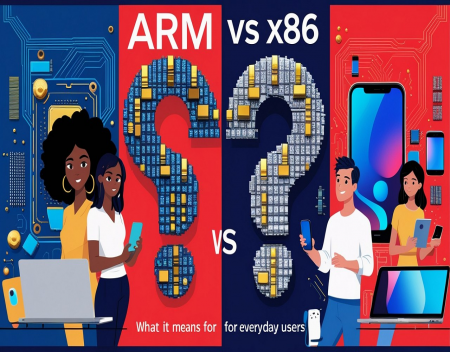
For most people, the inner workings of their devices remain invisible. You open a laptop, launch an app, or browse the web without thinking about the processor powering it all. Yet beneath the surface, one of the most important technological shifts in recent years involves a quiet rivalry between two processor architectures: ARM architecture and x86 architecture. While these terms may sound technical, the differences between them are starting to have a real impact on everyday users.
To understand why this matters, it helps to know what these architectures represent. In simple terms, they define how a processor handles instructions. The x86 architecture has been the dominant standard in desktop and laptop computers for decades, powering systems from companies like Intel and AMD. It is known for its compatibility and performance, particularly in demanding applications such as gaming, software development, and professional workloads.
ARM, on the other hand, was originally designed with efficiency in mind. It uses a simpler instruction set, which allows for lower power consumption and less heat generation. This made ARM the architecture of choice for smartphones and tablets, where battery life is critical. Companies like Apple have played a major role in bringing ARM into the mainstream of personal computing by using it in laptops and desktops.
For everyday users, one of the most noticeable differences between ARM and x86 devices is battery life. ARM-based systems are generally more energy-efficient, which can translate into longer usage on a single charge. This is particularly appealing for people who work on the go or rely on their devices throughout the day without easy access to charging. In contrast, traditional x86 systems often consume more power, especially under heavy workloads.
Performance is another key consideration. Historically, x86 processors have had an advantage in raw performance, especially for complex tasks and legacy software. However, the gap has been narrowing. Modern ARM chips are increasingly powerful, capable of handling demanding applications with ease. For everyday tasks like web browsing, streaming, and office work, many users may not notice a significant difference. In some cases, ARM devices can even feel faster due to their efficient design and optimization.
Software compatibility is where things can become more complicated. Because x86 has been the standard for so long, most desktop applications were originally built for it. ARM systems often rely on translation layers or require developers to create native versions of their software. While compatibility has improved significantly, there can still be occasional issues with older programs or specialized tools. For users who depend on specific software, this is an important factor to consider.
Another area where ARM is making an impact is in integration. ARM-based systems often combine multiple components, such as the CPU, graphics processor, and memory, into a single chip. This approach can improve efficiency and performance while reducing size and complexity. It also allows for tighter integration between hardware and software, leading to smoother user experiences. This is one reason why some modern laptops feel more responsive and consistent in performance.
Connectivity and mobility are also influenced by this shift. Many ARM-based devices are designed with always-on connectivity in mind, similar to smartphones. This can include features like instant wake, built-in cellular support, and seamless background updates. For users, this means devices that are ready to use at any moment, without the delays often associated with traditional systems.
Despite these advantages, x86 is far from obsolete. It remains the standard for many high-performance applications, including gaming, engineering software, and enterprise systems. The ecosystem around x86 is mature and well-established, offering a wide range of hardware options and software compatibility. For users with specific performance needs or reliance on legacy applications, x86 continues to be a strong choice.
The competition between ARM and x86 is driving innovation on both sides. As ARM pushes into areas traditionally dominated by x86, it forces improvements in efficiency and design. At the same time, x86 manufacturers are working to reduce power consumption and enhance performance. This competition benefits users by expanding options and improving the overall quality of devices.
Looking ahead, the line between these architectures may become less distinct. Hybrid approaches, improved compatibility layers, and cross-platform development tools are making it easier for software to run on different systems. For users, this could mean greater flexibility and fewer concerns about underlying architecture.
Ultimately, the shift from x86 to ARM is not about replacing one with the other, but about expanding the landscape of personal computing. Each architecture has its strengths, and the best choice depends on individual needs and priorities. Whether it is battery life, performance, compatibility, or mobility, the differences between ARM and x86 are shaping the devices people use every day.
In the end, what matters most is not the architecture itself, but how it enhances the user experience. As technology continues to evolve, the rivalry between ARM and x86 will remain a key factor in defining the future of computing.
Great experience with Computer Geek. They helped with my website needs and were professional, respon . . . [MORE].

Great, quick service when my laptop went into meltdown and also needed Windows 11 installed. Also ca . . . [MORE].
It was a great experience to working with you. thank you so much. . . . [MORE].
Thank you so much for great service and over all experience is good . highly recommended for all peo . . . [MORE].
We engaged The Computer Geeks in mid-2023 as they have a reputation for API integration within the T . . . [MORE].
The Evolution of Personal

The Hidden Cost of Free A

The Psychology of Notific