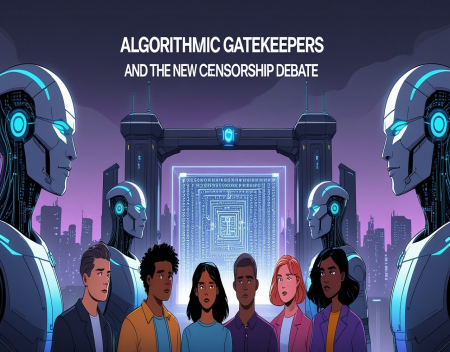
In the digital age, access to information is no longer controlled primarily by governments, publishers, or traditional media institutions. Instead, it is increasingly shaped by algorithms—complex systems that determine what content is seen, shared, and amplified. Platforms such as YouTube, Facebook, and TikTok have become the primary gateways through which people encounter news, ideas, and cultural content. These platforms rely heavily on algorithmic curation, transforming them into powerful gatekeepers of modern discourse.
Unlike traditional gatekeepers, algorithmic systems operate at immense scale and speed. They analyze user behavior—what people click, watch, like, and share—to determine what content should appear in feeds. The goal is typically to maximize engagement, keeping users on the platform for as long as possible. While this approach is efficient and personalized, it also introduces a new form of control over information flow, one that is often invisible and difficult to scrutinize.
This has led to a growing debate about censorship in the digital era. Traditionally, censorship is understood as the deliberate suppression of speech by authorities. Algorithmic gatekeeping complicates this definition. Content is not always removed outright; instead, it may be deprioritized, hidden, or made less visible. A video might not be banned, but if it is rarely recommended, its reach can be effectively minimized. This subtle form of influence raises the question: is limiting visibility a form of censorship, even if the content technically remains available.
One of the challenges in addressing this issue is the lack of transparency. Algorithms are often proprietary, meaning their inner workings are not publicly disclosed. Users generally do not know why certain content appears in their feeds or why other content does not. This opacity makes it difficult to determine whether decisions are based on neutral criteria, such as relevance and quality, or on more subjective factors, such as perceived risk or controversy. Without clear explanations, trust in these systems can erode.
Another key concern is bias. Algorithms are not inherently neutral; they reflect the data they are trained on and the objectives they are designed to achieve. If a system is optimized for engagement, it may prioritize sensational or emotionally charged content, regardless of its accuracy. Conversely, if it is designed to minimize harm, it may suppress content that is controversial but legitimate. In both cases, the algorithm is making value-laden decisions about what is worth seeing, even if those decisions are framed as technical outcomes.
The role of moderation policies further complicates the landscape. Platforms establish guidelines to regulate content, addressing issues such as misinformation, hate speech, and harmful behavior. These policies are often enforced through a combination of human moderators and automated systems. While necessary, enforcement can be inconsistent, especially given the volume of content being processed. This inconsistency can lead to perceptions of unfairness, where similar content is treated differently depending on context or timing.
From a political perspective, algorithmic gatekeeping has significant implications. The visibility of information can shape public opinion, influence elections, and affect social movements. When algorithms determine which stories gain traction, they indirectly influence which issues receive attention. This power is particularly notable during moments of crisis, where timely and accurate information is critical. Decisions about what to amplify or suppress can have real-world consequences, even if they are made with good intentions.
At the same time, the absence of algorithmic moderation would create its own challenges. Without filtering, platforms could become overwhelmed with spam, misinformation, and harmful content. The sheer volume of information would make it difficult for users to find relevant or trustworthy material. In this sense, algorithmic gatekeeping is not inherently negative—it is a necessary function in managing digital ecosystems. The issue lies in how it is implemented and governed.
The debate over algorithmic censorship is, at its core, a debate about power and accountability. Who gets to decide what information is visible, and under what criteria. Should these decisions be left to private companies, or should there be greater public oversight. How can systems be designed to balance freedom of expression with the need to prevent harm. These questions do not have simple answers, but they are increasingly central to the functioning of modern society.
There are ongoing efforts to address these concerns. Some platforms are experimenting with greater transparency, providing users with explanations for why content is recommended or removed. Others are exploring ways to give users more control over their feeds, allowing them to adjust algorithmic settings or choose alternative ranking methods. Regulators in various regions are also considering policies that would require greater accountability and disclosure.
Ultimately, algorithmic gatekeepers represent a new form of influence in the digital world. They do not censor in the traditional sense, but they shape the boundaries of visibility in ways that can be just as impactful. Understanding this shift is essential for navigating the modern information landscape.
As the debate continues, one thing is clear: the question is no longer just about what can be said, but about what can be seen. And in a world where visibility often determines relevance, the power to decide what is seen is one of the most significant forms of control there is.
Great experience with Computer Geek. They helped with my website needs and were professional, respon . . . [MORE].

Great, quick service when my laptop went into meltdown and also needed Windows 11 installed. Also ca . . . [MORE].
It was a great experience to working with you. thank you so much. . . . [MORE].
Thank you so much for great service and over all experience is good . highly recommended for all peo . . . [MORE].
We engaged The Computer Geeks in mid-2023 as they have a reputation for API integration within the T . . . [MORE].

Why Every Business Needs

ERP Systems for Small Bus
CRM Software Explained