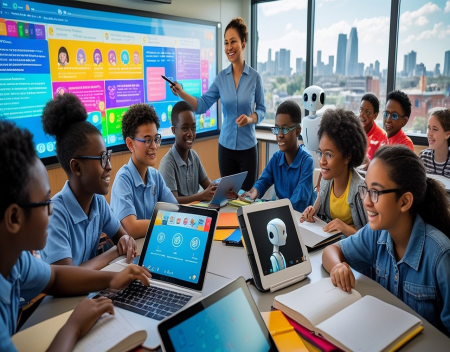
Artificial intelligence is transforming many aspects of modern life, and education is no exception. Schools, colleges, universities, and online learning platforms are increasingly incorporating AI-powered tools to improve teaching, personalize learning, and reduce administrative workloads. While traditional classrooms continue to rely on teachers as the foundation of education, artificial intelligence is becoming an important tool that can support both educators and students in new and innovative ways.
The role of AI in education extends far beyond simple automation. Modern AI systems can analyze learning patterns, provide personalized feedback, generate educational content, assist with grading, and even act as virtual tutors. As these technologies continue to evolve, classrooms are becoming more flexible, interactive, and tailored to the needs of individual learners.
One of the most significant benefits of artificial intelligence in education is personalized learning. In a traditional classroom, a teacher may be responsible for twenty or thirty students who all learn at different speeds and in different ways. While teachers work hard to accommodate every student, time and resources are naturally limited.
AI-powered learning systems can help address this challenge by adapting lessons to each student's individual progress. If a student struggles with a particular concept, the software can provide additional explanations, practice exercises, or alternative teaching methods. If another student masters the material quickly, the system can introduce more advanced topics without requiring the entire class to move at the same pace.
This individualized approach has the potential to improve student engagement and reduce frustration. Rather than following a one-size-fits-all curriculum, learners can receive instruction that better matches their abilities and learning styles.
Virtual tutoring is another rapidly growing application of artificial intelligence. AI tutors can answer questions, explain concepts, provide examples, and offer immediate feedback at any time of day. This allows students to receive assistance outside of normal classroom hours without having to wait for the next lesson.
Although AI tutors cannot replace experienced educators, they can serve as valuable supplemental learning resources. Students who need additional practice or clarification can benefit from immediate assistance whenever they encounter difficulties.
Teachers are also benefiting from artificial intelligence in several ways. One of the most time-consuming aspects of teaching involves administrative tasks such as grading assignments, preparing lesson plans, tracking student progress, and organizing educational materials.
AI tools can automate many of these routine responsibilities, allowing teachers to spend more time interacting directly with students. For example, multiple-choice quizzes can be graded instantly, written assignments can receive preliminary feedback, and classroom performance data can be analyzed automatically.
Lesson planning is becoming more efficient as well. AI can help educators generate quizzes, discussion questions, presentations, reading materials, and classroom activities based on specific curriculum requirements. Rather than creating every resource from scratch, teachers can use AI-generated materials as starting points that they customize for their students.
Language learning has also benefited significantly from artificial intelligence. AI-powered translation tools, pronunciation analysis, and conversational practice systems provide students with opportunities to practice speaking and listening skills in ways that were previously difficult to achieve outside the classroom.
Students studying foreign languages can now engage in realistic conversations with AI systems, receive pronunciation feedback, and practice vocabulary through interactive exercises available on computers and mobile devices.
Accessibility is another important area where AI is making a difference. Students with disabilities can benefit from speech recognition, text-to-speech software, real-time captioning, image descriptions, and adaptive learning technologies that help create a more inclusive educational environment.
These tools can assist students with visual impairments, hearing loss, learning disabilities, mobility challenges, and other conditions that may affect traditional classroom participation. By reducing barriers to learning, AI has the potential to improve educational opportunities for many students.
Online education has expanded rapidly over the past decade, and artificial intelligence is playing a major role in improving virtual learning environments. AI systems can monitor student engagement, identify learners who may be falling behind, recommend additional resources, and provide personalized study plans.
These capabilities are particularly valuable for large online courses where instructors may be responsible for hundreds or even thousands of students.
Artificial intelligence is also changing how educational content is created. Teachers can use AI to generate worksheets, practice problems, summaries, study guides, flashcards, and interactive learning materials much more quickly than before. This allows educators to devote more time to teaching while still providing diverse learning resources.
Despite these advantages, AI in education also presents several challenges. One of the most widely discussed concerns involves academic integrity. AI writing tools can generate essays, solve math problems, and answer homework questions, raising questions about plagiarism and independent learning.
Educational institutions are increasingly focusing on teaching students how to use AI responsibly rather than simply attempting to prohibit it. Understanding when AI can be used as a learning aid versus when independent work is expected is becoming an important part of modern education.
Privacy is another important consideration. AI learning platforms often collect data about student performance, learning habits, and educational progress. Schools and software developers must ensure that this information is protected and handled responsibly.
There are also concerns about overreliance on technology. While AI can be an excellent educational tool, it cannot replace many of the qualities that effective teachers bring to the classroom. Encouragement, empathy, mentorship, classroom management, creativity, and the ability to inspire students remain fundamentally human strengths.
Education involves far more than simply delivering information. Teachers help students develop critical thinking, communication skills, collaboration, emotional intelligence, and ethical reasoning. These aspects of learning continue to depend heavily on meaningful human interaction.
Looking ahead, artificial intelligence is likely to become a permanent part of education rather than a temporary trend. As technology improves, AI systems will become more capable of supporting personalized instruction, assisting educators, and expanding access to learning opportunities around the world.
The future classroom will probably combine the strengths of both human teachers and intelligent technology. AI can handle repetitive tasks, provide individualized support, and deliver instant feedback, while teachers continue to guide discussions, encourage curiosity, foster creativity, and build meaningful relationships with students.
Ultimately, the goal of artificial intelligence in education is not to replace teachers but to enhance the learning experience. When used thoughtfully and responsibly, AI has the potential to make education more accessible, more personalized, and more effective for learners of all ages. As classrooms continue to evolve, the partnership between educators and technology may become one of the defining characteristics of education in the decades to come.
Great experience with Computer Geek. They helped with my website needs and were professional, respon . . . [MORE].

Great, quick service when my laptop went into meltdown and also needed Windows 11 installed. Also ca . . . [MORE].
It was a great experience to working with you. thank you so much. . . . [MORE].
Thank you so much for great service and over all experience is good . highly recommended for all peo . . . [MORE].
We engaged The Computer Geeks in mid-2023 as they have a reputation for API integration within the T . . . [MORE].

Digital Minimalism in a C

Are We Becoming Too Depen

E-Waste: The Growing Glob