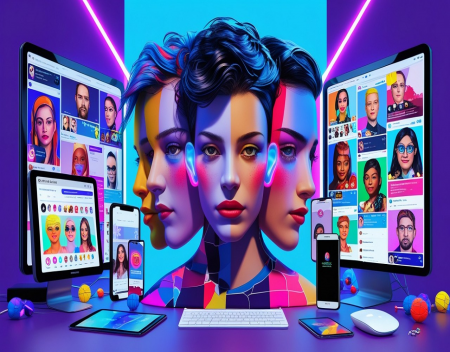
In the span of just a few decades, the idea of identity has shifted from something largely fixed and singular into something fluid, layered, and increasingly fragmented. Where once a person’s sense of self was anchored in physical presence, community reputation, and a relatively stable social role, the digital age has introduced an entirely new challenge. Many people now live simultaneously as several versions of themselves, each tailored to a different platform, audience, or purpose. This fragmentation of identity is no longer an exception. It is the default condition of modern life.
At the center of this phenomenon is the reality that digital spaces demand performance. Social media profiles, professional networks, gaming avatars, anonymous forums, and private messaging platforms all reward different behaviors, tones, and values. A single individual may present as polished and authoritative on a professional platform, casual and humorous on social media, fiercely opinionated in online debates, and deeply vulnerable in private digital spaces. None of these selves are necessarily false, yet none fully encompass the whole person either. Together they form a mosaic that can be difficult to manage and even harder to reconcile internally.
This multiplicity can be empowering at first. Digital identities allow experimentation without immediate real-world consequences. People can explore interests, beliefs, and aspects of their personality that might be constrained by geography, culture, or social expectation. For marginalized individuals in particular, digital spaces can provide room to exist more freely, to find community, and to express truths that might otherwise remain suppressed. The ability to shape and reshape one’s presentation offers a sense of agency that earlier generations rarely experienced.
However, the same flexibility that enables self-exploration can also lead to psychological strain. Maintaining multiple identities requires constant contextual switching. Each platform has its own unspoken rules, social incentives, and risks. The effort to remain consistent within each digital persona while keeping them separate from one another can create a sense of exhaustion and dissonance. Over time, people may begin to feel less like a coherent individual and more like a collection of managed profiles, each demanding attention and upkeep.
This fragmentation is intensified by the permanence and visibility of digital records. Past versions of the self do not simply fade away as they might in offline life. Old posts, photos, and opinions can resurface years later, colliding with a person’s current identity in ways that feel unfair or disorienting. Growth, change, and contradiction are natural parts of being human, yet digital environments often treat inconsistency as a flaw rather than evidence of development. The pressure to appear stable and authentic across time can discourage experimentation and reinforce self-censorship.
Another complicating factor is the role of algorithms in shaping identity. Digital platforms do not merely host identities; they actively influence them. Recommendation systems reward certain behaviors with visibility and validation, subtly encouraging users to lean into particular traits, opinions, or emotional tones. Over time, people may find themselves exaggerating aspects of their identity not because they feel authentic, but because those traits perform well within the system. The line between self-expression and self-optimization becomes increasingly blurred.
The social consequences of fragmented identity are equally profound. When different audiences encounter different versions of the same person, misunderstandings become more likely. Context collapse, where multiple social spheres overlap unexpectedly, can produce anxiety and conflict. A post intended for one community may be judged by another with entirely different norms. This risk pushes many people toward hyper-curation, limiting spontaneity and reinforcing a sense that every expression must be strategic.
Despite these challenges, managing multiple digital identities is not inherently harmful. The issue lies less in multiplicity itself and more in the absence of integration. Problems arise when individuals lose sight of their core values, or when external validation becomes the primary guide for self-definition. Without a grounding sense of continuity, identity can begin to feel reactive rather than chosen, shaped more by feedback loops than by intention.
Developing healthier relationships with digital identity requires conscious effort. This can include setting clearer boundaries between platforms, allowing different selves to exist without constant comparison, and accepting that not every version of the self needs to be publicly visible. It also involves embracing the idea that inconsistency is not deception, but evidence of complexity. Humans have always been multifaceted. The digital age simply makes those facets more visible and more difficult to compartmentalize.
Ultimately, the fragmented self reflects a broader cultural transition. As technology continues to reshape how people relate to one another and to themselves, the challenge is no longer to maintain a single, unified identity, but to navigate plurality without losing coherence. In learning to manage multiple digital identities with awareness and intention, individuals may discover not a loss of self, but a deeper understanding of what it means to be human in an increasingly mediated world.
Great experience with Computer Geek. They helped with my website needs and were professional, respon . . . [MORE].

Great, quick service when my laptop went into meltdown and also needed Windows 11 installed. Also ca . . . [MORE].
It was a great experience to working with you. thank you so much. . . . [MORE].
Thank you so much for great service and over all experience is good . highly recommended for all peo . . . [MORE].
We engaged The Computer Geeks in mid-2023 as they have a reputation for API integration within the T . . . [MORE].

The Rise of Automation in

Why Every Business Needs

ERP Systems for Small Bus