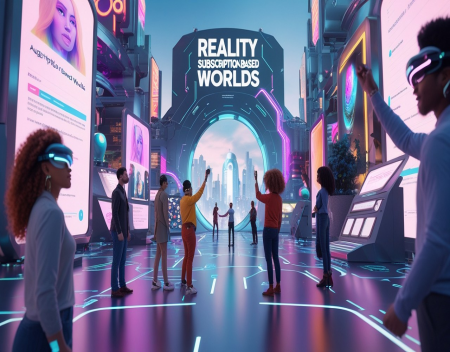
For most of human history, reality has been something people simply inhabited. It was not owned, packaged, or sold. The physical world existed as a shared environment where life unfolded without a price tag attached to perception itself. However, as digital technology advances—particularly in virtual reality, augmented reality, and persistent online environments—a new concept is beginning to take shape. Increasingly, elements of reality are being designed, controlled, and monetized by private platforms. This evolution raises the possibility of “Reality as a Service,” where immersive worlds are accessed not as public spaces, but as subscription based experiences.
The foundation of this idea lies in the growing sophistication of virtual and augmented environments. Modern systems can simulate physical presence, allowing users to work, socialize, and explore entirely digital landscapes. These spaces are no longer limited to games or temporary experiences. Many are persistent worlds that continue to exist and evolve even when individual users log off. Within them, people can own digital property, attend events, build communities, and even earn income. As these environments become more realistic and socially meaningful, they begin to compete with aspects of the physical world.
At the same time, the business models that support digital platforms are shifting. Subscription services have already transformed industries such as entertainment, software, and media. Instead of purchasing products outright, users pay recurring fees for access to content and tools. This model is now extending into immersive digital environments. Companies are exploring ways to offer access to virtual worlds through monthly subscriptions, tiered memberships, or premium features that enhance the experience.
In a fully realized version of Reality as a Service, individuals might spend significant portions of their daily lives inside subscription based environments. Workspaces could exist in virtual offices designed for collaboration across distances. Social gatherings might take place in customized digital venues. Entertainment could become fully immersive, with users participating directly in interactive narratives rather than simply watching them. Over time, these environments could become as central to daily life as physical spaces.
This shift introduces new forms of convenience and possibility. Virtual worlds are not constrained by the limitations of physical reality. Environments can be instantly reconfigured, distances eliminated, and experiences personalized to individual preferences. People could travel anywhere, meet anyone, and access a wide range of activities without leaving their homes. For individuals with mobility challenges or those living in remote areas, these environments could provide opportunities that might otherwise be inaccessible.
However, the transition toward subscription based realities also raises significant concerns. One of the most important issues is access. If immersive environments become essential spaces for work, education, and social interaction, the requirement to pay for access could create new forms of inequality. Those who can afford premium subscriptions may gain access to better tools, richer experiences, and more influential communities, while others are limited to basic or restricted versions of digital life.
Control is another critical factor. In a subscription based model, the environments people inhabit are owned and managed by private companies. This means that rules, features, and even the existence of certain spaces can be altered at any time. Users do not truly own the worlds they inhabit; they are granted access under specific terms. If a platform changes its policies, raises prices, or shuts down entirely, entire communities and digital assets could disappear.
There is also the question of autonomy. When reality itself becomes a service, the experiences individuals have may be shaped by algorithms designed to maximize engagement or profit. Environments could be optimized to keep users subscribed, influencing how they spend their time and attention. This introduces a subtle but powerful form of control, where the structure of reality is designed with specific outcomes in mind.
Psychological effects must also be considered. Spending extended periods in curated digital environments could alter how individuals perceive the physical world. Virtual spaces can be designed to be more visually appealing, more responsive, and more rewarding than everyday reality. This may create a preference for digital experiences, potentially leading to disengagement from physical environments and relationships.
Despite these concerns, the concept of Reality as a Service reflects a broader trend in the evolution of technology. As digital systems become more immersive and integrated into daily life, the boundary between physical and virtual existence continues to blur. What was once considered an escape from reality is increasingly becoming an extension of it.
The challenge moving forward will be to ensure that these emerging environments remain spaces that empower individuals rather than constrain them. Questions about ownership, accessibility, governance, and ethical design will play a central role in shaping how subscription based realities develop. Policymakers, technologists, and users alike will need to consider what it means to live in a world where reality itself can be accessed, upgraded, or restricted.
In the end, Reality as a Service is not just a technological development. It is a redefinition of how humans experience existence. Whether this shift leads to greater freedom and creativity or deeper dependence on controlled environments will depend on the choices made as these systems continue to evolve.
Great experience with Computer Geek. They helped with my website needs and were professional, respon . . . [MORE].

Great, quick service when my laptop went into meltdown and also needed Windows 11 installed. Also ca . . . [MORE].
It was a great experience to working with you. thank you so much. . . . [MORE].
Thank you so much for great service and over all experience is good . highly recommended for all peo . . . [MORE].
We engaged The Computer Geeks in mid-2023 as they have a reputation for API integration within the T . . . [MORE].
The Hidden Cost of Free A
The Psychology of Notific
Why Subscription Services