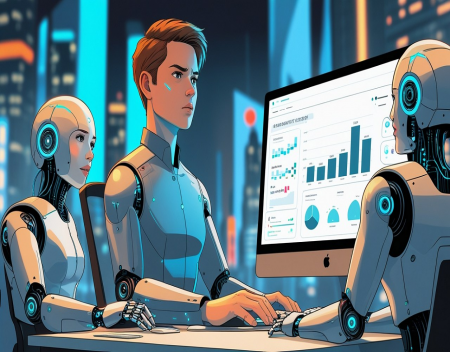
The modern workplace is undergoing a quiet but profound transformation. Tasks that once required hours of focused effort can now be completed in minutes with the help of AI-powered tools. From drafting emails to generating reports and organizing schedules, AI assistants are becoming deeply integrated into everyday workflows. Powered by advances in Artificial Intelligence, these systems promise to enhance productivity, reduce workload, and free up time for more meaningful work. But as their capabilities expand, an important question emerges: where do we draw the line between assistance and overreliance.
At their best, AI assistants act as powerful productivity enhancers. They can handle repetitive, time-consuming tasks with speed and consistency. For example, scheduling meetings, summarizing documents, or responding to routine inquiries can be largely automated. This allows individuals to focus on higher-level thinking, creativity, and decision-making. In theory, this shift should lead to more efficient and fulfilling work.
However, the reality is more complex. As AI assistants take on more responsibilities, there is a risk that users may begin to rely on them too heavily. When a system can generate text, analyze data, and provide recommendations, it becomes tempting to accept its output without critical evaluation. This can lead to a gradual erosion of skills. Writing, problem-solving, and even basic decision-making abilities may weaken if they are not regularly exercised.
One of the key issues is the distinction between augmentation and replacement. AI is often framed as a tool that enhances human capability, but in practice, it can blur into substitution. If an AI assistant writes a report, suggests strategies, and handles communication, what role does the human play. Ideally, the human remains in control, guiding the process and making final decisions. But in fast-paced environments, the pressure to save time can lead to shortcuts, where AI-generated output is used with minimal oversight.
Another concern is accuracy. While AI assistants can produce impressive results, they are not infallible. They can make mistakes, misinterpret context, or generate information that appears correct but is actually flawed. This is particularly important in professional settings where errors can have significant consequences. Relying too heavily on AI without verification can introduce risks that are not always immediately visible.
There is also a psychological dimension to consider. Productivity has traditionally been associated with effort and accomplishment. Completing a task often brings a sense of satisfaction, reinforcing motivation and confidence. When AI handles a large portion of the work, that sense of ownership can diminish. Users may begin to feel disconnected from the outcomes, as if they are supervising rather than creating. Over time, this can affect engagement and job satisfaction.
On the other hand, AI assistants can reduce cognitive overload. Modern work environments are often characterized by constant interruptions, large volumes of information, and competing priorities. AI tools can help manage this complexity by organizing data, filtering information, and providing quick insights. This can make it easier to focus on what matters most, improving both efficiency and mental well-being.
The challenge, then, is finding the right balance. Drawing the line between helpful assistance and overdependence requires intentional use. One approach is to treat AI as a collaborator rather than a replacement. This means using it to generate ideas, provide suggestions, and handle routine tasks, while maintaining active involvement in critical thinking and decision-making. Instead of accepting outputs at face value, users should question, refine, and build upon them.
Another important factor is transparency. Understanding how AI systems work, including their limitations, is essential for using them effectively. Users who are aware of potential biases or inaccuracies are better equipped to evaluate the quality of the output. This awareness helps maintain control and reduces the risk of blind reliance.
Organizations also have a role to play. As AI assistants become more prevalent in the workplace, companies need to establish guidelines for their use. This includes defining which tasks are appropriate for automation and which require human judgment. Training and education are equally important, ensuring that employees have the skills to work alongside AI effectively.
Looking ahead, the line between AI assistance and human productivity will continue to evolve. As systems become more advanced, they will take on increasingly complex tasks, further blurring the boundaries. The goal should not be to resist this change, but to shape it in a way that preserves human agency and skill.
Ultimately, productivity is not just about speed or efficiency—it is about value, understanding, and meaningful contribution. AI assistants have the potential to enhance all of these, but only if they are used thoughtfully. The line we draw is not fixed; it is a choice that individuals and organizations must make based on how they define the role of technology in their work.
In the end, the question is not whether AI should be used, but how it should be used. By maintaining a balance between automation and human input, it is possible to harness the benefits of AI without losing the skills and judgment that make human productivity truly valuable.
Great experience with Computer Geek. They helped with my website needs and were professional, respon . . . [MORE].

Great, quick service when my laptop went into meltdown and also needed Windows 11 installed. Also ca . . . [MORE].
It was a great experience to working with you. thank you so much. . . . [MORE].
Thank you so much for great service and over all experience is good . highly recommended for all peo . . . [MORE].
We engaged The Computer Geeks in mid-2023 as they have a reputation for API integration within the T . . . [MORE].
The Rise of Automation in

Why Every Business Needs

ERP Systems for Small Bus